May 18, 2026 • 4 min read
Microsoft Expands Contact Center Forecasting Into the Realm of AI Agents

Director of Content & Market Research
May 18, 2026
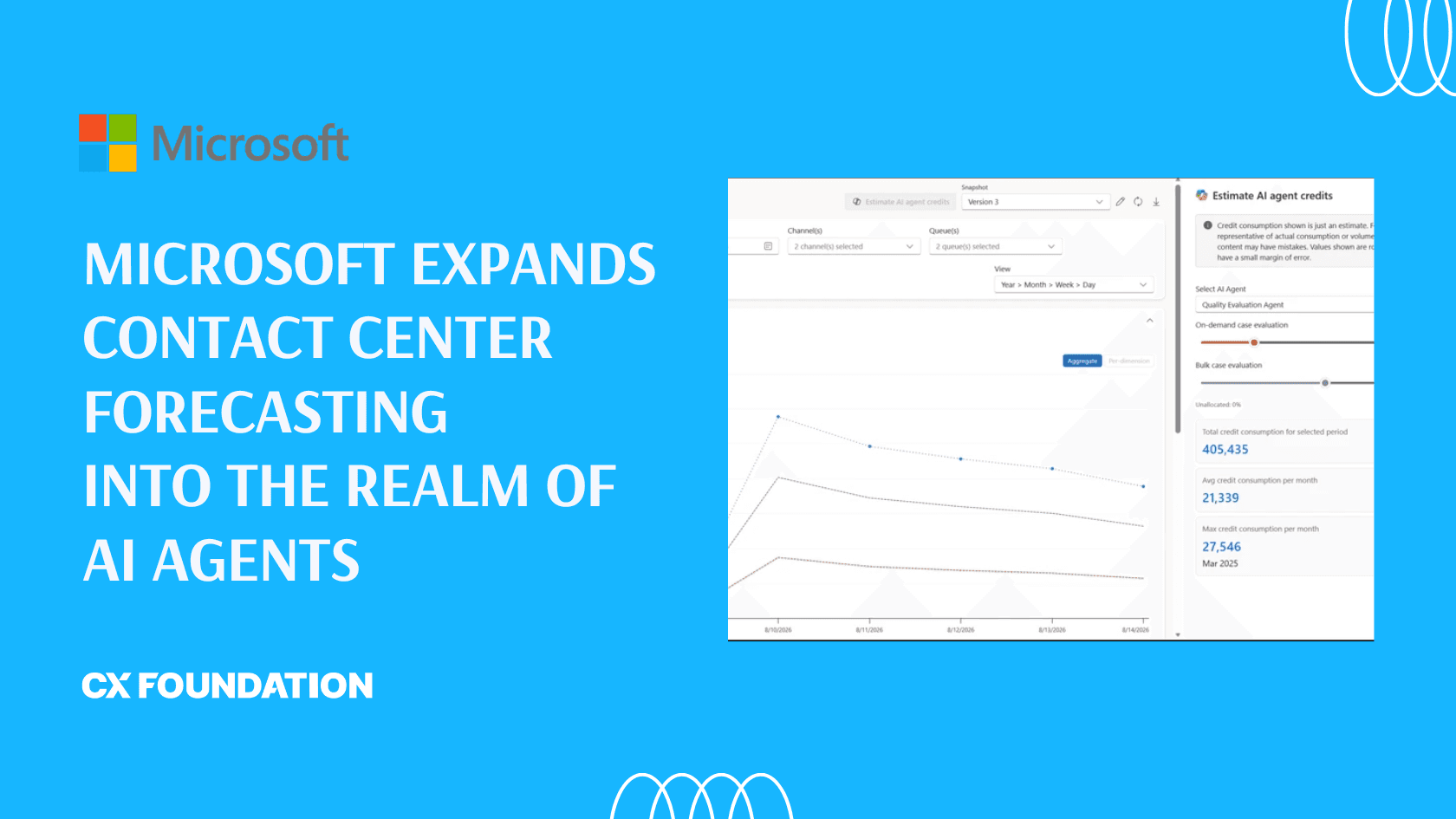
Microsoft has added a Credit Estimation feature to the forecasting capabilities available within its CCaaS platform: the Dynamics 365 Contact Center.
The feature enables workforce planners to forecast the usage of AI agents embedded across the platform in line with overall contact center demand.
Microsoft has inserted several AI agents into its CCaaS solution over the past 18 months.
Most recently, it added a Customer Assist Agent for self-service, a Quality Evaluation Agent for generating insights from customer interactions, and a Service Operations Agent that supports system configuration.
Additional agents in its portfolio include a Customer Intent Agent, which analyzes how service representatives resolve common customer queries and identifies emerging contact reasons, and a Knowledge Agent, which transforms insights from the Intent Agent into knowledge content.
Lastly, it also offers a Case Management Agent that updates cases based on live conversation context, lowering the need for human representatives to manually fill in fields.
Now, Microsoft is equipping contact centers with the tools to better manage some of these agents and control the credits they consume.
How Does the Credit Estimation Feature Work?
The Customer Intent, Case Management, Quality Evaluation Agent augment every customer interaction, unpacking the intent, updating fields, and extracting performance insights.
Each agent operates on a consumption model, with users spending Copilot credits.
Users can open the AI Credit Estimator, select one of the three agents, and forecast projected usage and spend across the same reporting periods as their primary demand forecasts.
In doing so, they can compile a unified projection of their human and AI agent spending.
Further into the future, Microsoft appears likely to add its new Customer Assist Agent, forecast the percentage of conversations agents handle autonomously, and establish a unified system to manage human and AI labor.
Indeed, Microsoft shared plans to build a more comprehensive workforce engagement management (WEM) offering in a 2025 release. Yet, this is an ongoing endeavor.
Such a WEM offering would cover workforce management (WFM), Quality Assurance (QA), employee engagement, and learning management solutions.
Why Does Credit Estimation Matter?
“When you can forecast demand, estimate AI cost, and compare both against service objectives, AI agents become truly plannable workforce components,” summarized Gopal Yuvaraj, Product Manager at Microsoft, in a company blog post.
Yet, this isn’t just about shifting the organization toward AI agents; it’s about empowering workforce planners with new tools to engage with the broader organization for mutual benefit.
Indeed, planners may utilize the capability to:
- Partner with Finance: Planners can become trusted advisors to finance teams, predicting AI agent expenditure and minimizing bill shock, the kind that causes contact centers to stall transformation projects.
- Guide Service Operations: When operations leaders are under pressure to reduce credit spend, planners can identify opportunities for savings. For instance, limiting the Quality Evaluation agent to compliance-critical calls and a representative sample of others, rather than evaluating every interaction, is one potential opportunity.
- Support IT Pilots: Planners can assist in gauging the expenditure and payback of AI agent use cases and validate deployments before going live.
These use cases underscore a significant shift in the planning role, as many planners aim to pivot from workforce managers to workforce strategists...
The Pivot from Workforce Managers to Workforce Strategists
Historically, workforce planners have often been viewed as the “computer says no” people, largely removed from frontline contact center teams and disconnected from the wider business.
As a result, they’ve frequently been left out of AI and digital transformation initiatives.
For many transformation leaders, the reasoning seemed straightforward: workforce teams focused on schedules and staffing, while automation programs centered on technology and cost savings. On the surface, there appeared to be little overlap between the two.
However, the use and costs of AI fluctuates with customer demand.
What’s more, AI deployments reshape customer demand patterns, triggering changes to capacity requirements, staffing models, hiring, training, and even organizational structures.
As such, when WFM teams stay stuck in their silos:
- AI deployments miss ROI targets.
- Savings projections fail.
- Operations become unstable.
From that point on, planners are left reacting after the fact.
Given this, WFM leaders need to insert themselves upstream into transformation decisions.
Innovations like the Credit Estimation feature give planners the opportunity to become AI impact analysts, strategic advisors, and cross-functional business partners.
With these tools, they’re no longer just “the people who build schedules”. Instead, they’re the “people who help redesign the operating model.”
Other WFM providers are making similar moves to support planners in this transition. For example, Assembled offers a unified WFM solution for its human and its first-party AI agents. Meanwhile, NiCE is planning something similar on CXone, having onboarded Cognigy agents.
Nevertheless, Microsoft demonstrates vision by launching such capabilities, and while its WFM offering still has much ground to cover to rival players like Assembled and NiCE, the pace of innovation since its CCaaS launch in July 2024 signals its intent in the contact center market.