February 17, 2026 • 4 min read
Klarna Recruits Its Own Customers as Service Reps, NPS Scores Go 'Through the Roof'

Director of Content & Market Research
February 17, 2026
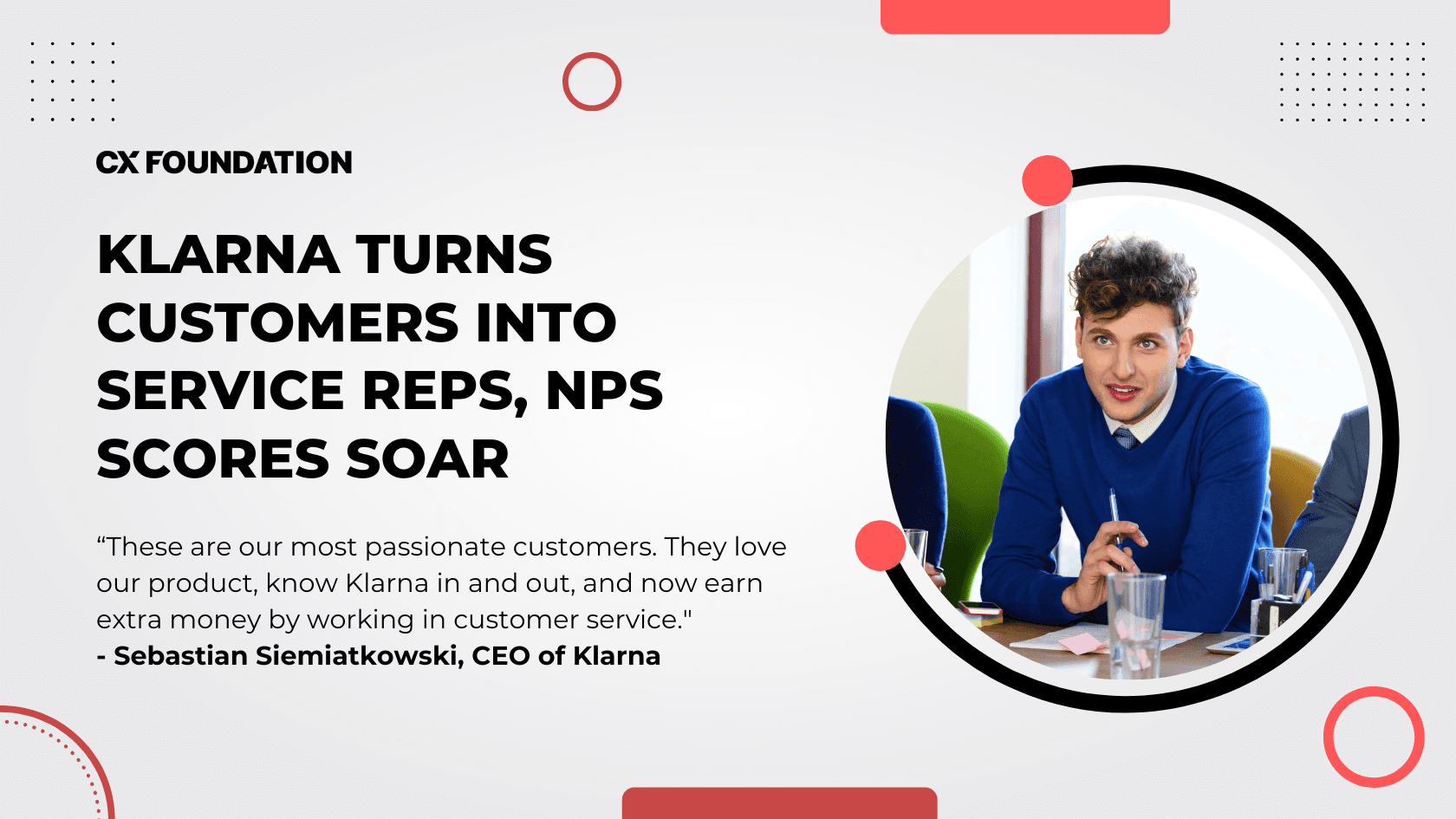
Klarna CEO Sebastian Siemiatkowski has revealed that the company is making a concerted push to recruit its own customers as service representatives.
Appearing on the 20VC podcast with Harry Stebbings, Siemiatkowski said his support team is onboarding its “most passionate” customers, who work remotely.
“We ask them if they want to work part-time in customer service,” he said. “Just like driving an Uber, they can jump on and work for Klarna’s customer service.”
“These are our most passionate customers. They love our product, know Klarna in and out, and now earn extra money by working in customer service. The NPS and customer satisfaction (scores) are through the roof.”

The move comes as part of Klarna’s vision for two-tier customer service, where AI delivers basic customer service and humans lead VIP experiences.
“Internally, we've focused too much on cost,” admitted Siemiatkowski. “We need to rethink this and make customer service a human experience. Everyone who wants a human connection should get it. That's what VIP service will look like in the future.”
Pushing back, Stebbings suggested that human agents are often underprepared to deliver VIP customer service, highlighting the burden on training and development teams to bring them up to that level
According to Siemiatkowski, that’s precisely why Klarna’s customer recruitment drive has proven so powerful, as reps more deeply understand the experience and can relate to customer emotions, uplevelling Klarna’s support experience.
Misconceptions In Klarna’s Customer Service Story
Siemiatkowski's admission during his podcast appearance that the company over-optimized for costs when delivering AI-led experiences is refreshingly candid.
After all, customer service teams often place too much emphasis on cost-based metrics such as containment and deflection. When that happens and optimizing these metrics becomes the strategy, not the measure, experiences suffer.
However, the remarks are somewhat surprising given the company’s 2024 boasts that its ChatGPT-powered service assistant eliminated the equivalent of 700 agents' worth of work in a now-deleted press release.
At the time, Siemiatkowski also affirmed his desire to become OpenAI’s “favorite guinea pig”.
While these comments attracted significant attention, Siemiatkowski has now asserted that no one at Klarna lost their jobs. Instead, the company lessened its outsourcing load and didn’t replace natural attrition.
Additionally, the CEO stated his belief that human customer service will not be fully replaced by AI, placing him at odds with predictions from OpenAI CEO Sam Altman.
“It is very important that we maintain the relationships with our partners, and the same goes for customer service. It's going to be, I’m still going to argue, vital to offer a human connection there,” said Siemiatkowski.
However, the CEO expects the company’s overall workforce to shrink as it leans further into AI. He predicts that the current base of more than 3,000 employees will fall below 2,000 by 2030, as the business increasingly opts not to replace staff lost through natural attrition.
Siemiatkowski concluded: “We also promised our employees, which is very important. We said: ‘Guys, this is going to mean we’re going to do much more with many fewer people. This is going to make more profit for us, and you’re going to share in that profit.’”
The Future of AI-Led Customer Support
Overall, there is a lack of creativity in AI-led customer service experiences. Still, contact centers look to replicate the same resolution flows for a particular intent across isolated channels.
That lack of creativity is spurring the development of new-wave consultancies focused specifically on conversational experience design.
These consultancies leverage the open architecture of modern conversational AI platforms to blend different types of AI, from the latest large language models (LLMs) to decades-old optical character recognition (OCR), to reimagine how contact centers serve customers.
They’re also blending channels within a single interaction, utilizing digital overlays and interactive elements on the modern smartphone to transform voice and video experiences.
Alongside greater individualization, where AI adapts to the speed and tone of a customer in real time, these trends will hopefully reshape how companies, including Klarna, approach AI-led support.
In doing so, they’ll place less emphasis on costs and instead focus on the experience, leveraging humans where they fit best in the experience.
Yet, these human agents will also leverage AI, with agent assist solutions offering real-time guidance, post-interaction support, and simulated training scenarios.
These are just some of the many AI use cases that will swarm the contact center in 2026.