For most of the last decade, the customer experience industry has been trying to solve a channel problem. Voice needed to connect with chat, chat with messaging, messaging with digital, and all of it eventually had to connect back to CRM. The industry called the destination omnichannel.
Glia's latest move suggests that omnichannel may only have been an intermediate step.
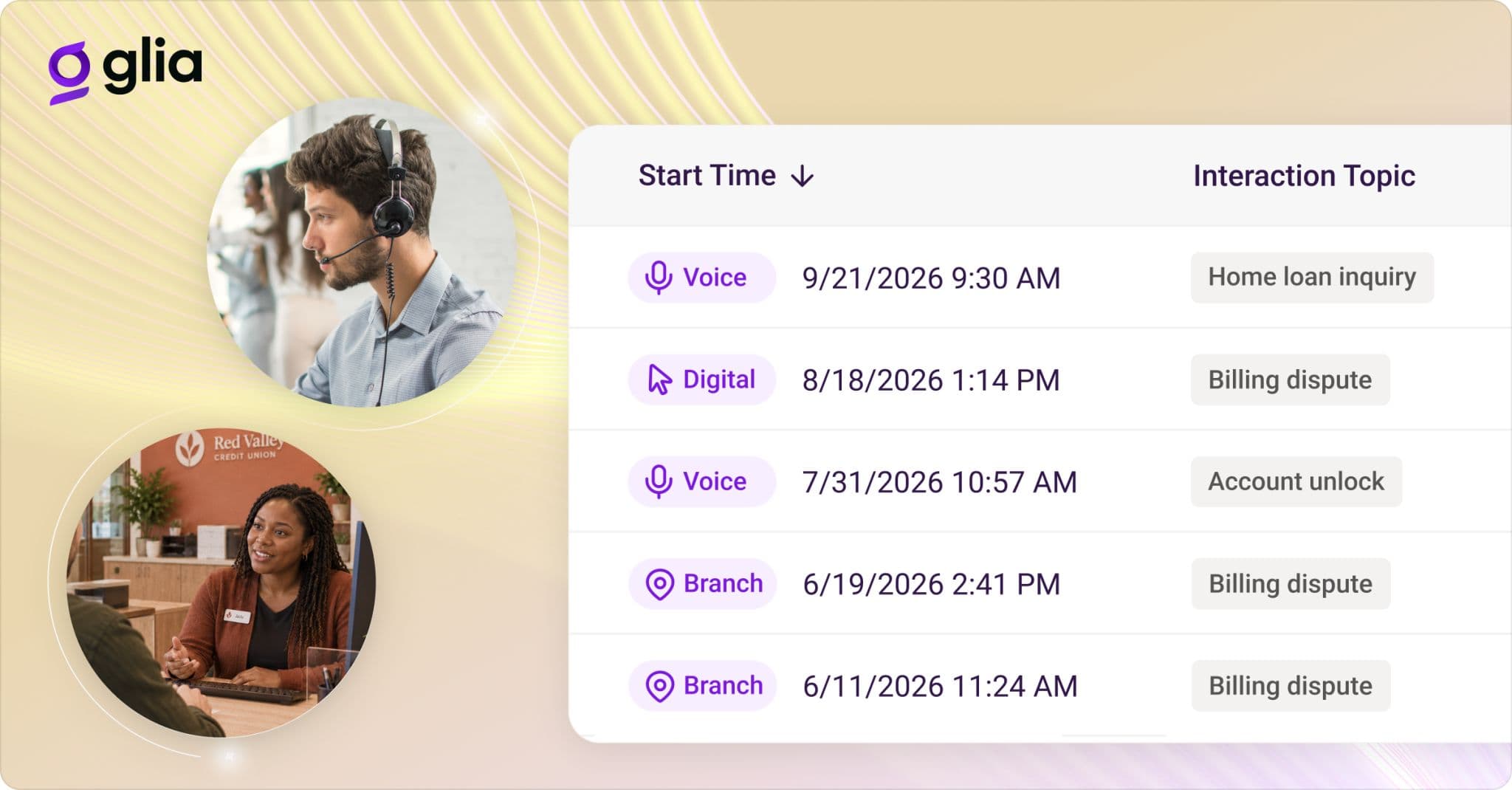
The company has introduced Glia Relationship Management (GRM) and Glia Branch, expanding its platform beyond digital and contact-center interactions into customer relationship management and, more unusually, the physical bank branch. On the surface, this looks like a financial-services CX vendor adding two more products to its portfolio. But the more interesting interpretation is that Glia is attempting to create a persistent intelligence layer around the customer, one that can remember what happened across digital, voice and even face-to-face interactions, then make that context available to both humans and AI.
If Glia can pull that off, it's building something considerably bigger than another contact center platform.
The AI Race Is Becoming a Context Race
Much of the current CX conversation revolves around which company has the most capable AI agents. But as the underlying models improve and increasingly converge in capability, the differentiator may shift from the intelligence of the model to the quality of the information surrounding it.
An AI agent can be exceptionally sophisticated and still deliver a mediocre customer experience if it doesn't know the customer.
Consider a credit-union member who walks into a branch and spends half an hour discussing plans to buy her first home. She explains that she's probably six months away, talks through what she can afford and asks about mortgage options. Historically, much of the intelligence contained in that conversation could disappear the moment she walks out the door.
Three weeks later, she visits the website or calls the contact center and asks another mortgage question. The institution may technically know who she is, but the employee or AI agent handling that interaction may know almost nothing about the conversation she already had.
That's the exact problem Glia is attacking.
GRM brings voice, digital and branch interaction histories together with core banking data, while Glia Branch extends that intelligence into physical locations. The result is potentially powerful: instead of treating the branch, contact center and digital experience as separate channels that occasionally exchange data, the institution begins developing something closer to organizational memory of the customer.
Glia CEO and Co-Founder Daniel Michaeli describes the objective in similarly direct terms:
“Trust isn't built on single transactions—it's built on continuity. We're giving financial institutions the single memory they need to turn every interaction into a lasting relationship.”
Daniel Michaeli
CEO and Co-Founder @ Glia
The result is potentially powerful. Instead of treating the branch, contact center and digital experience as separate channels that occasionally exchange data, the institution begins developing something closer to organizational memory of the customer.
And organizational memory is exactly what AI needs.
Glia Is Making the Branch Machine-Readable
This may be the most interesting aspect of Glia's announcement.
Contact centers have generated machine-readable customer intelligence for decades. Calls are recorded, chats are stored, sentiment is analyzed, intent is classified and outcomes are measured. Every interaction creates another piece of data that can potentially improve the next interaction.
The physical world remains much harder to capture.
A customer might spend 45 minutes discussing retirement, a mortgage, a business loan or a financial hardship with someone inside a bank, yet much of that information never becomes usable intelligence for the rest of the organization. At best, an employee might enter a few notes into another system. At worst, the context disappears entirely.
Glia Branch attempts to change that by turning the physical conversation into another source of customer intelligence. That means the next employee—or increasingly the next AI agent—doesn't simply know that the customer has a checking account and mortgage. It could potentially understand what the customer has been trying to accomplish across multiple interactions.
That's a fundamentally different level of context.
It also points toward a future where the distinction between "digital CX," "contact center CX" and "branch CX" starts to matter much less. From the customer's perspective, there was never much reason for those distinctions to exist in the first place.
Glia Is Also Quietly Moving Up the Enterprise Stack
There is another strategic implication here that shouldn't be overlooked: Glia is moving closer to CRM territory.
Traditional CRM systems were largely designed around customer records. They are exceptionally good at telling an organization what products a customer owns, what opportunities exist, what cases have been opened and what activities employees have recorded.
AI requires something richer.
It needs to understand the relationship surrounding those records: what the customer recently discussed, what they're trying to accomplish, what frustrated them, what they may need next and what has already happened across previous interactions.
That's where the distinction between a customer record and customer context becomes important.
Glia isn't arguing that banks should immediately rip out Salesforce or another incumbent CRM. GRM can coexist with existing CRM infrastructure. But its introduction raises a strategically important question for the entire CX industry: if the CX platform increasingly understands the customer's identity, interaction history, intent and relationship—and AI agents begin acting on that intelligence—where does CRM end and CX begin?
The boundaries become increasingly difficult to define.
And that could become a much larger competitive battleground over the next several years.
Vertical AI May Be Glia's Biggest Advantage
Glia also has an advantage that shouldn't be underestimated: it isn't trying to solve this problem for every industry.
The company says its technology is already used by more than 700 banks, credit unions and financial institutions. That installed base gives Glia something horizontal AI platforms have to work much harder to develop—deep exposure to how financial institutions actually interact with customers.
Banking has its own workflows, terminology, regulations, customer journeys and relationship dynamics. A generic AI platform needs to learn that environment. Glia already lives inside it.
That makes GRM more interesting than simply "Glia launches a CRM."
Glia is effectively building a banking-specific customer intelligence layer around the interactions its platform already manages. And because core GRM functionality is being made available to existing Glia customers without additional cost, the company potentially has a relatively frictionless path to getting that intelligence layer deployed across a substantial installed base.
That could become strategically important. Once a platform becomes the place where customer conversations, intent, history and AI orchestration converge, replacing it becomes considerably more difficult than replacing a communications tool.
From Omnichannel to Omnicontext
For years, the CX industry's destination was omnichannel: connect every place the customer interacts so the experience feels continuous.
AI raises the ambition.
Connecting channels answers where the customer interacted. The next generation of CX platforms will need to understand what the enterprise learned from those interactions and remember it the next time the customer appears.
That creates a different architecture. Voice, messaging, digital behavior and physical conversations become inputs. Customer context becomes the memory layer. AI becomes the intelligence layer. Human employees and AI agents become different interfaces into the same underlying understanding of the customer.
Glia isn't alone in recognizing this. Salesforce, Genesys and other major CX platforms are increasingly emphasizing unified data and context as prerequisites for effective agentic AI.
But Glia is approaching the problem from an unusually interesting direction. By extending that intelligence into the physical branch, it's attempting to capture a part of the customer relationship that most CX platforms barely see.
That's why Glia Relationship Management and Glia Branch deserve more attention than a typical product launch.
Glia may have started as a digital customer service company, but its trajectory is beginning to look much more ambitious. If it can connect digital interactions, contact-center conversations, banking data and physical conversations into a persistent intelligence layer, Glia isn't merely helping banks communicate with customers.
It's positioning itself to become the system that understands the relationship.
And that could matter enormously as AI becomes embedded throughout customer experience. Models will improve. Agents will proliferate. Many AI capabilities that look differentiated today will eventually become commonplace.
What will remain scarce is proprietary context: the history, intent and accumulated understanding of an individual customer.
That leads to a much more consequential question than whether Glia has launched a new CRM:
In an AI-powered customer experience, does the most valuable platform ultimately become the one that knows the customer best?
Glia appears to be betting that it does.
Stay updated with cx news
Subscribe to our newsletter for the latest insights and updates in the CX industry.