
November 17, 2026 • 5 min read
Genesys Announces Standalone AI Agents, New Effort-Based AI Pricing Model

Director of Content & Market Research
November 17, 2026
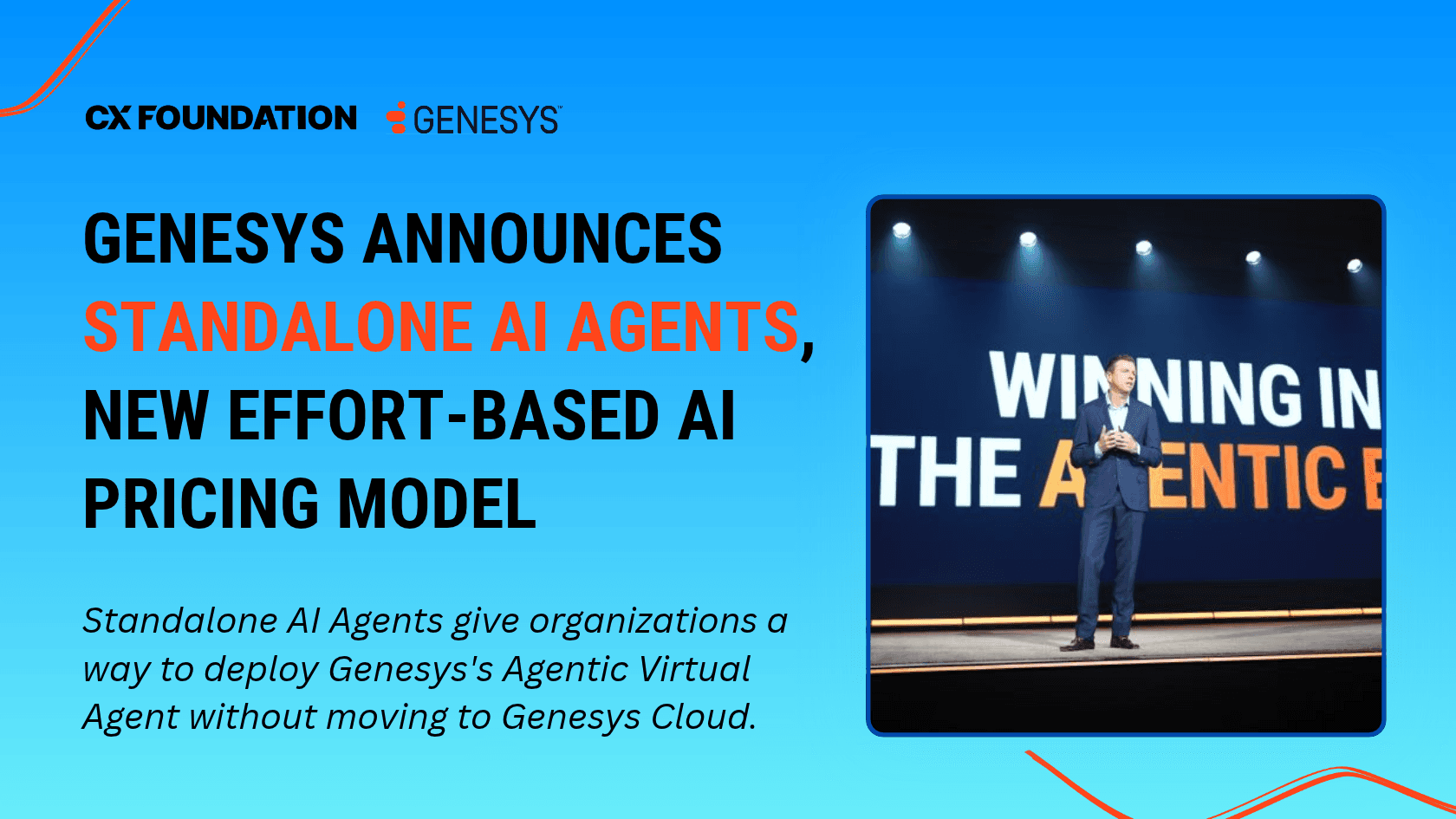
Genesys has unveiled Standalone AI Agents to target a new type of conversational AI buyer.
This new buyer wants to layer AI on top of its existing CX environment before committing to a full-scale transformation.
Standalone AI Agents enable exactly that.
They allow organizations to implement the Genesys Cloud Agentic Virtual Agent without first migrating to the broader Genesys Cloud platform.
As a result, they can accelerate time to AI value.
Meanwhile, further in the future, these new buyers will likely migrate to maximize AI’s performance with a more flexible foundation.
After all, that platform-level foundation sets a ceiling for AI performance.
For brands deploying Standalone Agents, Genesys becomes the obvious migration partner.
Indeed, it’s not only delivering the initial benefits of AI transformation, but also orchestrating customer context, service workflows, and automation.
As Genesys does so, it offers clients forward-deployed engineer assistance, bolstering their initial Standalone AI Agent deployment and any subsequent transformation project.
Many standalone conversational AI providers, including Sierra, Decagon, and Bland, have found success with this model.
By embracing it, Genesys moves closer to its customers, bolstering the implementation experience and building relationships that will support a broader, future CX transformation.
What Else Did Genesys Announce?
Alongside Standalone Agents, Genesys announced the Genesys Arena and a new “effort-based” pricing model.
Together, these innovations aim to support organizations in scaling customer-facing AI.
“With Standalone AI Agents, Genesys Arena, and a new effort-based pricing model, we’re giving organizations more choice in how they put agentic AI to work today and scale it as their needs evolve.”

Here’s a closer look at these two additional announcements.
1. The New Genesys Arena
The Genesys Arena provides pre-built Agent Kits, which comprise the foundational components of “more than 50 common industry use cases.”
These components include skills, integrations, knowledge, and guardrails.
Genesys claims organizations can deliver a “functional AI agent” in just ten minutes when these are delivered together.
From there, they can use natural language prompts to customize the agent, preview the experience, and - for those already in Genesys Cloud - deploy it.
“Genesys Arena gives teams a practical head start, so they can spend less time on the foundational work and more time shaping AI around their customers, business, and the results they want to achieve."'

With this head start, organizations may also advance their prototypes with new voice customization tools, allowing brands to tailor the personality, tone, and delivery of their agents across use cases.
They can also seek the support of Nokta’s forward-deployed teams. Yet, they should work closely alongside them. After all, organizations must understand what those engineers are doing to avoid becoming overeliant on third-party support.
2. A “More Flexible” Effort-Based AI Pricing Model
Genesys announced a new “effort-based pricing model” that scores customer interactions on their complexity.
It works by marking each interaction as simple, moderate, or complex, and charging a specific number of “Experience Units” for each graded interaction.
As a result, Genesys hopes to better align costs with the work AI performs.
From here, Genesys will rename AI Tokens “Experience Units,” providing Genesys customers a common way to consume all its AI solutions.
Why Consider Genesys for Conversational AI?
Genesys Standalone AI Agents may appeal to a specific buyer, but that buyer has many options, from its rival contact center providers to conversational AI specialists.
That begs the question: why chose Genesys?
With the Arena and forward-deployed engineers, Genesys may argue time to value. Its new pricing model is also disruptive.
Yet, beyond this, three further reasons stand out:
- Future-Ready Operations: Many organizations have long-term ambitions of migrating to Genesys Cloud. This first deployment gives them a practical first step that also lets them deploy AI and experience the vendor relationship.
- Governance and Accountability: The Agentic Virtual Agent explains why it took specific actions, leaving audit trails, and ensuring accountability. This is a significant differentiator against providers still largely focusing on text-generation safety, i.e., monitoring hallucinations and tracking bias.
- Broader Portfolio: Genesys delivers solutions like Radarr for social media monitoring, which bolster the initial conversational AI deployments. For instance, this tool monitors customer sentiment and can trigger a proactive, AI-led engagement that saves business. Genesys Cloud Predictive Engagement is another powerful example.
Genesys may also add that its Agentic Virtual Agent leverages Large Action Models (LAMs), not Large Language Models (LLMs), which it believes could bolster more action-oriented agents.
More News from Genesys
The news is coming thick and fast from Genesys this fall.
It started to snowball in September at its Xperience 2026 event, with the vendor announcing four new solutions for journey orchestration, alongside strengthened partnerships with Adobe, AWS, ElevenLabs, Salesforce, ServiceNow, and others.
Soon after, it announced its participation in the new Personal Agent Protocol, delivered by Meta. This ensures that a brand’s agent can authorize a customer’s AI agent.
Genesys also celebrated an expansion of its forward-engineering teams, opened a new office in Canada, and achieved market leader status in the latest CCaaS Gartner Magic Quadrant study for the 12th consecutive year.
Expect even more to come before the end of the year…