
November 20, 2026 • 7 min read
CX News Roundup: Standalone AI, Integrations, Voice AI Upgrades

CX Analyst & Thought Leader
November 20, 2026

This week in CX was all about orchestration and the “conscious uncoupling” of CCaaS platforms and AI capabilities. In the past, if enterprises wanted to get agentic AI agents, infrastructure, and intelligence, then they had to buy the complete contact center software: and rip-and-replace their existing systems.
The news this week shows vendors are finally moving away from the “all-or-nothing” approach by selling their AI capabilities as standalone products, separate from underlying telephony and routing platforms. Enterprises can now deploy autonomous virtual agents, set real-time voice guardrails, and manage cross-platform supervision on top of their existing legacy infrastructures.
Key CX announcements and events for the week of November 13-20 include:
- Genesys launched Standalone AI Agents, Genesys Arena, and effort-based pricing at Genesys Xperience in NYC.
- At Microsoft Ignite 2026, NiCE Cognigy and Microsoft announced NiCE Cognigy now connects to Microsoft Teams, Azure, and Dynamics 365 Customer Service. Additionally, Enterprises can add Cognigy as an Intelligent Voice Agent in Teams Phone.
- Also at Ignite, Microsoft announced the general availability of Microsoft Contact Center Intelligence (CCI). It also debuted Copilotforce, a plugin that lets sales teams access Salesforce customer context, AI tools, and sales workflows directly within Copilot.
- Twilio added AI agent Supervision to Twilio Conversations, including two Conversation Intelligence operators: Task Completion and Hallucination Detection flags.
- Cresta launched Soundcheck, an automated voice simulation framework that evaluates voice AI agents under synthetic real-world call conditions, stress-testing acoustic degradation, background noise, caller interruptions, and edge-case compliance
Genesys Launches Standalone AI Agents, Genesys Arena, Effort-Based Pricing
At Genesys Xperience New York, Genesys debuted Standalone AI agents, Genesys Arena, and effort-based pricing.
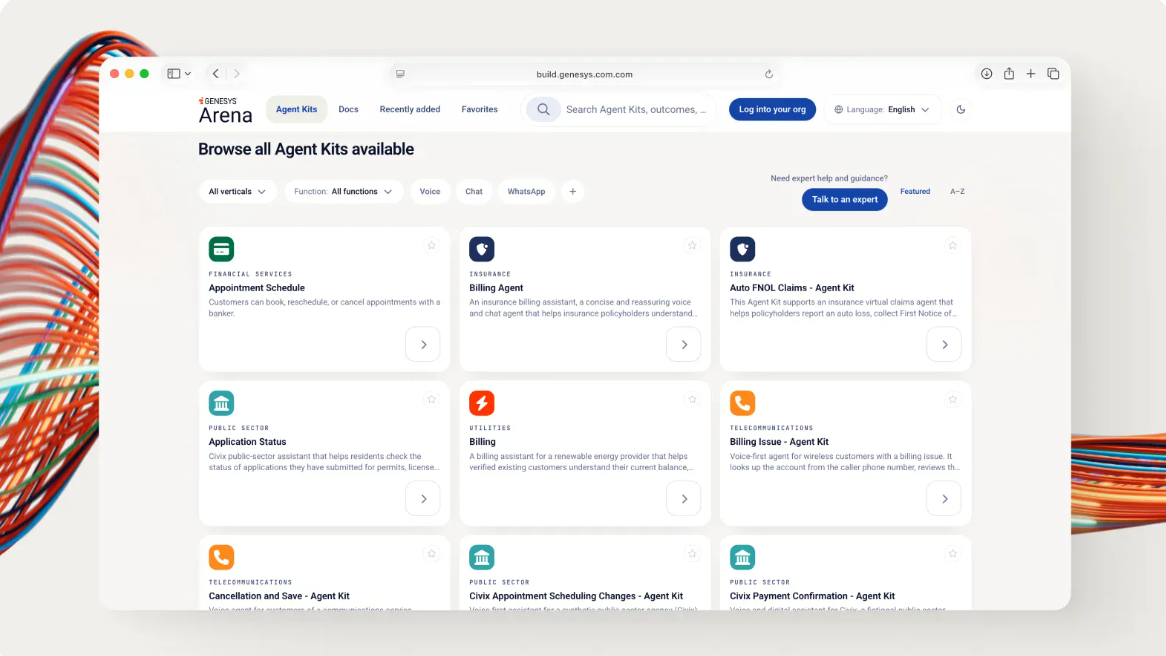
Standalone AI Agents work with your existing contact center infrastructure to give you no-migration-required access to the Genesys Agentic Virtual Agent for voice and digital channels.
Genesys Arena improves the AI agent building process by providing prebuilt Agent Kits. Agent Kits let you deploy industry-specific working AI models for over 50 common use cases, significantly reducing build time and complexity. Genesys says teams can create a functional AI agent in as few as 10 minutes.
“AI is advancing quickly, and enterprises shouldn’t have to start from zero every time they want to put a new idea to work. Genesys Arena gives teams a practical head start, so they can spend less time on the foundational work and more time shaping AI around their customers, business and the results they want to achieve.”
Youssef Nokta
Genesys also introduced effort-based pricing at the event, which classifies each interaction as simple, moderate, or complex and charges. Customers pay lower amounts for low-effort tasks and higher amounts for high-effort ones. Charges are based on Experience Units, Genesys’ renaming of AI Tokens.
As of this writing, Genesys Standalone AI Agents are generally available, with Agent Kits generally available via Genesys Arena later this month.
Read our complete coverage of this announcement
NiCE Cognigy and Microsoft Announce Connected Infrastructure for Teams Phone, Azure, Dynamics 365
At Microsoft Ignite, NiCE Cognigy announced a deep strategic expansion with Microsoft, centering on NiCE Cognigy's integration across Microsoft Azure, Microsoft Teams, and Microsoft Dynamics 365 Customer Service.
NiCE Cognigy was one of the first to complete Teams Unify integration model certification for voice agents. Microsoft Teams Phone users can add Cognigy as an Intelligent Voice Agent within the Teams interface, while Teams Phone still manages the overall telephony infrastructure.
“We are moving past the era where AI merely deflects calls. By deeply integrating NiCE Cognigy with Microsoft Teams and Dynamics 365 Customer Service, we are empowering a unified workforce where AI and human agents collaborate in real-time to solve complex customer issues instantly.”
Jeff Comstock
Read our complete coverage of this announcement
Cresta Introduces Soundcheck for Advanced Voice AI Pre-Deployment Testing
Cresta launched Soundcheck, a more scalable, realistic pre-deployment voice AI agent testing and evaluation tool. Soundcheck builds on Cresta’s existing Synthetic Customer and Testing 2.0 capabilities, letting users customize the synthetic caller’s voice and behavior, speed of speech, emotion, microphone quality, interruption frequency, and more.
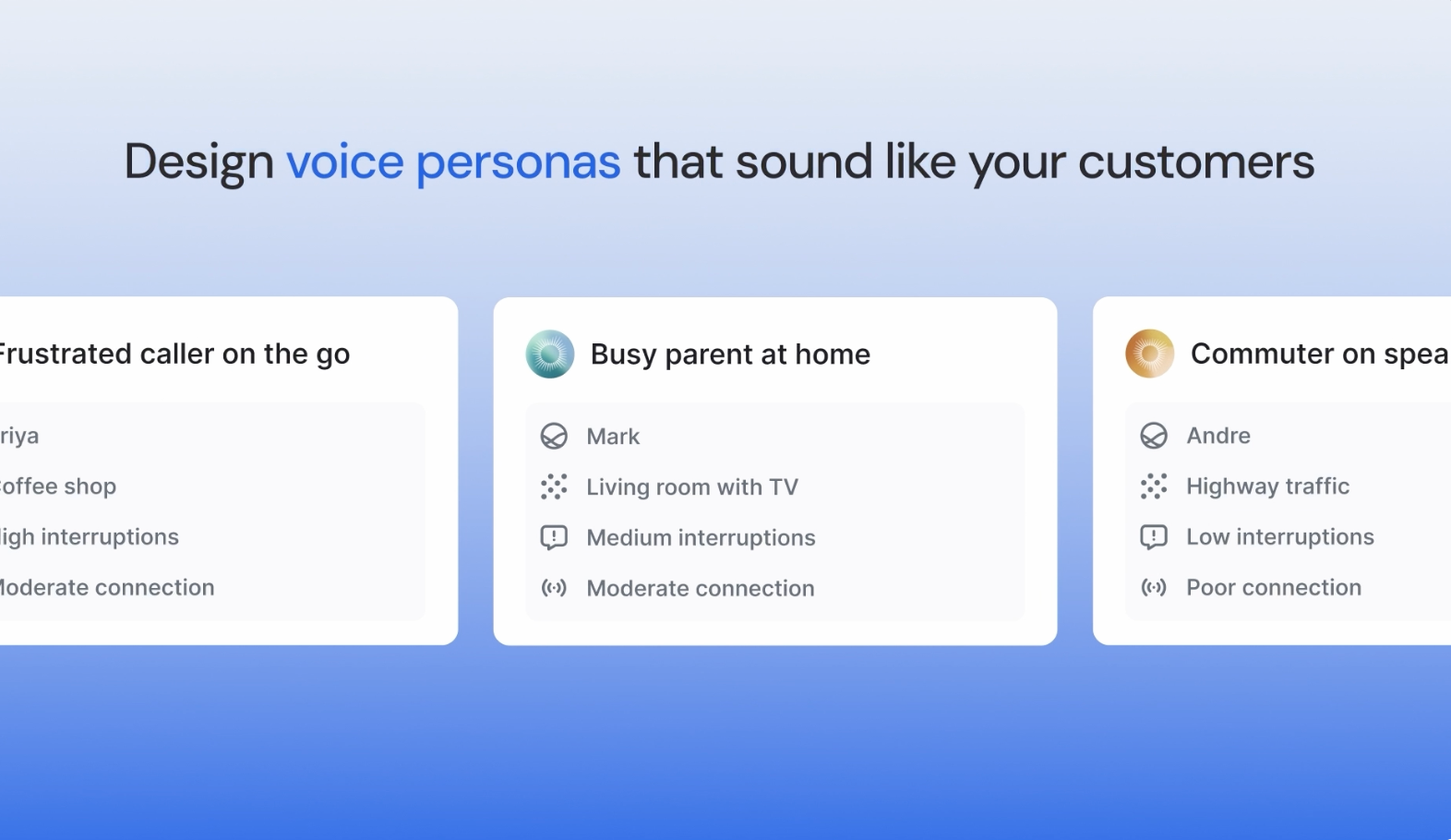
The goal is to test voice AI agents across real-world situations: accents, colloquialisms, background noise, poor network quality, etc.
Instead of evaluating only what the customer said, Soundcheck looks at how they said it. AI agent communication is evaluated based on factors like interruption handling, unresponsiveness, latency, overtalk, word error rate, or gibberish.
Twilio Expands Voice AI Infrastructure, Conversations Layer
Twilio delivered critical infrastructure upgrades to its Voice AI and Conversations Layer, making it much easier for enterprises to deploy and supervise natural-sounding voice AI agents, at scale.
Conversation Relay now includes ElevenLab’s lowest-latency v4 Turbo voice model for natural conversations across over 90 languages. Later this month, HD audio, dynamic configuration parameters, smart turn detection, and STT failover will be generally available.
Agent Connect now includes SDK partner packages, developer tooling, and product capabilities, meaning it’s easier for teams to integrate Twilio into their existing workflows, using their preferred voice and AI models.
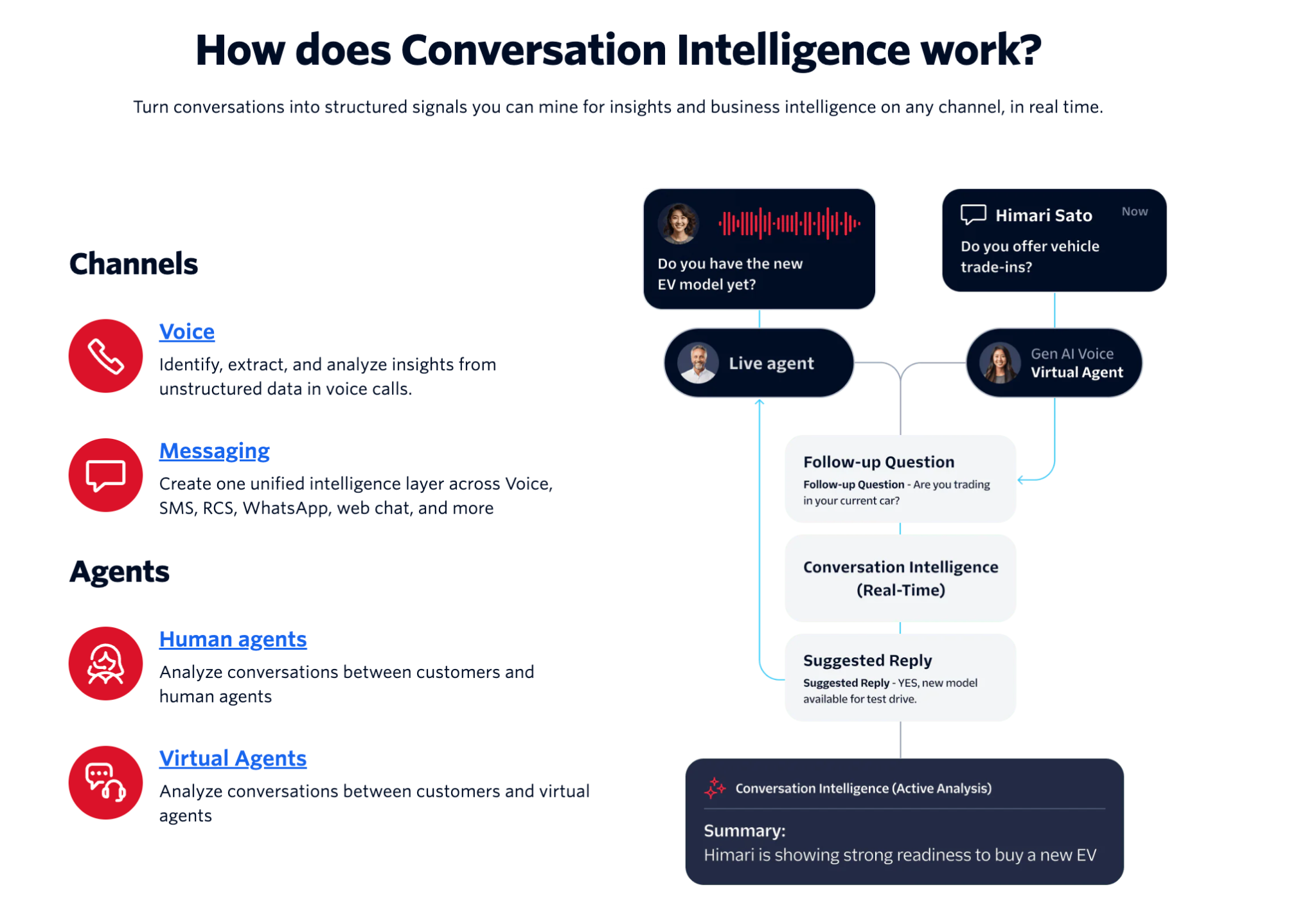
Twilio also introduced additional Conversation Intelligence capabilities, including native transcript analysis, deeper quality and policy compliance monitoring, and better insight into accuracy, task completion, loop detection, and hallucinations.
Microsoft Announces Copilotforce Partnership With Salesforce, Microsoft Contact Center Intelligence Generally Available
At Microsoft Ignite, Salesforce and Microsoft announced Copilotforce, a plugin that lets sales teams access Salesforce data directly within Microsoft Copilot.
The two vendors also announced that Salesforce Data 360 and Microsoft Fabric are now connected via "bidirectional zero-copy capabilities." In layman’s terms, this means data can be shared between Salesforce CRM and Microsoft Copilot and Teams without copying files.
Additionally, users can now add Copilot AI into existing contact center platforms, including Five9, Avaya, and Cisco. Microsoft also announced the General Availability of Microsoft Contact Center Intelligence (CCI).
“Through Copilotforce, we’re bringing Salesforce to the largest surface in enterprise software today, embedding trusted Salesforce context and intelligent sales workflows directly where sellers work.”
Miguel Milano
Read our complete coverage of this announcement
The CX Impact
The era of unbundled, production-grade agentic CX is here. Whether or not it will actually lead to fluid, action-oriented conversations that truly move customer interactions forward remains to be seen.
What’s certain is that as long as tools like Genesys Standalone Agent allow enterprises to add AI agents on top of existing legacy systems, deployment will get significantly faster and less complex (and hopefully, cheaper.)
Infrastructure innovations like Twilio Conversation Relay and deeper testing capabilities from tools like Cresta Soundcheck will make AI agents sound more natural, respond in sub-500 milliseconds, and handle background noise or interruptions gracefully without breaking.
Twilio's automated supervision operators grade 100% of finished calls for factual accuracy, while Microsoft’s integrations with NiCE Cognigy Voice AI and Salesforce ensure everyone has access to the same data.
While these upgrades are certainly a win, none of them guarantee success. Enterprises should not take these advancements as a cue to become more hands-off when building, testing, and deploying AI at scale.