
November 13, 2026 • 6 min read
ServiceNow Takes Aim at Legacy Rivals with Its New Autonomous CRM Engine

Director of Content & Market Research
November 13, 2026
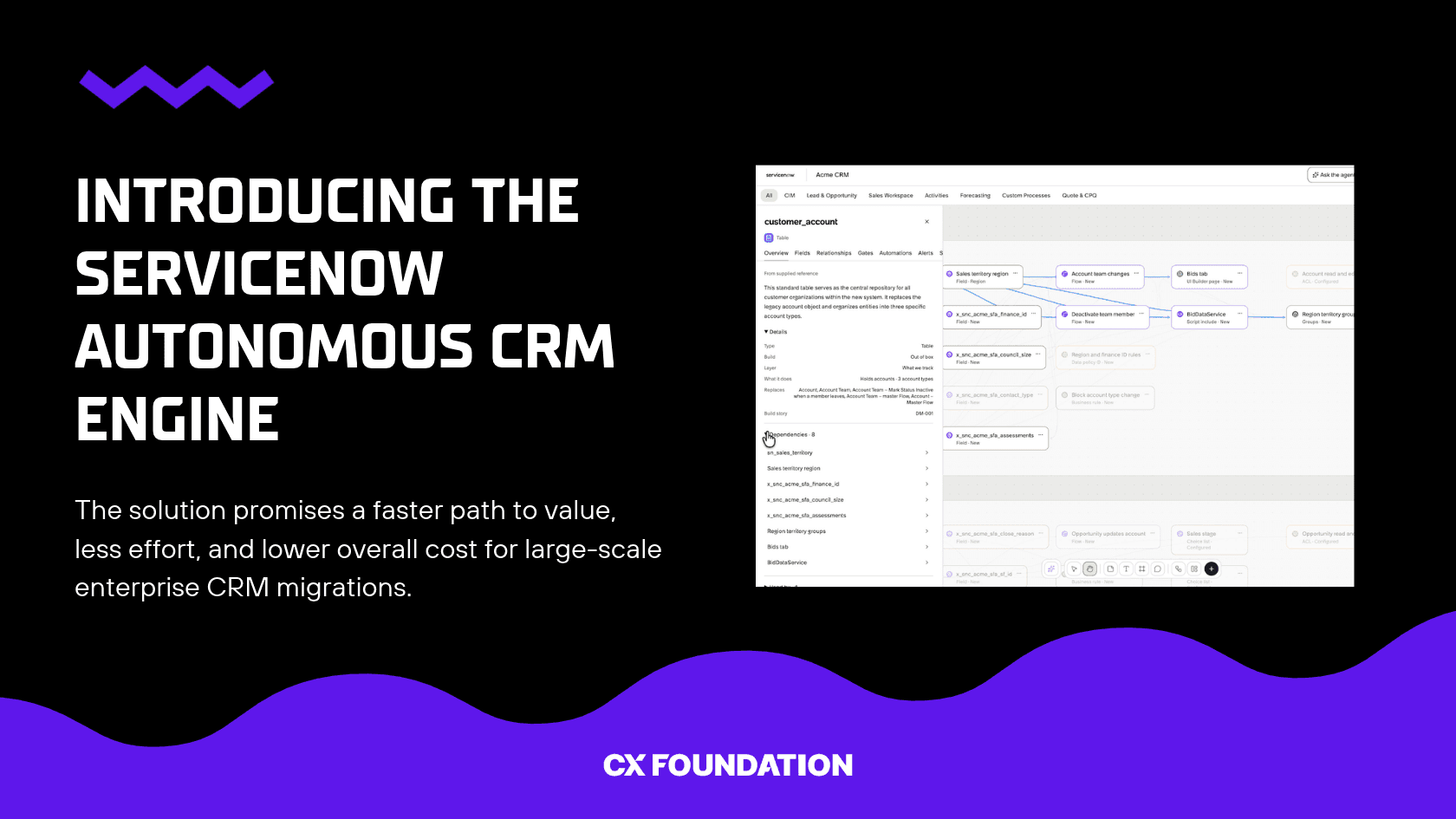
ServiceNow has launched an Autonomous CRM Engine to streamline CRM migrations.
The solution uses AI to map the current CRM ecosystem, identify opportunities for more modern processes, and design the future state environment in ServiceNow.
In doing so, the Engine standardizes code and configurations, then monitors changes over time to prevent drift and maintain a lean, mean CRM environment.
“We redefined what an enterprise CRM can be. Now we’re redefining how fast enterprises can deploy and scale it,” added John Ball, EVP & GM of CRM & Industry Workflows at ServiceNow.
“Autonomous CRM Engine shortens the move from legacy systems to AI-native CRM to weeks, giving enterprises a practical path off legacy CRM platforms.”

Currently, the solution is in controlled visibility, with extended capabilities touted for 2027.
However, its potential is significant in a market where legacy environments are common, and ServiceNow has space to grow.
The Backdrop
Since the start of 2025, ServiceNow has made a big push on CRM.
In May that year, it brought its Customer Service Management (CSM) and Sales and Order Management (SOM) solutions together to deliver a unified CRM platform.
While it notably excludes the marketing element, adding order management is unique.
Why does it matter? Because as soon as a deal closes, organizations can launch fulfillment workflows, closing the gap between what sales promises and what gets delivered.
Yet, ServiceNow has other differentiators. For instance, in owning enterprise workflows, it can pull rich operational data into the CRM environment. It also goes deep on industry-specific workflows and delivers a CPQ that reaches new revenue touchpoints.
Many organizations have recognized these differentiators, and its CRM business is accelerating.
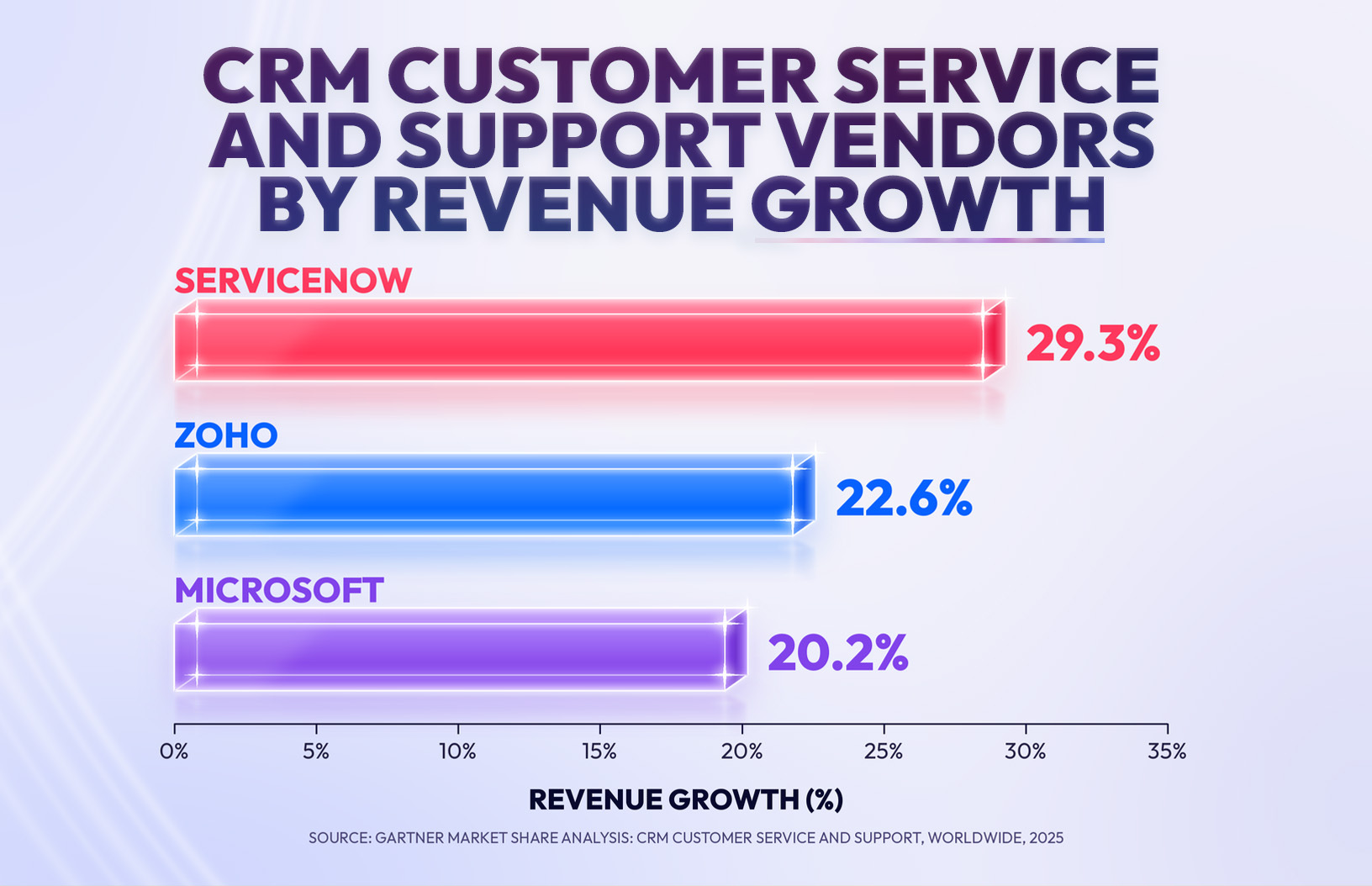
Among the top ten most prominent global CRM providers (specifically for customer service and support), ServiceNow led on revenue growth in 2025, according to a Gartner Market Share Analysis. The graphic below highlights the top three.
At the same time, the CRM market is becoming more fragmented.
Now, the top ten providers only account for 50.8% of global revenue. That’s down from 61.6% just 12 months earlier.
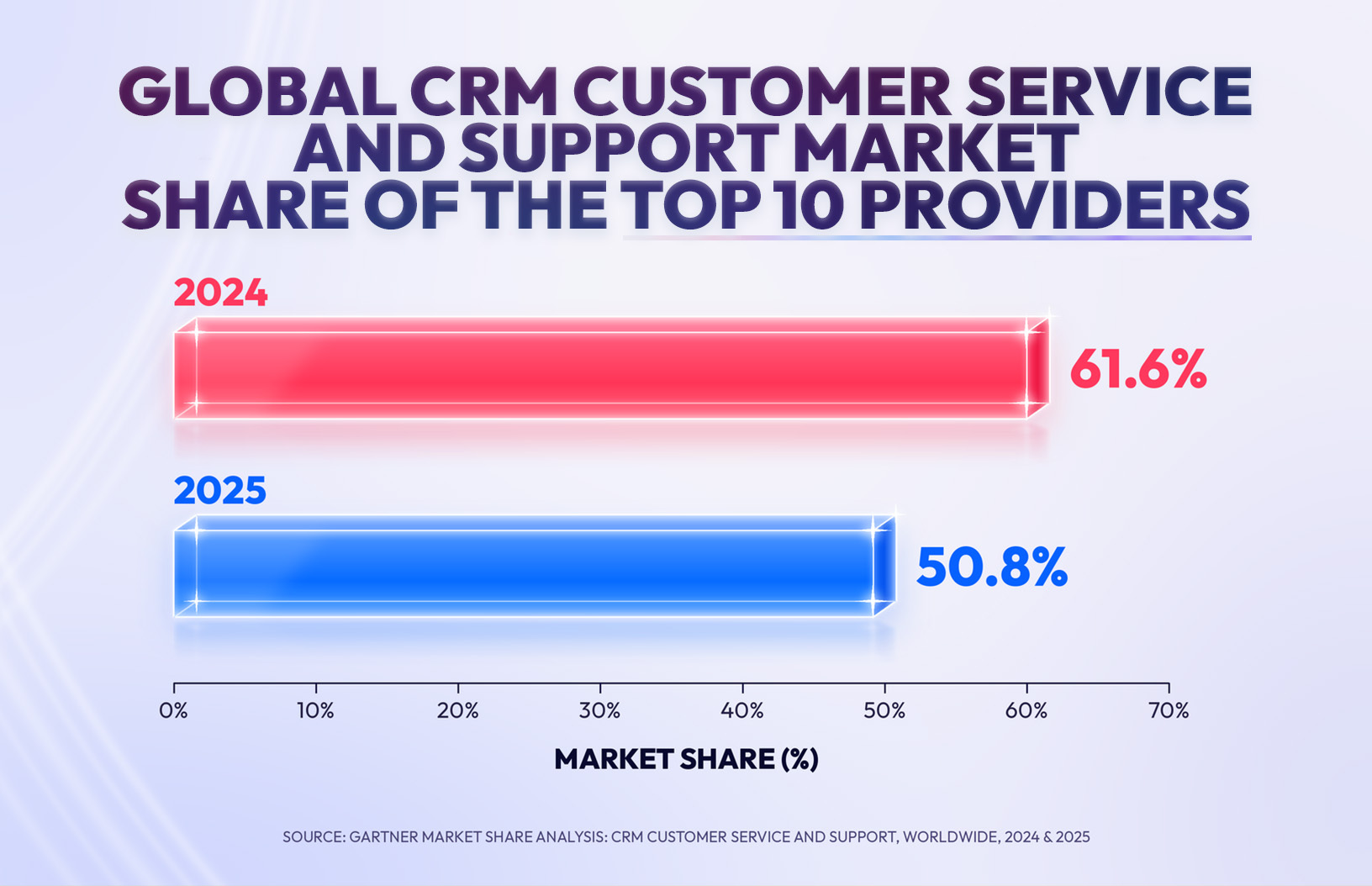
The findings point to a clear appetite among enterprises to switch providers, with disruptors like ServiceNow gaining ground on the large legacy platforms.
However, they understand the cost and complexity of migration, from rebuilding configurations and integrations to managing overlapping subscriptions and new training plans. As such, many large enterprises feel stuck in the mud.
The new Autonomous CRM Engine aims to be the rope that helps to pull them out.
How the Autonomous CRM Engine Works
The Autonomous CRM Engine builds on ServiceNow’s Sweep acquisition from September 2026, bringing its Build Agent and other AI capabilities to the party.
That Engine follows a four-part process:
- Analyze and map: It examines the existing CRM environment before mapping processes, metadata, data models, and underlying structures.
- Recommend and redesign: It identifies opportunities to modernize existing processes and suggests new approaches based on a more contemporary framework.
- Build: It leverages ServiceNow's Build Agent to translate the current environment and approved changes into ServiceNow code and configurations.
- Continuously monitor: Business requirements inevitably evolve, even during a migration. The Engine monitors those changes over time to help ensure the migration stays aligned with business needs.
The result is a faster path to value, less effort, and lower overall cost for large-scale enterprise CRM migrations. Yet, there are other benefits too…
Additional Benefits of the Autonomous CRM Engine
The primary benefit is in lowering the initial pain of an enterprise CRM migration, as Rebecca Wettemann, CEO and Principal Analyst at Valoir, stressed.
"By starting with how the current CRM is actually used and building from there, [the] Autonomous CRM Engine takes on one of the biggest obstacles to change.”

Now, think of Salesforce, Oracle, SAP… enterprises have relied on these systems for years, if not decades. They’re baked into not only the organization’s processes, but also its psyche.
That’s the buyer that ServiceNow is targeting.
Aside from absorbing that complexity and reducing cost on their behalf, ServiceNow also hopes that its Autonomous CRM Engine will:
- Lower Total Cost of Ownership (TCO): The Engine streamlines development and encourages more standardized, reusable code. That helps organizations avoid expensive customization work that becomes difficult to manage over time.
- Support More Efficient AI Deployments: Organizations need their data to be properly structured, accessible, and in the right place to power AI agents, agentic workflows, and other intelligent capabilities… In the age of AI, this is particularly important. The Engine provides that structure.
Martin Schneider, VP & Principal Analyst at Constellation Research, isolated these two points in a LinkedIn video post.
“If you're a go-to-market leader, CRO, CCO, or COO considering where your CRM strategy should go in the age of AI, and you've already been talking to ServiceNow, this could make the transition considerably easier,” he concluded.
“And if you haven't been looking at ServiceNow, but you're interested in a modern CRM platform with agentic capabilities, alongside strong customer support, sales, and ITSM functionality, all brought together across the customer lifecycle, it's becoming a pretty compelling option."

Finally, ServiceNow also plans to evolve the Autonomous CRM Engine into an agentic layer that keeps the CRM running and improving over time.
Such a prospect of a CRM that continuously learns, adapts, and improves itself is exciting for the future.
The Broader Trend
While this announcement compounds ServiceNow’s increasing CRM ambition, it’s not the only vendor using AI to simplify CRM migrations.
In September, Microsoft launched Dynamics 365 Activate as a migration tool that uses AI agents to map the CRM estate and build a migration success plan.
Currently, it only supports Salesforce migrations. However, Microsoft plans to extend the solution across the broader CRM space and into new realms of enterprise software.
These include finance, operations, supply chain, and the contact center.
Elsewhere, more niche players are also leaning into this trend. Consider the customer experience assurance vendor Occam. Its SimplifAI solution converts configuration files into technical and business-friendly diagrams, so contact center architectures become easier to understand. This supports not only migrations, but also ongoing testing and continuous process improvement.
With these examples, expect more AI migration solutions to pop up in 2027. These offer significant promise for industry disruptors like ServiceNow, but will ask tough questions of many established legacy providers that still largely depend on enterprise stickiness.