
November 19, 2026 • 8 min read
Opus Research BPO, AI, & CX Intelliview 2026: 7 Top Takeaways

Director of Content & Market Research
November 19, 2026
For decades, customer experience BPOs sold a simple proposition.
They recruited, trained, and managed contact center teams that could deliver better support than their clients could on their own.
Meanwhile, offshoring and low labor costs sweetened the cost equation.
Yet, AI is now challenging the long-term viability of that model.
The most obvious threat is that AI is absorbing much of the contact volume BPOs are paid to handle, while the work left for humans grows more complex and demands a different kind of employee base.
At the same time, competition is widening, with software vendors, service providers, and AI specialists all chasing the same customer experience budgets.
However, AI also opens new opportunities. Clients need help managing knowledge, integrating systems, handling AI escalations, and more, and BPOs are well-placed to provide these services.
So, while the industry faces a tricky transition, it’s not only a story of doom and gloom.
In its 2026 Intelliview, Opus Research spotlights six prominent global BPOs making positive strides.
What Is the Opus Research BPO, AI, & CX Intelliview 2026?
The Intelliview primarily evaluates six customer experience BPOs: Concentrix, Firstsource, Foundever, iQor, TELUS Digital, and TP (formerly Teleperformance).
Opus Research sent out a Request for Information (RFI), held briefings, saw demos, scoured case studies, and verified client results to compare them.
In doing so, the research firm honed in on the maturity of several aspects of each BPO’s proposition, including:
- Frontline augmentation
- Autonomous customer service
- Workforce transformation
- Analytics and optimization
- Client-facing AI services
- Governance and control
That analysis then informed the following BPO, AI, and CX Intelliview Map.
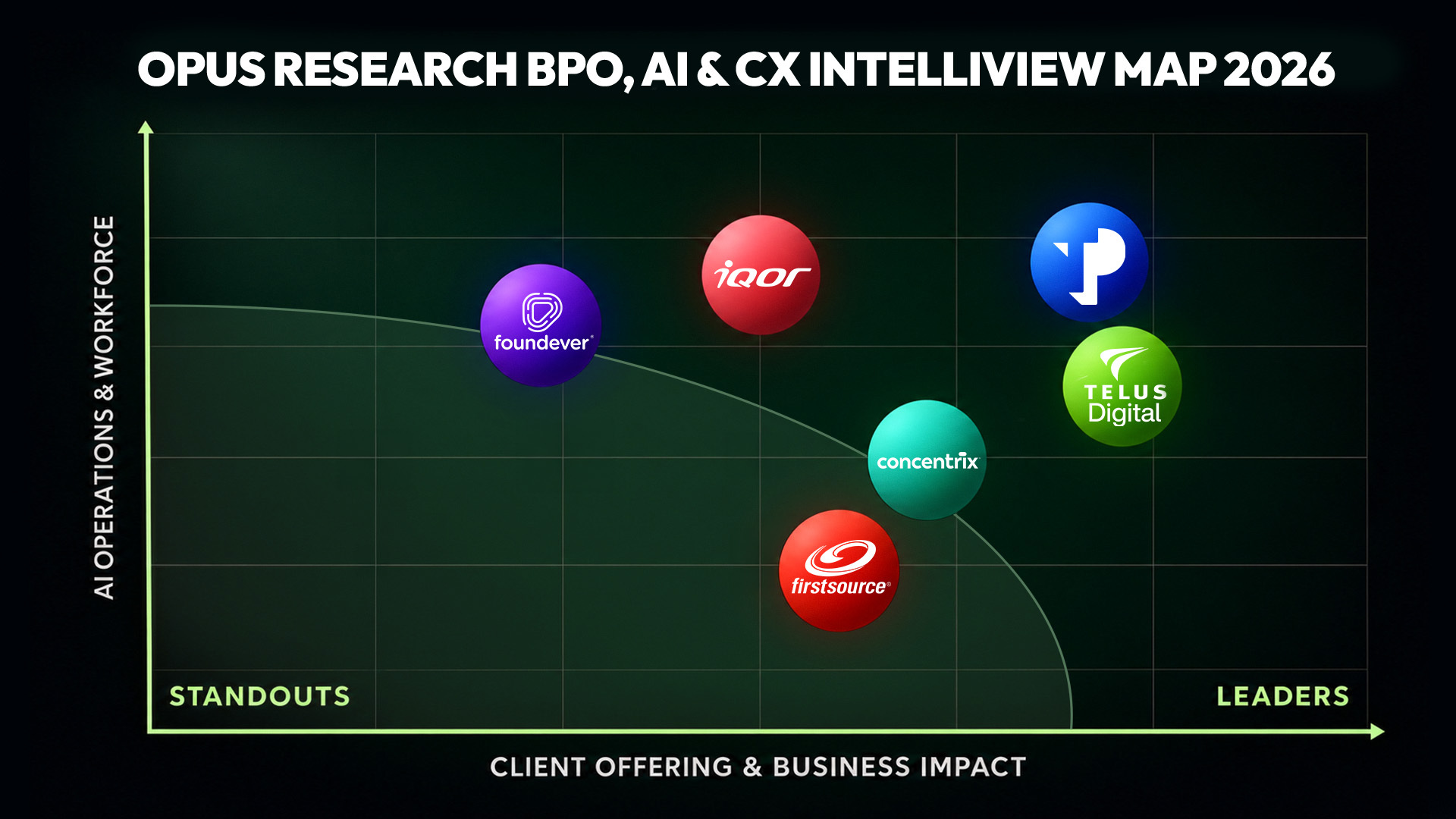
While Opus Research stresses that this graphic reflects its analyst judgement only, the report is incredibly deep.
In 30+ pages, it highlights several fascinating trends reshaping the BPO space, alongside its vendor evaluation.
Several of these trends are explored below.
7 Top Takeaways from the 2026 Opus Research Intelliview
From new focuses to changing commercial models, the Opus Research BPO, AI, & CX Intelliview offers valuable insights into the market’s current state.
Here are seven key takeaways alongside insights from the Opus team.
1. BPOs Become AI Service Companies Faster Than They Become AI-Driven Operations
BPOs are evolving into AI services companies faster than they are transforming their own operations with AI, and the economics behind this shift are easy to understand.
After all, BPOs need to replace the revenue that automation could eliminate.
Given this, it makes sense for them to develop new AI services they can sell, while remaining reliant on human labour in their own service delivery.
Nevertheless, in walking this line, CX BPOs are effectively running two businesses simultaneously:
- Their traditional business of managing people.
- A newer business focused on implementing and operating AI for customers.
“Our view is that the companies most likely to succeed will be those that can bring these two businesses together into a coherent model before their traditional labour-arbitrage business deteriorates too much.”

In this sense, BPOs are racing against time. Can they combine two businesses successfully before the human-labor model they’ve historically built their organizations around starts to wobble?
2. Operational Expertise, Rather Than AI, Is the Biggest Competitive Differentiator
Some may assume that as AI service propositions take off, that will be what most differentiates BPOs. Yet, Opus Research’s study implies otherwise.
Instead, it suggests that the biggest competitive battleground for BPOs is still in operational expertise, not AI technology.
Why? Because BPOs all have access to the same foundational models, conversational AI platforms, and automation tools. Even their proprietary AI tools aren’t necessarily providing a durable competitive advantage.
“The real differentiation comes from how they use analytics and conversational intelligence to turn data into operational improvements,” said Jacobs.
Critically, these improvements will make the human labor side of the business more viable for longer, driving significant efficiencies in areas such as coaching, workflow design, and insights for the broader business.
3. Commercial Innovation and Pricing Models Become Increasingly Important
While this challenge isn’t unique to BPOs, they’re at the forefront of the uncertainty surrounding how to measure and price AI work.
BPOs must consider: How do we measure success? Do we charge separately for human and AI labor? How can we charge for the work that humans and AI complete together?
As they think this through, commercial innovation becomes just as important as operational innovation going forward.
Outcome-based pricing is one option the BPO industry has discussed for a decade. However, it never took off because providers couldn't control the technology required to price outcomes properly.
For instance, how could a BPO define what an outcome costs if someone else owned the knowledge base, and that knowledge base wasn't performing properly?
Thankfully, AI changes that equation, according to Jacobs.
“If BPOs become managed-services providers for a brand's AI, they'll have much greater insight into the technology and its performance. That could give them the information they need to price services based on outcomes.”
Similarly, managed service consumption-based models may also emerge.
Yet, while experimentation is the order of the day, expect the ability to price and package services for specific enterprise buyers to become a significant differentiator.
4. Smaller BPOs Have an Opportunity to Compete and Thrive
The takeaways above suggest there is room for smaller BPOs to innovate, survive, and thrive.
Thriving doesn’t necessarily mean becoming as large as Teleperformance or Concentrix. It means finding ways to innovate and grow around pricing models, operational experience, and the combination of AI and human labor.
For example, smaller providers could combine the trust and value associated with onshore human labor with AI technology. That appears to be a viable business model, and that possibility surprised Jacobs.
“I already understood that the scale advantages enjoyed by the largest providers were becoming less significant because of AI. But it's not simply that AI is taking away human labor. It's that more innovative business models combining human expertise and AI could begin to chip away at the business of the very largest BPOs.”
Ultimately, this is an important implication of the first three takeaways.
5. AI Is Transforming Recruitment, Training, and Employee Development
Many large BPOs are deploying AI before they staff programs.
For instance, some are creating an AI version of a customer who might call in or message as part of a specific client program.
As a result, a prospective employee can have a simulated conversation with that AI, allowing the BPO to assess how they would handle a client interaction, even before they’re hired.
TP has teamed up with Centrical to offer this, carrying the initiative into onboarding with targeted simulations to accelerate time to proficiency. Ongoing simulations then support ongoing development.
However, TP is not alone. AI is being used more broadly to compress time to proficiency, which may not be what clients pay for, but it pays the BPO back in efficiency gains.
Additionally, AI is acting more as an assistant to service reps, but not necessarily in the traditional sense of surfacing a knowledge article. The applications have expanded much further.
“We're seeing a different level of operational maturity, and it's surprising that the same level of maturity hasn't yet been achieved in customer-facing applications,” concluded Jacobs.
6. BPOs Mine Conversations for Operational Improvement and Revenue Intelligence
BPOs have used AI to analyze 100% of their interactions for some time. The question is what they actually do with that capability.
One area is operational efficiency. Yet, another is spotlighting automation opportunities, predicting their impact, and monitoring new workflows.
Derek Top, Principal Analyst and Research Director for Opus Research, observed that many BPOs continually follow a four-point process:
- Understanding where an opportunity exists.
- Proposing what the solution could look like.
- Implementing an appropriate intervention, intent, or new workflow.
- Using that implementation to realize the automation opportunity.
However, perhaps the most innovative use case is using analytics to reveal opportunities to improve customer lifetime value (CLV), and feeding that into a brand’s revenue intelligence layer.
With such insights, BPOs become part of the broader CX ecosystem, supporting marketing and sales teams, not just customer support.
7. AI-First BPO Providers Offer an Alternative Model
Opus Research initially included Cresendo.ai in its study. At first, it may appear an unusual choice, as it’s best known as a conversational AI provider.
In fact, it doesn't supply or price frontline labor anymore, with previous customers now accessing human support through its partner Alorica.
However, that dual model of maintaining a seat-based agent business and AI business is a fascinating alternative proposition. That’s why Opus Research keeps it as a reference.
“We wanted to highlight an interesting alternative model: an AI company that adds human labor, rather than a traditional human-labor company trying to work out how to add AI,” said Jacobs.
“Crescendo effectively used its human-labor operation as a captive testing ground for its AI.”
In a sense, this could offer a potential learning model for the more traditional BPOs, which many may lean into moving forward.
Wish to go deeper? Discover more about the Opus Research Intelliview here.