
October 19, 2026 • 8 min read
At the 2026 NiCE Analyst Summit, Trust and Accountability Emerge As Core Differentiators

CX Analyst & Thought Leader
October 19, 2026
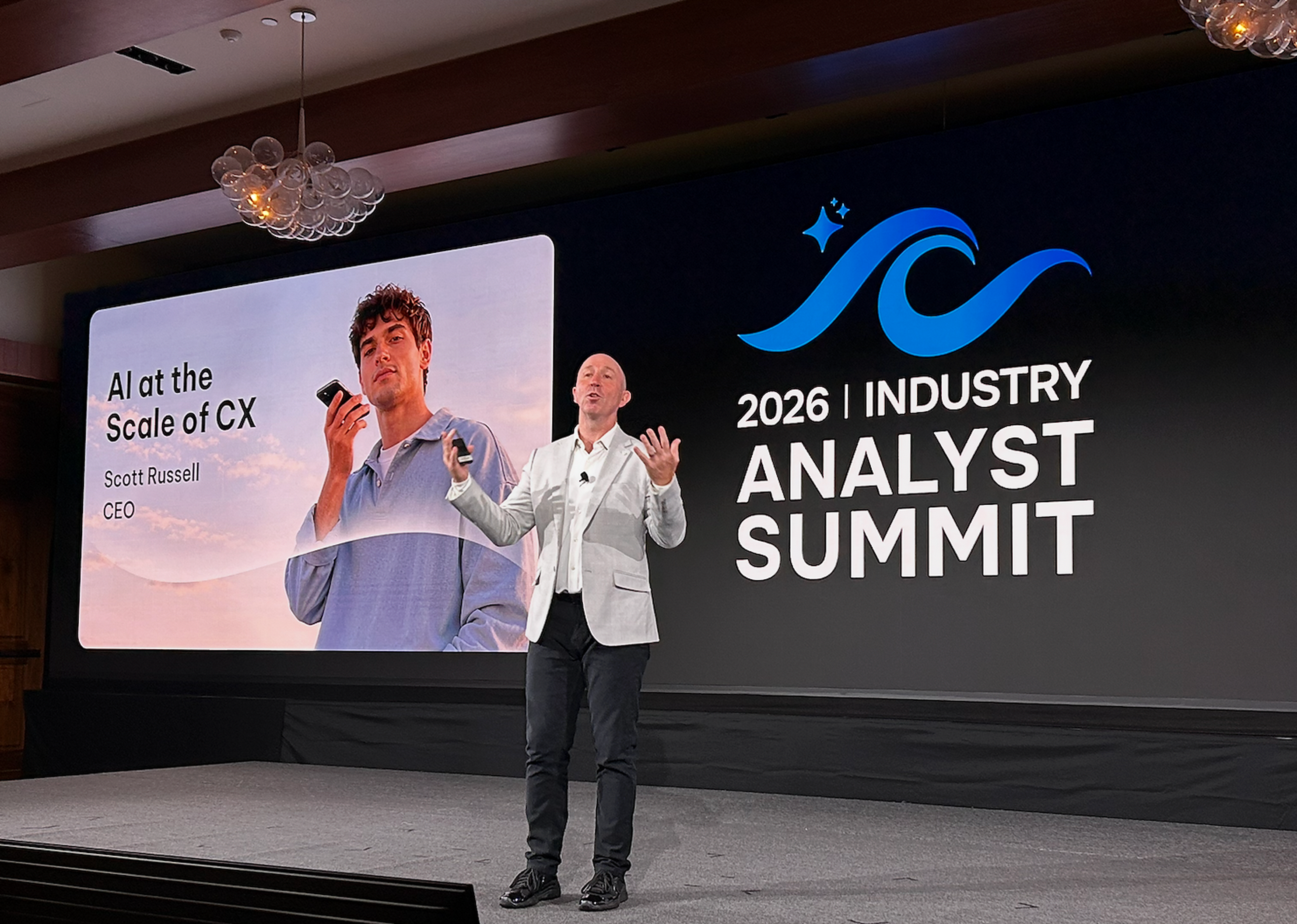
If the 2026 NiCE Analyst Summit in Maui had to be summed up in one word, it would be huliau: the Hawaiian word for a time of change or a pivotal moment. NiCE CEO Scott Russell invoked this concept in his opening keynote, highlighting that changes brought by the agentic era are admittedly uncertain and unknown:
“There is a level of uncertainty that’s in the market about what is to come. I love that uncertainty, because it allows leading organizations to surge ahead and create the path.”
Scott Russell
NiCE’s Cognigy acquisition and AI-first pivot has been more than validated by rapid market adoption and earnings results, including a 52% YoY growth in CX AI ARR and +72% in AI backlog growth.
But while those results are inarguably promising, they’re no longer the key differentiator they once were. In the uncertain Agentic Future, trust and accountability have emerged as market-defining values. Today, technology vendors (and, frankly, technology vendor leadership) are no longer judged by the level of autonomous AI they can provide. Instead, they’re measured by how reliably and safely they can govern those actions at scale.
To that end, 5 key accountability and trust themes emerged from NiCE’s Analyst Summit:
- Consolidating onto a single, open, and AI-first platform eliminates trust leaks
- Real-time governance defines agentic accountability
- Total Resolution, not containment/deflection, measure CX AI success
- Human oversight continuously improves performance
- Personal Agent Protocol builds trust for the A2A era
Why CX AI Trust and Accountability Matter More Than Ever
Although there’s no doubt that enterprises are embracing AI at breakneck speed, neither executives nor employees fully trust its ability to achieve ROI, reduce workloads, and improve productivity just yet.
An October survey of nearly 3,000 executives found nearly 75% of executives say AI ROI fell short of expectations.Just 23% of executives and 37% of customer service agents report complete confidence in AI output accuracy, while over 60% of employees say AI has led to a significant increase in overall workloads.
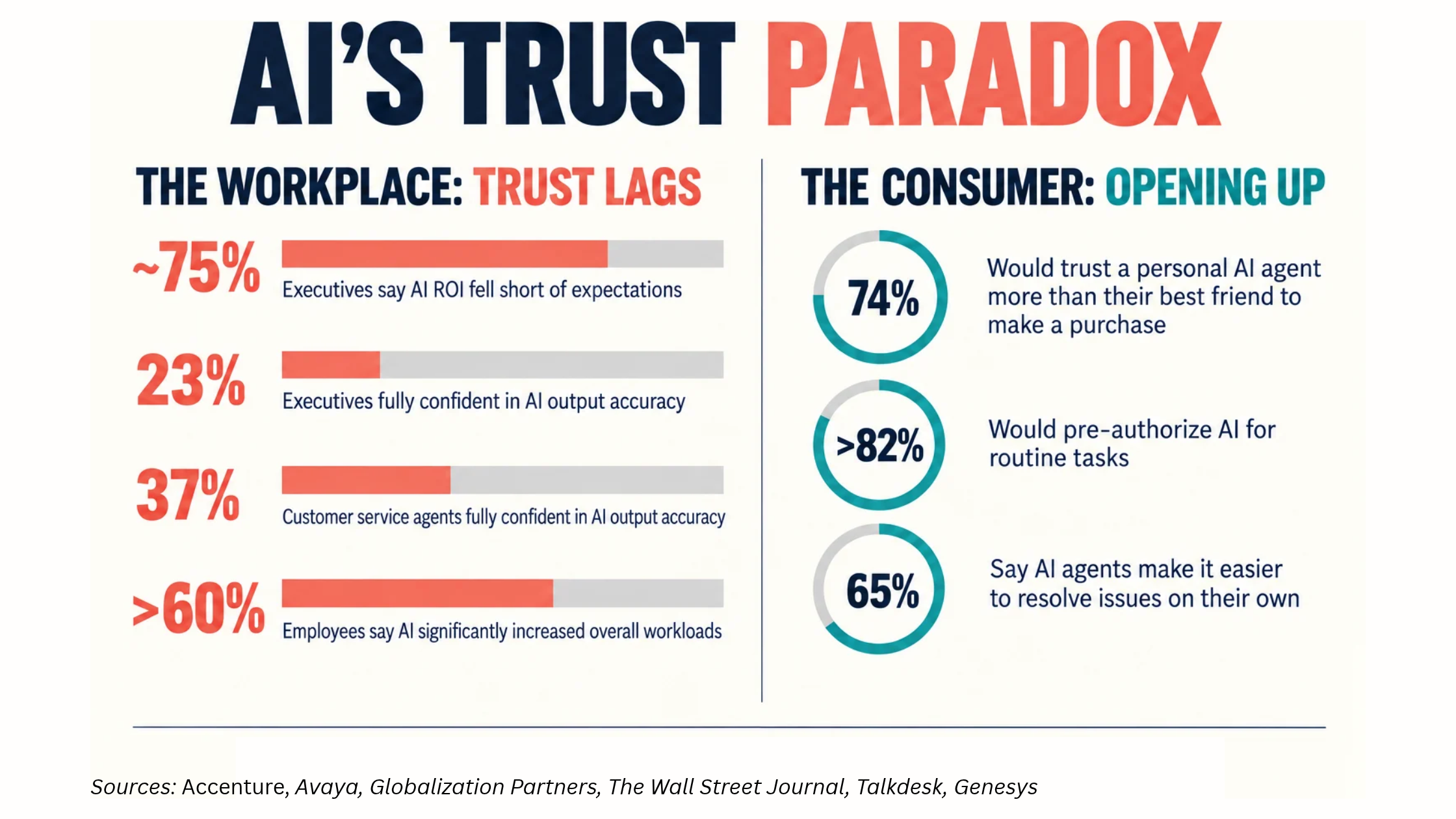
However, as Russell pointed out, consumer trust in AI is on the rise, citing an Accenture survey showing 74% of consumers would trust a personal AI agent more than their best friend to make a purchase. Additional findings back this up: over 82% would pre-authorize AI to execute routine tasks like refund processing, account updates, and appointment changes. 65% of consumers say AI agents have made it easier to resolve issues on their own.
Consolidating Onto an AI-First, Unified, and Open CX Platform Eliminates Trust Leaks
The first meaningful step towards accountability is platform consolidation. For NiCE, the platform to consolidate onto is CXone: an open, unified, and AI-first CX solution that recently celebrated an all-time record quarter for AI bookings.
Per Russell, accountability cannot reasonably come from over a dozen tools and applications that are loosely stitched together. These disconnected environments, and the countless handoffs between them, are rife for security vulnerabilities, data leaks, and disjointed customer experiences.
Instead, accountability and clear ownership of outcomes comes from a single platform that connects people, agents, data, and workflows: all strengthened by shared context and experience memory.
Per NiCE’s David Gustafson and Tim Harris, NiCE CXone AI platform buyers achieve 3.5x higher retention rates and 16 x higher growth rates precisely because unified data architecture delivers safer and reliable automation at scale.
In short, you can’t audit what you can’t orchestrate. True enterprise trust, at scale, requires a single and accountable source of truth.
Agentic Accountability Requires Real-Time Governance
NiCE CEO Scott Russell, CAIO Phil Heltewig, and President of CX Product+TechnologyJeff Comstock addressed this trust gap and provided a promising solution in an Executive Q&A during the Summit: accountability. According to Russell, the biggest roadblock to complete enterprise trust in AI isn’t the technology itself or the quality of AI models. Instead, it’s whether or not enterprises can successfully govern autonomous agents in high-risk environments that carry serious financial, reputational, and regulatory risks.
“No one’s questioning the capabilities of the technology…What really matters is accountability...You can’t script autonomy. You can’t stop an agent thinking, reasoning, and acting…especially if you roll it out at scale. What you really want is accountability in that environment. You have to deliver an environment that provides the benefits of automation, but in an accountable way."
Competing on trusts, per NiCE executives, requires shifting governance to real-time oversight that tracks intent, permissions, actions, and (everyone’s favorite word) outcomes. Successful AI governance and guardrails no longer live in static prompt engineering alone. For NiCE, that governance tool is Guardian AI, which detects risk and monitors human and AI agents actions in real-time.
Complete Resolution Builds Trust, Not Containment and Deflection
In the past, measuring CX AI success was about control and predictability. Key metrics included containment and deflection: whether or not AI agents could keep customers away from human agents. But deflection makes customers feel like enterprises are gatekeeping humans, and containment doesn’t actually reveal if the customer’s problem was fully solved.
Enter the new metric for the autonomous agentic era: resolution.
NiCE’s definition of accountability, the “total resolution standard,” means ensuring that the customer’s issue was completely resolved, regardless of the channels, agents, tools, and timelines required.
This end-to-end resolution ensures customer needs are fully met within permissions and guardrails, then verifies the final outcome. In addition to building trust, this total resolution standard is also an effective argument for outcomes-based pricing.
Human Oversight Rules The Human-AI Workforce
While it’s no secret that AI agents are taking over routine customer interactions at warp speed, NiCE’s vision is about orchestrating humans and AI as a single hybrid workforce.
Under Russell’s concept of “two kinds of workers, one standard,” human and AI agents are managed under identical operational benchmarks. Both must be governed, evaluated, monitored, and continually coached to improve performance outcomes.
When an AI agent meets an edge case, the goal is to provide a smooth, context-rich handoff to a human specialist to prevent customer repetition. Once the human agent resolves the issue, validated findings flow directly back into the AI learning loop, ensuring virtual agents can handle similar interactions in the future.
This is part of NiCE’s approach to QA as an active driver of continuous CX improvement, not a passive post-call auditing process.
Critically, human accountability remains the anchor of the system here. As Jeff Comstock, NiCE President of CX Product+Technology, put it, CXone is “autonomously improving, not autonomous.”
Building Trust in The Agent-to-Agent Era: Personal Agent Protocol
Much of the NiCE Analyst Summit focused on how A2A (Agent-to-Agent) communication will entirely uphold the customer journey.
Brands, argued Russell in his keynote, will no longer own the customer journey: personal AI agents will.
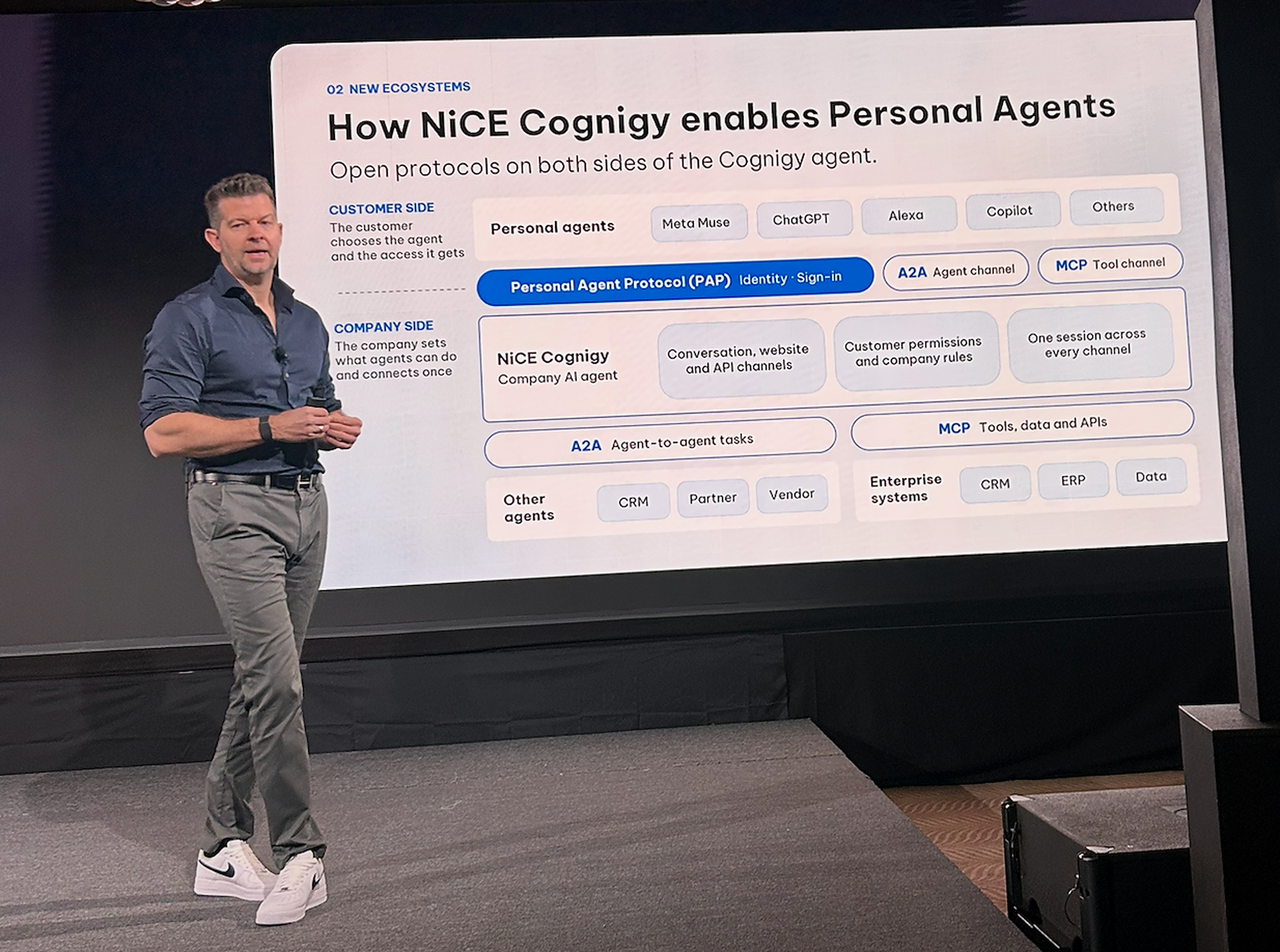
Heltewig urged enterprises to start preparing for a future where personal AI agents are the primary inbound customer channel. NiCE already has, joining up with Meta, Genesys, Sierra, Shopify, Stripe, and others to create the Personal Agent Protocol: an open standard for how personal agents connect to businesses and their AI agents. These protocols ensure that when personal AI agents act on a human customer’s behalf, the receiving enterprises can verify intent, enforce real-time guardrails, and offer traceability.
In this age of CX AI uncertainty, the simplest truth is that enterprises will trust the vendors confident enough to jump into co-founding personal agent standards much more than those that wait for others to dictate them. By getting in on the ground floor of A2A protocol, NiCE establishes immediate credibility as an architect of the agentic economy, not merely an observer of it.
NiCE Bets The Agentic Future On Accountability
In this moment of CX AI huliau, NiCE is betting that autonomy and technology alone aren’t strong enough differentiators.
Instead, enterprises are looking for vendors that can prove autonomy is governed, verified, and accountable at scale, and across every step.
Unified platforms, real-time oversight, resolution-focused metrics, and human-in-the-loop learning, and open A2A standards all highlight the new reality: trust, note technology, is now the product.
Sources: Globalization Partners 2026 AI at Work Report, Accenture Talk to My AI Agent Report, The Wall Street Journal "Why AI is Leaving Many Employees More Overworked and Less Productive", Talkdesk The State of Agentic Automation in CX, Genesys 2026 State of Customer Experience Report, Avaya Customer Experience on Their Terms Report