December 2, 2025 • 18 min read
CX Trends Reshaping the Contact Center: Insights from Five9's CRO Matt Tuckness

CX Analyst & Thought Leader
December 2, 2025
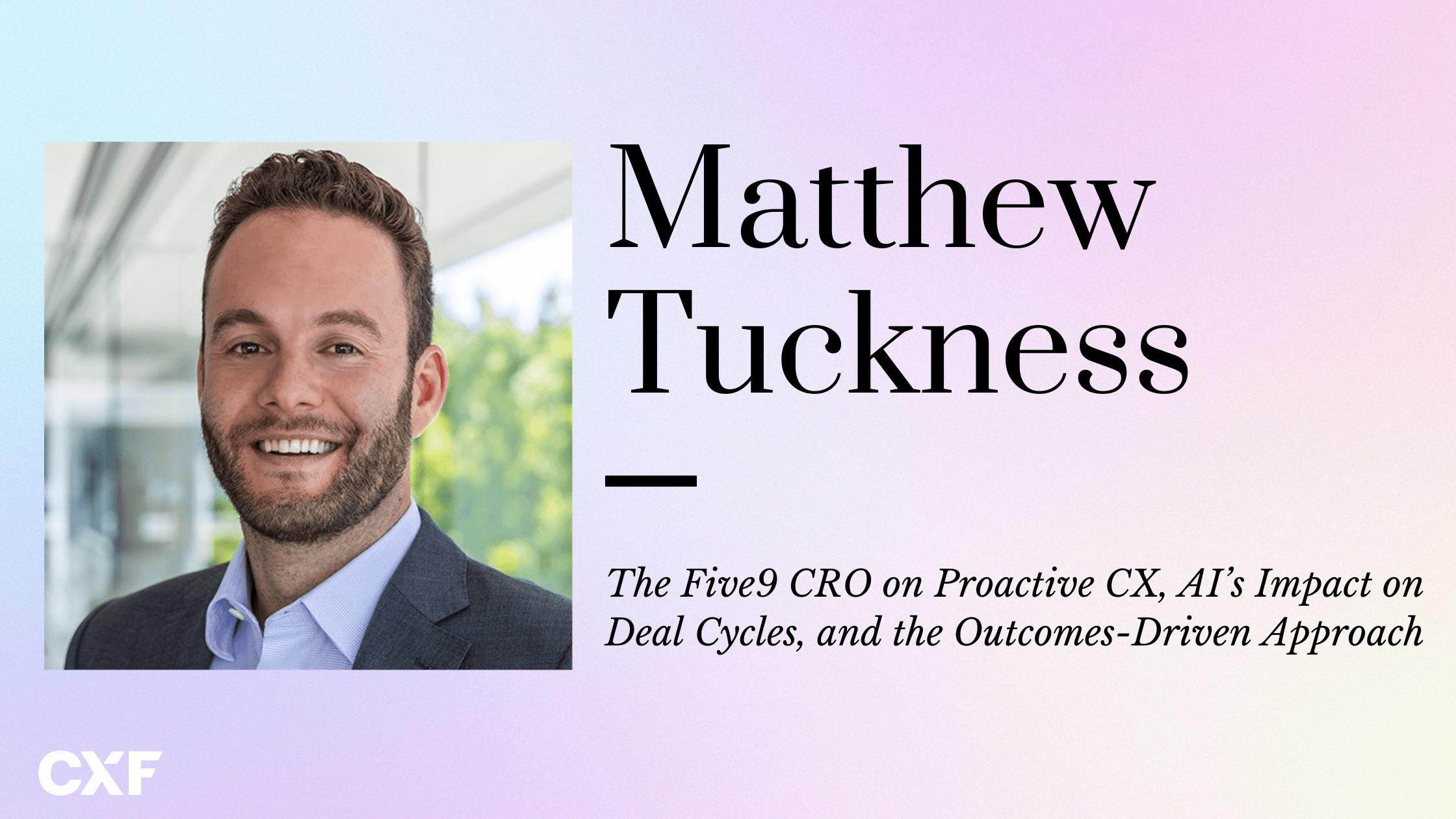
At Five9's CX Summit 2025 in Nashville, I sat down with Five9 Chief Revenue Officer Matt Tuckness, who offered a remarkably candid look at how artificial intelligence is fundamentally transforming the contact center landscape. But beyond the expected discussion of AI capabilities, Tuckness revealed five critical customer experience trends that signal a major shift in how organizations approach customer service--and how technology vendors must evolve to remain relevant. Below are highlights from the interview, followed by the complete interview transcript. The transcript has been edited for length and clarity.
The Five CX Trends Defining Five9's New Era
My interview with Matt revealed the 5 new CX trends influencing Five9's concept of #TheNewCX:
- Proactive Prevention Over Reactive Firefighting: Customers now expect partners to prevent problems before they occur, not just solve them quickly
- Real-Time Interaction Optimization: Every customer interaction must be dynamically optimized with real-time agent performance data
- Outcomes-Driven Investment: Technology decisions are anchored to measurable business results like CSAT and containment, not feature checklists
- C-Suite Strategic Ownership: CEO involvement in CX deals has jumped from under 10% to one-third, elevating AI to a board-level priority
- Trusted Technology Curator: Organizations need established technology partners to vet and integrate tools from the CX an AI startups flooding the market
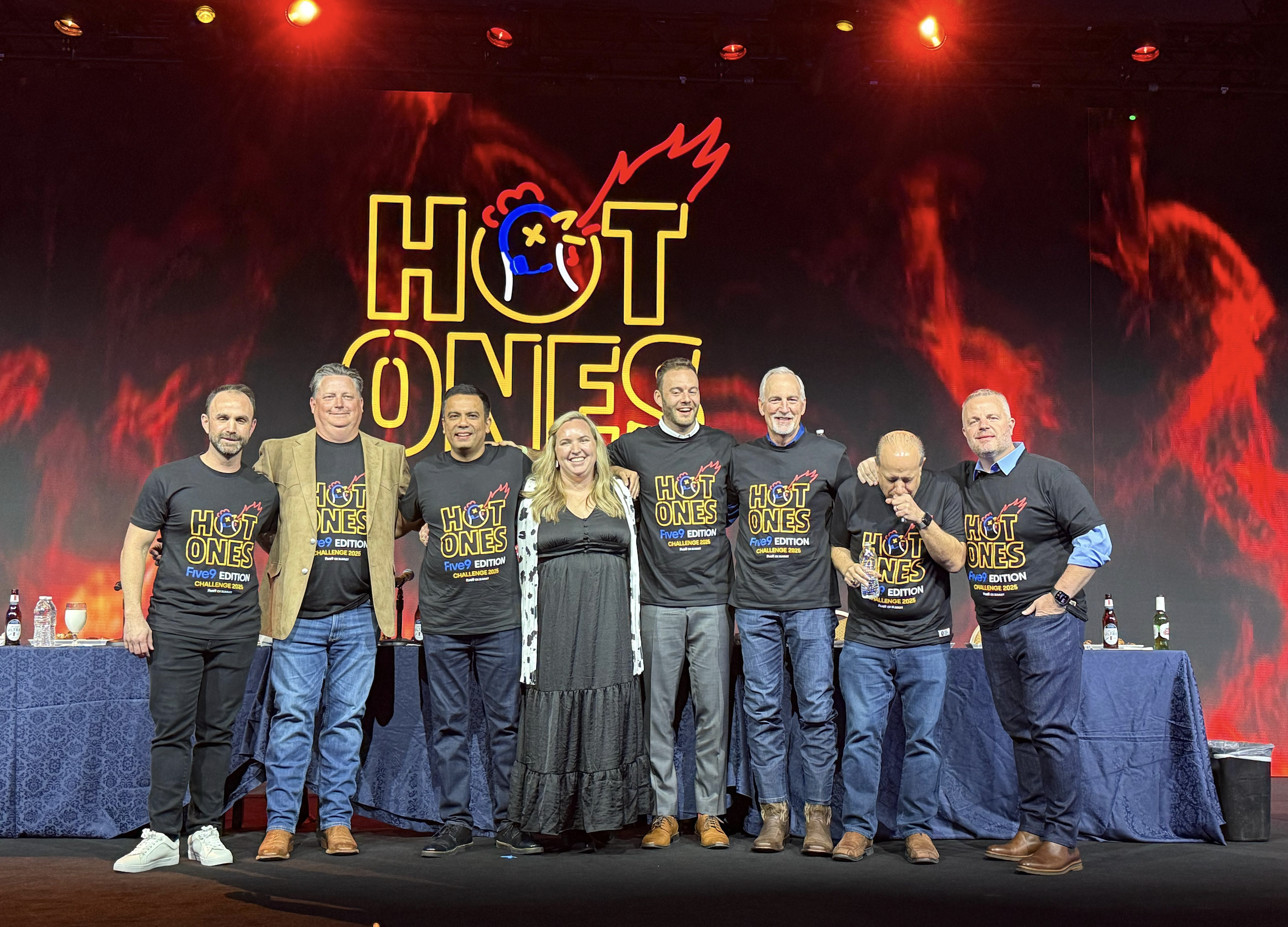
Tuckness, center, was also declared the winner of the Hot Ones spicy wing eating contest.
1. From Firefighting to Fire Prevention: The Proactive CX Mandate
Perhaps the most striking shift Tuckness identified is the evolution from reactive problem-solving to proactive partnership. "At Five9, we have been some of the best firefighters in the world," Tuckness acknowledged. "When a customer calls us, we will show up in force, we will be there quickly, we will get the problem solved fast."
But that's no longer sufficient. Today's customers expect their technology partners to prevent problems before they occur. This fundamental change requires a complete reimagining of staffing models and resource allocation. Proactive engagement means thinking about the customer's business when they don't have time to--requiring an intimate understanding of their operations and the ability to deliver corrective recommendations before issues surface.
Tuckness put it bluntly: "I just assume they're talking to one of our competitors every day, and that we just have to continue to win their business every day." This mindset reflects the new reality where loyalty must be earned continuously through demonstrated value, not just promised in a contract.
2. Real-Time, Personalized Interaction Optimization
The second trend represents a technical revolution in how contact centers operate. CX success is increasingly defined by the ability to optimize every single interaction using real-time data from unified systems, moving decisively beyond static, rules-based systems.
This trend is embodied in Five9's approach to combining Agentic Quality Management (AQM) with Genius AI Routing. AQM automatically monitors and evaluates up to 100% of customer interactions, scoring agents and conducting sentiment analysis to create constantly updated agent rankings. This real-time data then feeds directly into Genius AI Routing, which dynamically connects each customer to the most suitable agent at that precise moment.
"Every call that comes in is connected to the best agent in real time, based on real-time agent rankings," Tuckness explained. The system considers granular attributes like empathy levels and specific certifications, with agent profiles continuously updated based on actual performance data. This ensures customers receive the most proficient and suitable assistance immediately, dramatically improving first-contact resolution and customer sentiment.
3. Investment Driven by Outcomes, Not Features
The third trend marks a shift in how technology decisions are made and justified. The conversation has moved decisively away from functional specifications--fancy "wow factor" features--toward measurable business results.
"Most sales organizations in the enterprise SaaS space are used to selling feature function," Tuckness observed. "When feature functions are rapidly evolving and changing, it's very hard to keep up." Five9's response has been to anchor discussions around desired outcomes and key results: "What are you trying to accomplish, and what are those key results you're trying to drive?"
This outcome-focused approach means successful CX implementations are now measured by objectives like driving greater containment rates, achieving improved CSAT scores, or boosting top-line revenue. The specific technology used to achieve these outcomes--whether AI-powered or traditional--becomes secondary to the goal itself. This shift provides the flexibility customers need to adjust to the rapid pace of technological change without being locked into specific feature sets.
4. Executive-Level Ownership of CX and AI Strategy
The fourth trend reflects the strategic elevation of customer experience within organizations. Decisions related to core CX technology, particularly AI, are no longer confined to contact center management but are escalating to the C-suite.
Tuckness revealed a striking statistic: CEO involvement in enterprise-grade deals has jumped from less than 10% to about one-third in just the last quarter. This dramatic increase indicates that AI and customer experience investments are being treated as strategic, top-down initiatives that fundamentally impact the business, rather than merely operational expenditures.
This elevation changes everything about the sales process. "We need to be better at driving the executive relationships across the board," Tuckness emphasized. It also explains why Five9's approach focuses on business outcomes that resonate at the executive level, not just operational efficiency metrics that matter primarily to contact center managers.
5. The Trusted Technology Curator in a Chaotic Market
The fifth trend addresses a critical pain point: the overwhelming proliferation of AI vendors has created a confusing landscape where customers struggle to make informed decisions. With potentially 400+ AI and CX startups in the broader market, organizations face genuine uncertainty about which solutions to choose.
"A partner like Five9 is a knowledge expert in the space," Tuckness explained. "Our customers trust in us to bring them the best in the market." This curator role involves performing extensive due diligence--Five9 evaluated over 20 platforms before narrowing their AI partnership focus to just two companies: Cresta for enterprise-grade deployments and Level for more nimble implementations.
This trusted advisor position requires maintaining an open platform approach while carefully vetting third-party tools to ensure compatibility and reliability. Customers increasingly want to offload the burden of research and vendor management to a stable platform provider they can trust to keep their CX technology stack current and future-proof.
Where Five9 Is Going Next
Beyond these broader trends, Tuckness shared several specific insights about Five9's strategy and market positioning:
AI Product Prioritization: When forced to choose, Tuckness identified AQM as providing the fastest ROI due to its ability to automatically evaluate 100% of interactions. He views Genius AI Routing as having the most significant long-term impact because it creates a continuously improving system. OneVUE, while valuable, could potentially be replicated through partnerships with BI tools.
Contract Evolution: Contrary to expectations, Five9 isn't seeing pressure to reduce contract lengths. Instead, major Fortune 100 organizations are signing 5 plus-year agreements structured around revenue commitments rather than seat counts. These contracts anticipate a 15% decline in agent populations over three to five years, coupled with increased AI capability adoption.
Focused Partner Ecosystem: Rather than expanding their partner network, Five9 is doubling down on key relationships. "It's not about the number, it's about the focus and execution," Tuckness emphasized, noting the goal is to double the business existing partners do rather than continuously adding new ones.
Deal Loss Analysis: Using a third-party research firm to analyze lost deals, Five9 identified that poor qualification (pursuing bad-fit opportunities) is the most common failure mode, followed by insufficient executive relationship development and simple execution failures like missed meetings.
Legacy of Authenticity: On a personal note, Tuckness shared that his goal is to create an authentic environment where people can grow as individuals, not just employees. Having started as an intern 13 years ago, he wants Five9 to be remembered as a place where people felt heard, supported, and empowered to find their own voice.
What Differentiates Five9 From Competitors
Throughout the conversation, several key differentiators emerged. Five9's platform flexibility allows customers to choose their entry point--whether starting with CCaaS, AI capabilities, or specific use cases. The synergy between AQM and Genius Routing creates a self-improving system that continuously optimizes performance. Their open ecosystem approach, combined with rigorous partner vetting, positions them as a trusted curator in a chaotic market.
Most fundamentally, Five9's shift from feature-focused to outcome-focused partnerships provides the adaptability customers need in an era where, as Tuckness put it, "the long-term or five-year plan for contact centers is dead because of the current pace of technology."
In a market experiencing unprecedented change, these insights suggest that success belongs to vendors who can combine technological innovation with genuine partnership, proactive engagement, and an unwavering focus on measurable business outcomes. The question isn't whether AI will transform customer experience—it's whether vendors can transform themselves fast enough to guide their customers through the revolution.
Full Transcript, Interview with Matt Tuckness, Chief Revenue Officer at Five9
Conducted at Five9 CX Summit 2025, Nashville
Katherine: You've announced several major AI-powered capabilities at once: Agentic Quality Management (AQM), Genius Routing, and OneVUE. If you had to kill one of these tomorrow, which would it be, which one provides the fastest ROI, and which one has the biggest impact on CX over time?
Matt: I would probably kill OneVUE. I would accelerate AQM, because I think there's the most immediate value there. Genius routing has the most long-term impact.
Killing one of these is a hard choice, and I think the OneVUE visibility layer is wonderful. But you can obviously partner that with a lot of BI tools to get to the outcome you need.
AQM scores agents, includes sentiment analysis, and has real-time agent rankings that plug into Genius Routing. I'm always the most excited about that. Every call that comes in is connected to the best agent in real time, based on real-time agent rankings.
Evolving Deal Cycles in the AI Era
Katherine: Obviously, AI is changing deal cycles. Sometimes it makes them way longer, sometimes it makes them way shorter. Are customers signing with Five9 faster because they feel pressured to adopt AI? Or, is it an "analysis paralysis" issue where deals take longer to close because potential customers are also talking to 45 other vendors?
Matt: It feels like the early days of cloud, a lot of "land and expand." Now, we're in a world of small, focused, and pilot-based use cases. So, the larger opportunity takes longer, and you have to prove out the use case to capture the entire potential.
The immediacy of the need is greater than it's ever been. We're seeing a few months to make a decision on a pilot--maybe even sooner, sometimes weeks. Larger deals take anywhere from six to nine months to close.
The beauty of our platform is that you can choose where you want to start. Do you want to start with CCaaS? Do you want to start with AI? Which AI solutions do you want to start with? Everybody has the flexibility to determine what's the best place of entry.
The Future of Multi-Year Contracts
Katherine: Multi-year contracts used to be the gold standard. Now that technology is evolving so rapidly, is there a part of your customer base that's worried about signing a multi-year contract for a platform they fear may become obsolete--or that may not evolve as quickly as competitors? Are you seeing that kind of pressure to reduce the length of your contracts, and how does that impact revenue predictability?
Matt: Today, we're not seeing the pressure to reduce contract length. We had 2-3 Fortune 100 organizations, including a healthcare organization and an airline, that all extended for 5+ years.
What they're doing, though, is building flexibility into their renewals. They're moving away from traditional seat commitments into revenue commitments, and those revenue commitments have a different mix of solutions. They're planning for a natural decline of their agent population--around 15% is the average we're seeing--over the next 3-5 years. They're also planning for an increase of AI capabilities.
They're still planning on growing revenue with us, but their product mix and solution will look very different 5 years from now.
Transforming Sales: From Features to Outcomes
Katherine: Let's switch gears a little bit and talk about things from a sales perspective. Your sales team trained on how to sell your traditional contact center features: IVR, ACD, rules-based call routing, etc. How has Five9 evolved sales training to account for AI-powered features like agent assist and AQM?
Matt: I think you just have to take a step back. Most sales organizations in the enterprise SaaS space are used to selling feature function. When feature functions are rapidly evolving and changing, it's very hard to keep up. From a product perspective, it's very hard to know that what you promised six months ago is the same thing that you're going to deliver six months later.
So at Five9, we say, "Let's go back to the heart of what we care most about, what our customers care most about, and what their outcomes are." The solution underneath that might evolve, but the anchor is: "What are you trying to accomplish, and what are those key results you're trying to drive?"
We elevate our sellers to have that discussion, instead of, "Hey, you want an ACD, you want an IVR? I got the best in the market." A big part of my responsibility is helping our sales organization have an outcomes-focused conversation instead of a feature-focused conversation.
Katherine: So, Five9 has the flexibility to adjust alongside client expectations?
Matt: Yes. The long-term or five-year plan for contact centers is dead because of the current pace of technology—it's changing so fast.
You heard from a lot of our customers here that one of Five9's biggest differentiators is the partnership. Our customers know we care about understanding where they're trying to go, and they know we're going to work together to get there. A partner like Five9 is a knowledge expert in the space. Our customers trust in us to bring them the best in the market. The baseline is trust--it has to be.
Building Strategic Partnerships
Katherine: I went to Cresta WAVE last week in Dallas. Five9 and Cresta have a strong partnership--how did that partnership come about? What made you choose Cresta over their competitors?
Matt: We probably evaluated 20+ platforms with capabilities similar to Cresta's. We looked at feature functionality, products currently on the market, how well their culture aligned with Five9 and our customers, and their ability to actually deliver.
We had six partners in our ecosystem, now we've whittled it down to two: Cresta and Level. Cresta is our market enterprise-grade play. Level is more nimble. Cresta has the more mature ecosystem and products.
Katherine: Channel partners or direct sales: which one has the best outcomes? Channel partners add complexity, but they're essential—especially for the mid-market. If you had to pick, would you have more partners or fewer partners?
Matt: Our partner ecosystem is critical—we won't succeed without it. I'm a big believer in focusing on the key partners that are going to make the biggest impact.
As Five9 has grown, we've gone broad with a very wide partner ecosystem. If we're going to talk channel partners specifically, I think we need to be very focused on who are the right resellers to work with. We need to double down on enabling them, empowering them, and supporting them. Specifically, we want to double the business that they're doing with us today.
Direct will always play a role, but our channel ecosystem is the best path to continuing to drive a lot of the transformation we believe we can do. So, do we need more partners? My short answer is no. Could we be more focused with partners we currently have and help them deliver more? 100%. So it's not about the number, it's about the focus and execution.
Understanding Why Deals Are Lost
Katherine: When you lose a deal, what do you think is the actual reason? Is there a marked difference between what your customers are telling you and what sales reps or partners are telling you?
Matt: Every deal is its own thing. We actually hired Closed, a third-party research firm that calls our lost customers or lost deals to get their unfiltered take. We compare that against our rep feedback. One of the issues we see consistently is that potential customers don't have the budget—they couldn't get buy-in from external or internal stakeholders. The board didn't approve.
The top three reasons why we lose?
First: We should have never been in the deal in the first place. It was just a bad fit. We just missed our initial qualification. That happens the most often.
Second: Our sales team never got the right executive relationships. Last quarter for enterprise-grade deals, CEOs are involved in a third of the conversations. It used to be less than 10%. CEOs didn't care. We need to be better at driving the executive relationships across the board.
Third: We just didn't show up. We forgot an email, we missed a meeting.
Managing POCs and Qualification
Katherine: Customers today want 60-day trials with full implementations before they'll commit. How do you manage Proof of Concepts that suck up engineering resources, tank deal velocity, and may or may not even come to fruition?
Matt: This is why qualification is the most important thing—you can't pilot for everybody. The truth is, any time you're early in a market, the new entrants are so desperate to buy in that they're happy to sign up for anything, with anyone, at any time. If I was in their shoes, I'd do the same thing.
As a more established player, we have to be more thoughtful about where we choose to play. We can't waste our sales cycles and time trying to prove it out to organizations who don't have full commitment.
So there's a few things that we try to do in the qualification, like assess data architecture, AI-readiness, etc. If you're not ready for AI, then we shouldn't even talk about a pilot—we have to have a whole different infrastructure conversation. There are organizations that are more ready to jump all in. Reference-based selling and customer-based selling also goes a long, long way.
Protecting Top Accounts
Katherine: Your largest customers are probably your most at-risk customers: they have the leverage, the budgets, and the attention from your competitors. What's your survival strategy for protecting your top 20 accounts?
Matt: We need to bring the right level of proactive partnership to these top 10-20 customers. At Five9, we have been some of the best firefighters in the world. When a customer calls us, we will show up in force, we will be there quickly, we will get the problem solved fast.
But now, our customers have different expectations. They want to see us prevent the problem from ever happening, to get ahead of it. So we have to bring the right resources, because firefighting requires an on-demand team that's ready to respond.
Proactive engagement requires thinking about the customer when they don't have the time to. We have to have the right resourcing and staffing model to do that, plus an intimate understanding of our customers' businesses. We're challenging our teams to have the right alignment on core customer objectives and outcomes, build the staffing structure around them, and bring those corrective recommendations to the table.
I just assume they're talking to one of our competitors every day, and that we just have to continue to win their business every day.
Legacy and Leadership
Katherine: Final question—what legacy do you want to leave at Five9?
Matt: I started as an intern at Five9 almost 13 years ago. About three years ago, I quit Five9 to take some time off. It was a wonderful experience. Before I left, I was very in it for myself. I was young, I was driven, I was focused on growing my career.
As I took 14 months away, I had a lot of time to reflect on what I wanted for my life, and what life was about for me. What I realized is the personal relationships, the connections with people, matter the most in this life. Five9, I've been here over a third of my life. These people are not just my coworkers and colleagues—they're my close friends. Those relationships, to me, are incredibly important.
The legacy that I want to leave is an understanding of how to create an environment that's authentic, that allows people to find their own voice, and to grow as individuals. How can work be a part of your personal growth? How can you work with a group of people who support you, who help you push yourself, who are truly in your corner, and who want you to grow?
If I walk away and people feel like Five9 was not only a great place to work, but that it was a place where people felt heard, where people wanted me to be the best I could be, where people were there for me—if they could say that, I would feel like I did my job.