
August 18, 2026 • 8 min read
APAC Frost Radar for Customer Experience Management Services 2026: Top Takeaways

Director of Content & Market Research
August 18, 2026
As AI agents become more capable and deployments spread, the customer experience management (CXM) services industry is destined to shrink… or is it?
The 2026 Frost Radar: CXM Services for Asia-Pacific (APAC) estimates that the APAC market alone will reach $52.57 billion by 2030. That’s up from $41.91 billion in 2024, with a compound annual growth rate of 3.8%.
The industry leaders driving that growth aren’t simply following the traditional offshoring model for customer support. Instead, they’re fundamentally rethinking the services they offer.
In doing so, they’re moving beyond Level 1 and Level 2 support to better understand customers: who they are, what they need, and how organizations can serve them better across the customer lifecycle.
Some providers are lagging as this trend takes hold. But those that get it right have an opportunity to evolve their propositions and deliver significantly greater value.
To explore this shift, CX Foundation caught up with Krishna Baidya, VP of Information & Communications Technology at Frost & Sullivan, to learn more about what the APAC market leaders are doing right and unpack the key takeaways from the Frost Radar report.
Why Focus on CXM Service Providers APAC Specifically?
APAC is a complex region, with diverse languages, compliance requirements, and dense coverage of outsourced contact center operations, dynamics that a global study may obscure.
As such, it warrants a separate evaluation serving both offshore and APAC-based buyers.
For offshore buyers, the focus is on APAC delivery capabilities, cost efficiency, and proven regional performance. For APAC-based buyers, the evaluation considers a provider’s local investment, market presence, and ability to serve growing regional customers, not just its global track record.
A standalone APAC study can also surface local “hidden gems” that may be overlooked in global rankings, per Baidya.
That said, Frost & Sullivan’s evaluation still places many well-established global providers at the top…
Frost & Sullivan’s CXM Services Visionary Leaders for APAC
In 2026, Frost & Sullivan named ten companies as “visionary leaders” in CXM services for APAC: Teleperformance, Concentrix, TaskUs, Genpact, Alorica, InfosysBPM, TTEC, Tech Mahindra, transcosmos, and Sutherland.
The research firm also evaluated other providers, ranking them as either “innovators” or “contenders,” as shown in the graphic below.
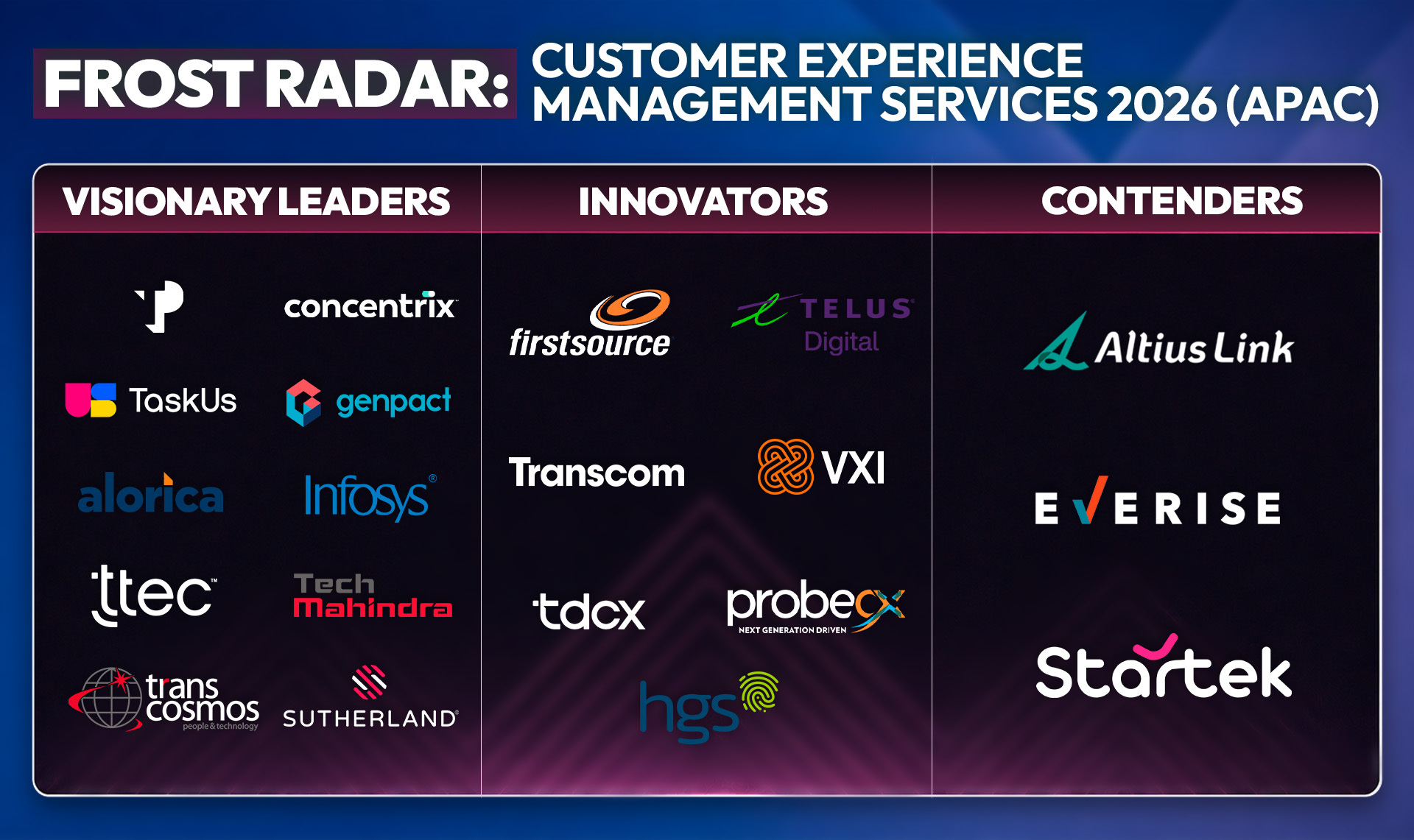
While similar Frost & Sullivan reports have included a “growth champions” category, no providers qualified for that designation in this study.
Frost & Sullivan assessed providers using two measures: a Growth Index and Innovation Index.
The Growth Index considers:
- Market share
- Revenue growth
- Growth pipelines
- Vision and strategy
- Sales and marketing
The Innovation Index considers:
- Innovation scalability
- Research and development
- Product portfolio
- Megatrends leverage
- Customer alignment
The leaders scored above average across both indexes.
Beyond the rankings, however, the report highlights how the “visionary leaders” are adapting as AI disrupts the space, and where new growth opportunities are emerging across the industry.
6 Top Takeaways from the Frost Radar for CXM Services 2026
With Baidya’s support, here’s an analysis of the report’s key takeaways for CXM service providers and buyers, both offshore and APAC-specific.
1. Commercial Models for CXM Services Evolve
CXM service providers recognize the need to become more consultative partners and move up the value chain. Yet, lingering “BPO” connotations leave some questioning whether they can deliver truly bespoke support rather than generic solutions.
To prove their merits, some now champion outcome-based pricing as an alternative to traditional capacity-based economics.
Firstsource is a strong example. Through its “UnBPO” framework, it ties pricing to outcomes such as cost per digital interaction and cost per voice minute. This ensures that fees aren’t based on headcount alone but on AI adoption and customer service enhancements that move the needle.
“I think that's an approach that increasingly almost everyone else is going to take,” added Baidya. “Already, operations that connect AI deployment to verifiable client metrics are winning consolidated global program awards over pure cost competitors.”
2. Partner Ecosystems Become Much More Than a Marketing Tool
CXM services providers are known for making grand announcements about partnerships with CCaaS, CRM, and conversational AI leaders.
But these partnerships need to be more than a marketing spiel. Providers must demonstrate genuine global delivery capabilities. Those that do can unlock their “most powerful competitive differentiator,” according to Baidya.
Those that fail to do so risk dropping off shortlists as CXM services mandates increasingly come directly from the C-suite, which is more invested in connecting the enterprise ecosystem. Providers therefore need to find ways to become more relevant in those conversations.
“We're seeing providers partner with strategy and management consulting firms to open those conversations, because sometimes they don't necessarily have that access themselves.”

“We're also starting to see some of the bigger organizations create separate entities just to focus on the technology side,” continued Baidya. “It’s increasingly likely we’ll see these types of strategies come in to maintain differentiation.”
3. Industry-Specific Offerings Grow in Maturity
On the topic of differentiation, it often comes down to a CXM provider’s ability to build credibility in specific industries. This means developing domain-specific models, workflow libraries, and integrations, customized to the needs of organizations in each sector.
Frost & Sullivan sees this trend gaining momentum. Its report notes: “Providers with proprietary vertical assets in healthcare, BFSI (Banking, Financial Services, and Insurance), and eCommerce hold advantages that horizontal platform investments and hyperscaler partnerships cannot replicate.”
Industry-focused strategies also enable providers to establish “defensible competitive positions in APAC enterprise procurement,” per the report.
4. Changing Global Regulations Create Challenges & Opportunities
In the APAC market, CXM service providers face a growing range of compliance requirements.
India’s DPDP Act, Australia’s Privacy Act reforms, Japan’s amended PIPA regulations… The list goes on. Then there are the standards expected by organizations offshoring to APAC, including GDPR, HIPAA, and SOC 2.
Keeping pace with these evolving requirements can be challenging. But, as Baidya highlights, it also presents an opportunity.
By embedding regulatory compliance into AI infrastructure and engagements from the outset, brands can make “compliance by design” a real differentiator, especially against rivals applying different governance standards onshore versus offshore.
Establishing these stronger capabilities around compliance, data residency, model explainability, and escalation protocols, CXM service providers can move further up the value chain, positioning themselves as trusted advisors not only on global compliance, but also on AI governance.
Alongside this, some visionary leaders are reskilling their workforces for AI orchestration and oversight roles, an investment Frost & Sullivan deems “crucial” for the region today.
5. The Immediate Threat to Outsourced Voice Services Subsides
Alongside the Radar report, Frost & Sullivan conducted an Enterprise Buyers survey. It found that, despite the rise of customer-facing AI in contact centers, voice call volumes have increased across the industry. “The duration of those calls was also increasing,” noted Baidya.
Interestingly, this reflects recent findings from CRM giant Zendesk. It found that as organizations automated more customer support contacts, overall contact volumes spiked. As a result, service reps were handling more calls, not less, as the graph below showcases.
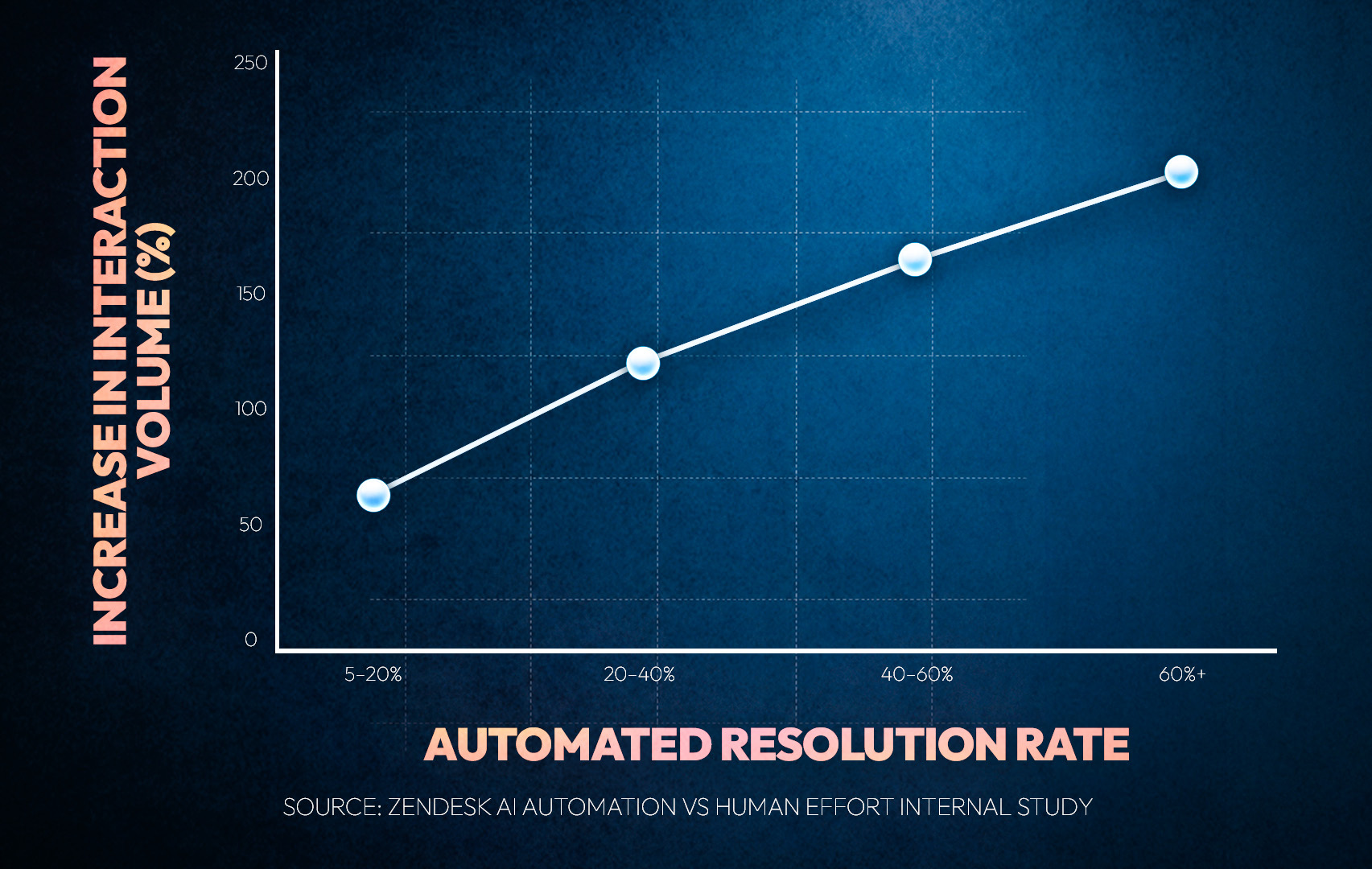
Zendesk CTO Adrian McDermott cited Jevon’s paradox when investigating the trend. The principle states that as technological processes become more efficient, use increases, rather than decreases.
In other words, as AI-led customer support experiences improve, customers may be more likely to contact organizations about issues they previously would have let slide.
If this trend takes hold, providers may have less to fear about their core outsourcing business disappearing at the pace some headlines suggest.
However, they will need to ensure clients measure value through experience-focused metrics, not through contact volume reduction.
Again, this is why an outcome-focused commercial model, not only purely driven on headcount, increasingly makes sense in this space.
6. Voice Transformation Technologies Are In High Demand
Alongside voice automation, providers of CXM services are increasingly implementing other forms of voice AI, including accent modification, offered by vendors such as Krisp and Sanas.
These technology vendors often target the APAC market, with demos of how their technology “neutralizes” a speaker’s accent across various countries. Below is an example of the software transforming a Filipino speaker’s accent.
In 2025, providers from Teleperformance to Everise touted their use of this somewhat controversial technology, highlighting improved first contact resolution (FCR) rates by reducing misunderstandings, alongside gains in employee experience measures.
Yet, given the rapid growth of these technologies, this is no longer a differentiator. The real point of interest is: what comes next?
Interestingly, these same companies are now rolling out real-time translation tools. Baidya notes that he has yet to see the technology deployed at scale, but believes it could be a “big deal” for the APAC market, and it could well give early adopters a short-term edge.
While this article has covered several overarching trends hitting the CXM services market, Frost & Sullivan unpacks the differentiation of specific vendors in its complete Radar report. A copy of the study is available here.