March 20, 2026 • 12 min read
10 CRM Trends to Watch Out for in 2026

Director of Content & Market Research
March 20, 2026
The CRM market is changing as pricing models evolve, AI agents enter the chat, and lines blur with other enterprise technologies.
Some brands are even experimenting with building their own CRM systems through vibe coding (more on this later!).
Nevertheless, despite an accelerating innovation cycle, familiar problems persist in terms of data quality, integration, and cross-team collaboration.
On that note, here are ten CRM trends that provide an overview of where the market is today and where it is heading.
1. The Same Providers Continue to Dominate the CRM Market
A 2026 study from The Futurum Group highlights Salesforce as the market leader, with $24.5 billion in annual recurring revenue (ARR) for CRM.
That’s over three times more than its closest competitor, Microsoft, which pulls in $8 billion through Dynamics 365. Oracle, Adobe, and SAP then follow, as shown in the chart below.
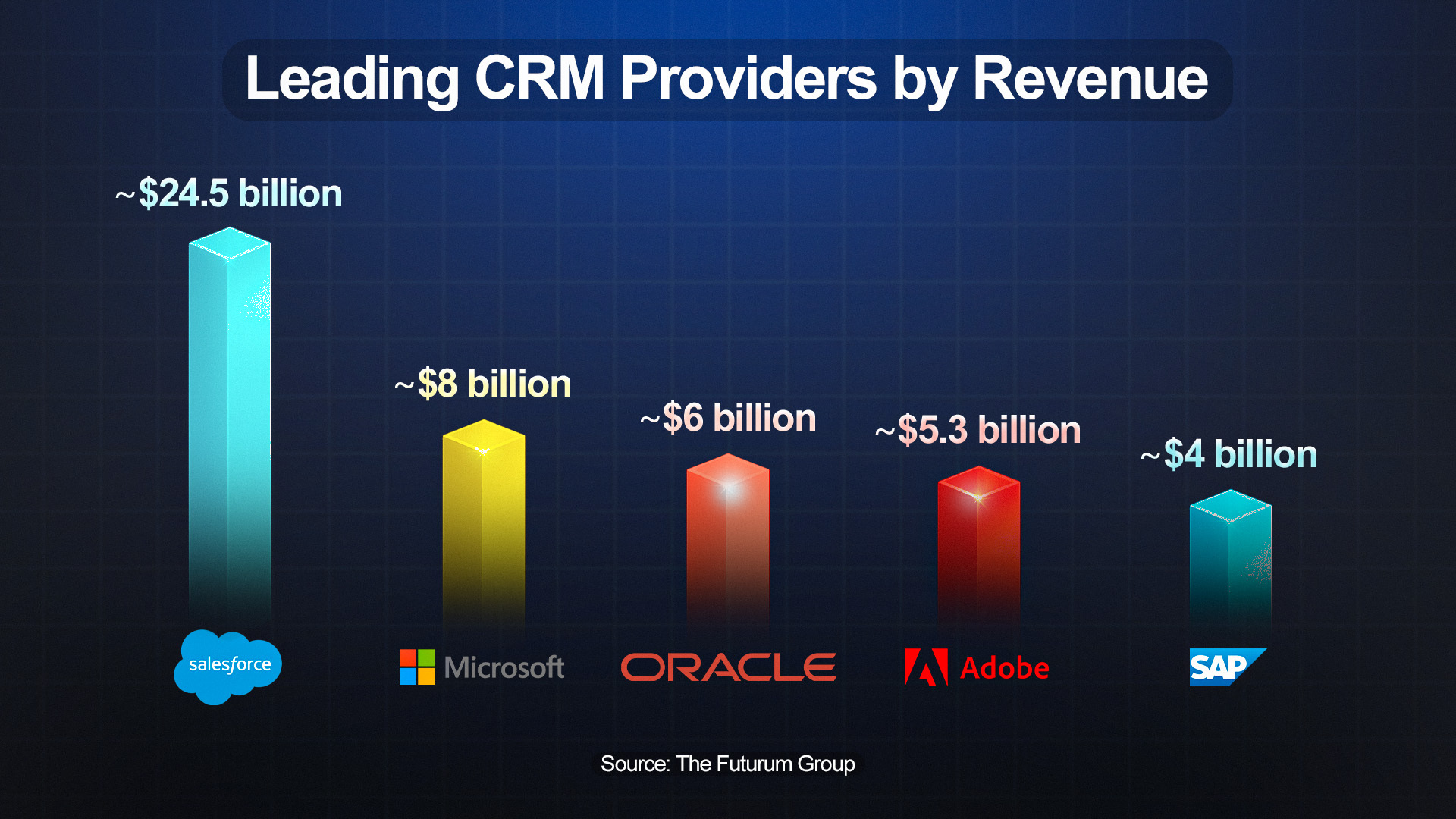
The results underscore a lack of movement in the market. Indeed, IDC data from 2020 also highlights these five vendors as the CRM revenue leaders.
That said, CRM providers like HubSpot and Zoho are now more widely deployed than the vendors mentioned above, aside from Salesforce. However, their presence is largely concentrated in the midmarket, where deal sizes are smaller.
Meanwhile, disruptors such as Creatio, Pegasystems, and ServiceNow have gained some traction in the enterprise segment. Still, they face a key challenge: many organizations are so deeply embedded with their existing CRM providers that migration has become incredibly complex.
“Part of that is because the lines between categories are blurred,” said Keith Kirkpatrick, VP & Research Director at the Futurum Group.
“For example, CRM systems and Customer Data Platforms (CDPs) overlap in many areas. As a result, more data now gets stored in a CRM, creating data gravity. Once all that information and its relationships exist in one system, moving it elsewhere becomes extremely difficult.”

2. Smaller CRM Players Specialize to Compete
While many enterprises may feel locked in to their current systems, smaller vendors can still compete, particularly through vertical specialization.
Because they’re not as large or rigid as the major platforms, lesser-known players can design solutions tailored to specific industries.
Consider Spiro. It has gained momentum by focusing on manufacturing, building specialist ERP integrations and workflows.
There are similar opportunities across other sectors. Kirkpatrick shared an example:
“Automotive dealerships and healthcare clinics share a common challenge: appointment management and customer acquisition workflows. If a CRM vendor builds software specifically optimized for those processes, it can become very compelling for that industry.”
Smaller vendors may also offer more functionality out of the box, including pre-configured AI agents steeped in specialist data sets.
CRM leaders are also heading in this direction. Yet, across complex, highly-customized environments, AI agents still often require significant work before they can drive positive outcomes.
3. Some Firms Build Their Own CRM Solutions, Most Don’t
In January 2026, former Amazon Worldwide Consumer CEO Dave Clark claimed he built a custom CRM for his new company over a single weekend using vibe coding.
His viral LinkedIn post amplified narratives that CRM and traditional software could face an existential crisis, thanks to the rise of AI.
Former CEO of Amazon Worldwide Consumer just vibecoded a custom CRM for his company over the weekend. Well, alrighty then. pic.twitter.com/vjTCvsH01l
— tae kim (@firstadopter) January 20, 2026
However, while some smaller firms may try to build a CRM from the ground up, most enterprises will likely scoff at the prospect. After all, vendors bring three key advantages:
- Years of experience building software for common enterprise use cases.
- Mature data models that are difficult for new entrants to replicate.
- Deep experience working with enterprise organizations and maintaining their environments.
“If you’re a company that makes widgets, your focus should be making widgets, not building enterprise software infrastructure,” added Kirkpatrick.
“Yes, companies can customize systems or build small tools, but developing and maintaining a full enterprise-grade CRM platform is extremely complex.”
4. CRM Providers Rush to Build Platforms
Think back to 2020. Then, the debate amongst CRM leaders was whether to build a suite of best-in-class tools or develop a centralized platform for customer-facing functions. Now, the latter has won, and every major player is racing to become a platform.
The pandemic proved an unlikely catalyst for this shift. Teams left siloed environments and began to work more flexibly, leveraging new collaboration solutions.
Over time, marketers started doing tasks traditionally owned by sales. Service teams, who were directly engaging customers, became well-positioned to drive renewals, recommend products, and influence revenue.
It forced brands to rethink functional silos across marketing, sales, and service, and reconsider how work actually gets done.
Yet, tools didn’t keep up. They were still highly siloed and function-specific. That made it difficult to adapt, and customer-facing functions started looking left and right, leveraging one another’s solutions in isolation.
As such, platforms are fast becoming essential, not just for architecture but for enabling data flow and flexibility. And, more importantly, for supporting AI.
Salesforce, Oracle, SAP, and others are all moving in this direction. Consider SAP CX. Traditionally, it had been structured as three distinct clouds: sales, service, and marketing. Now, it has pivoted, adding an engagement layer that runs over the top.
Some may argue that such shifts are all about bundling tools. However, they’re more about enabling outcomes across functions.
5. Systems of Record Become Systems of Outcomes
Traditional CRM applications store structured data, act as a “source of truth”, and ensure consistency and compliance. In other words, they’re “systems of record”.
While they may be reliable and easily auditable, they’re passive by nature, dependent on human input, and only tell users what has already happened.
Thankfully, systems of record have shifted to become systems of action over the past decade.
Layering over AI and automation, these CRM systems trigger workflows (i.e., emails, alerts, and approvals), recommend next best actions, and automate repetitive tasks.
That’s a significant evolution. However, this is still largely rule-based and reactive, optimized for efficiency and not effectiveness.
As such, another evolution of CRM is happening. Leaders are shifting from systems of action to systems of outcomes.
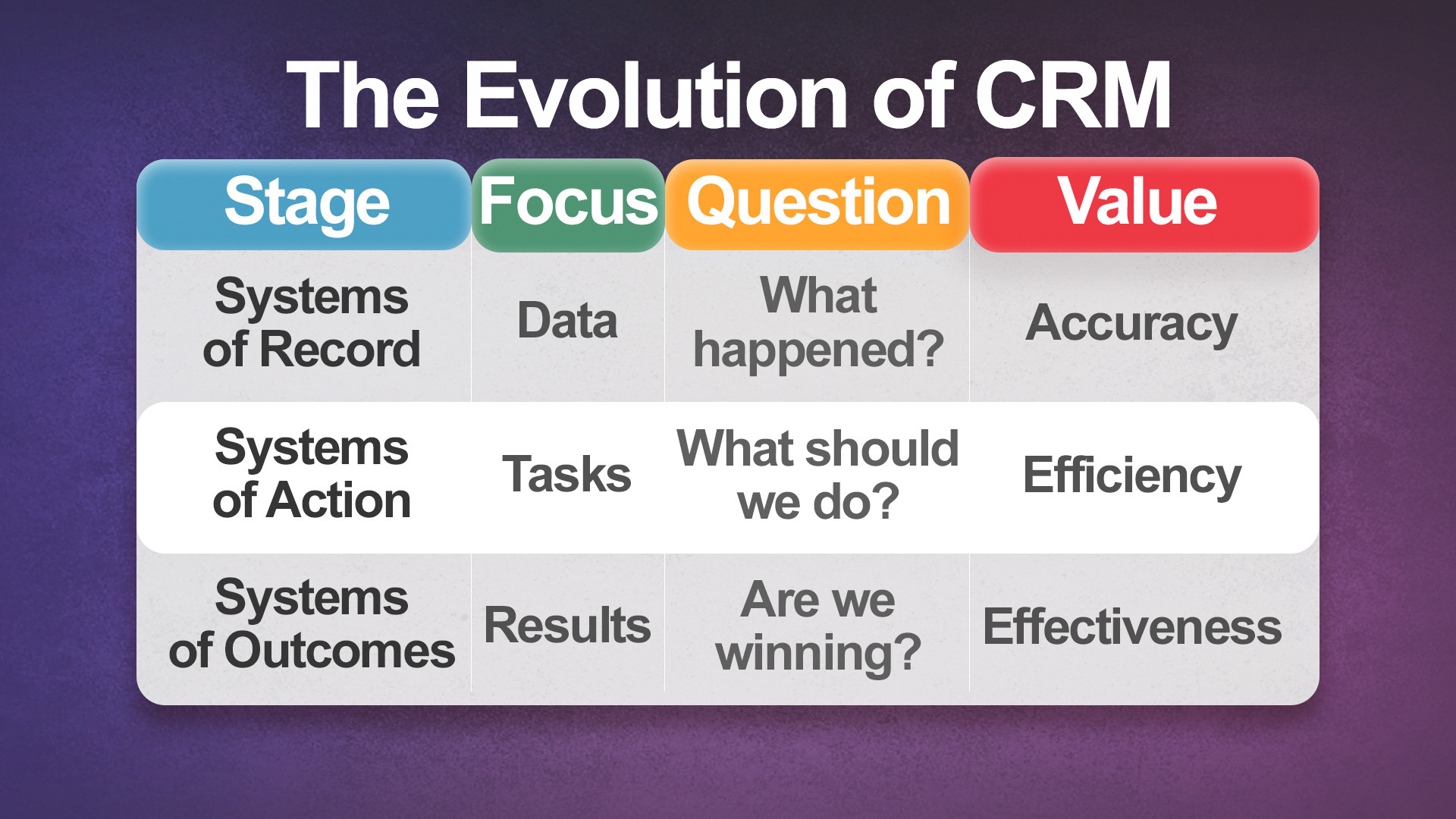
Martin Schneider, VP & Principal Analyst at Constellation Research, talks extensively about this shift. He believes that instead of simply tracking or automating activity, CRM platforms will become increasingly oriented around business results, revenue growth, retention, expansion, and customer lifetime value (CLV).
How? By vendors running a revenue intelligence layer over the top to continuously analyze signals across the customer lifecycle.
As this happens, CRM systems will not only predict what will happen but also orchestrate actions to influence outcomes, continuously learning and adapting over time.
Consider this example. Currently, a CRM might say: “Pipeline is down 12%.” In the future, it will say: “Pipeline will miss target in 18 days unless you reallocate three reps to Segment B.”
Still, while systems of outcomes may be the future, their requirement for clean data, cross-functional alignment, and trust in AI will prove significant blockers. However, it’s an exciting direction for the market.
6. AI Evolves Conventional CRM Pricing Models
AI consumption will slowly become the primary revenue driver for many CRM vendors, rather than traditional software license fees.
Vendors like Creatio are leading the midmarket in this direction. With a more composable solution, its customers can pick the capabilities they need, layer in AI workflows, and build an end-to-end CRM solution at a lower upfront cost, paying for AI on an ongoing consumption basis.
Salesforce’s approach to CRM + AI pricing approach is also evolving. It now charges based on the tasks AI completes. For example: Was a case opened? Was a workflow triggered? Was an action taken? It’s also experimenting with “all in” and flex credit models.
“A flex credit model allows organizations to decide where consumption-based pricing makes sense and where seat licenses make more sense.”
Ultimately, these emerging pricing models have sparked a significant shift in how software is priced and packaged beyond the CRM space, changing how brands perceive value.
Nevertheless, in 2026, finance leaders are still cautious about variable pricing and AI-induced cost fluctuations. Therefore, vendors will keep pricing structures flexible and likely focus on providing greater ROI transparency through enhanced telemetry.
7. The Line Between CRM and CCaaS Blurs
CRM platforms are expanding to offer native Contact Center as a Service (CCaaS) solutions.
For instance, Microsoft added the Dynamics 365 Contact Center in 2024. A year later, Zendesk bought CCaaS provider Local Measure, extending its Resolution Platform. Then, in 2026, Salesforce launched the Agentforce Contact Center as an extension of Agentforce Service (formerly Service Cloud).
These moves come as more businesses leverage CRM solutions as the primary interface for customer service as opposed to pure-play CCaaS solutions.
Metrigy confirms this trend. The research firm suggests that only 32.4% of contact centers used their CRM as the primary interface for service in 2025. However, it predicts this will rise to 53.4% by the close of 2027.
As this trend persists, CRM vendors sense an opportunity to not only take a stranglehold on the service stack but also ownership of customer interaction data.
Additionally, the likes of Zendesk and Salesforce are expanding their service CRM applications into HR and IT support, recognizing a common need for case management and a shared opportunity for AI self-service.
8. CRM and Collaboration Platforms Collide
In early 2026, Salesforce CEO Marc Benioff announced Slack CRM on X, promising “AI on top, Salesforce underneath” in “one pane of glass.”
New: Slack CRM.
AI on top, salesforce underneath.
One pane of glass. 🤯 pic.twitter.com/6YupoMCedG— Marc Benioff (@Benioff) March 12, 2026
Yet, Salesforce isn’t the only vendor to tie CRM and collaboration platforms. For instance, Zoho released “CRM for Everyone” in 2025, giving every department a shared space to manage customer deliverables within the CRM.
Meanwhile, Microsoft ties Dynamics 365 Customer Service with Teams, enabling CRM users to share customer cases across the business.
Expect this convergence to increase as more companies consider customer experience a team sport and different departments work more closely together.
9. The Risk of CRM Vendor Lock-Ins Grows
Enterprises don’t just buy CRM platforms; they invest in consultants and customization. They modify fields, workflows, and integrations to match their processes. Once they’ve sunk that much cost into a system, it becomes extremely hard to unwind and replace it. In other words, they become “locked in”.
As CRM providers expand into CDP, CCaaS, AI agents, and beyond, and customers follow them, the risk of lock-in heightens. That can be an issue if vendors raise their prices.
Salesforce did that last year, bumping up its costs by an average of 6%. Meanwhile, in 2024, Microsoft hiked prices for Dynamics 365 apps by between 9% to 17%.
While customers may only feel that increase at renewal time, it can be substantial, especially for large organizations with thousands of licenses.
As such, while brands may go all-in and embrace a converged ecosystem, there may be solutions, like CCaaS, that they wish to keep separate, even if that’s more expensive in the short term.
10. Integration & Data Quality Challenges Persist
CRM integration challenges continue to slow innovation as teams revalidate their APIs whenever they build something new.
Data quality is equally painful. On the sales and marketing side especially, gaps, inconsistencies, and missing signals are the norm rather than the exception.
Again, this isn't a new problem, but it's becoming an urgent one, because every AI agent built on top of CRM data is only as good as the data itself.
That fundamental truth is coming further into view. Indeed, many of the early AI agents rushed to market by major platforms have underperformed, not because the AI technology failed, but because the underlying data wasn't ready.
Salesforce’s December 2025 acquisition of Qualified is telling. Its first out-of-the-box agent did precisely what Qualified does. Yet, Qualified solved a data problem it couldn’t.
To avoid such issues, Salesforce and its competitors are working to make their own data layers - CDPs, unified customer profiles, integration frameworks - function coherently together. Yet, that work is ongoing, and enterprises are largely building on unstable ground.
A Deep Dive Into the CRM Market
Salesforce continues to dominate the enterprise CRM space. There are many reasons for this, from its CRM + Agentforce vision to the chilling thought of customers uprooting all the time and money they have invested into its ecosystem.
Yet, the element of enterprise prestige is also key. Companies feel that once they reach a certain scale, they need an enterprise-grade system, and Salesforce is seen as the default standard.
That said, there are companies challenging the status quo. ServiceNow has proven particularly vocal in its ambition to disrupt the space. Meanwhile, HubSpot and Zoho are increasingly engaging with CEOs and CIOs, attempting to surge upmarket.
Each vendor can offer something different. On that note, here’s a closer look at the leading players: 11 CRM Vendors & What Differentiates Them in 2026