July 6, 2026 • 15 min read
20 Contact Center Analytics Initiatives to Run in 2026

Director of Content & Market Research
July 6, 2026
As the old proverb goes: "You don't fatten a pig by weighing it."
The same holds true for a contact center. Leaders can track the same metrics and check the scale every day, but that alone won't drive progress.
Instead, they need to go to the trough: dig into what's actually driving those metrics, extract real insight, and act on it.
That's the goal of contact center analytics initiatives, and there's no shortage of initiatives to pursue.
Below is a rundown, but first, here is a recap of the basics.
What Is Contact Center Analytics?
Contact center analytics is the process of collecting raw data from across a customer service operation and turning it into meaningful and actionable insights.
That data comes from many sources, including:
- Customer conversations (AI- and human-led)
- CRM records and ticket management data
- Contact center operational reports
- Agent performance and coaching data
- Workforce Management (WFM) data
- Knowledge base data
- Voice of the Customer (VoC) data
- Desktop telemetry
Depending on their goals, contact centers may also draw on data beyond their own operations to add context to their analytics initiatives, from website analytics to transaction and order data.
To make sense of all this data, contact centers use specialized tooling, such as business and conversational intelligence platforms, to convert it into insights and reports.
Contact center agents, supervisors, managers, and quality and workforce management analysts then act on these insights to improve customer, employee, and business outcomes.
20 Contact Center Analytics Initiatives
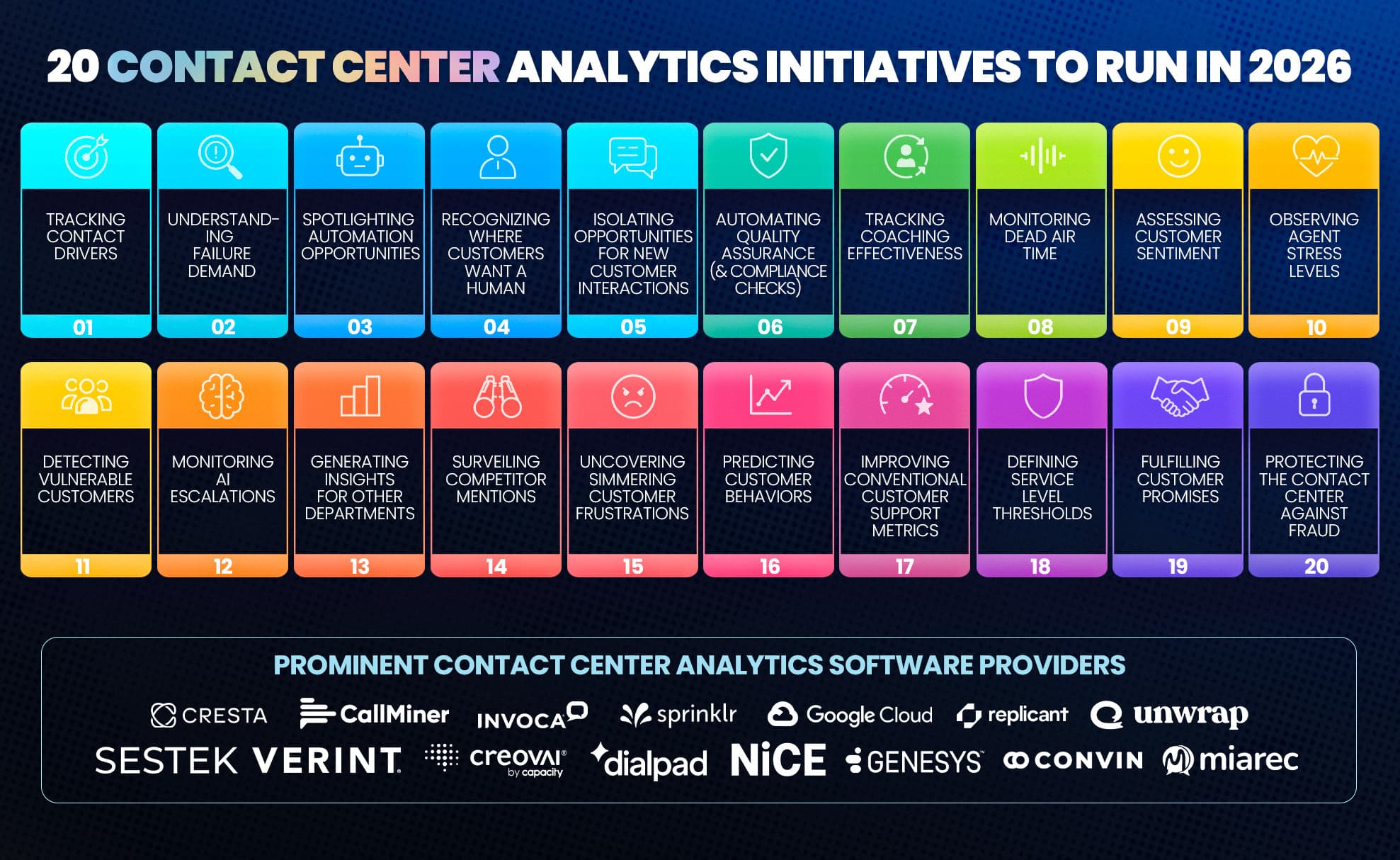
Generating reports with the same stale metrics delivers little value. These contact center analytics initiatives uncover fresh insights that drive action and elevate customer support performance.
1. Tracking Contact Drivers
Contact centers need to know exactly what's driving demand before they can manage it.
In many operations, generative AI now auto-tags tickets, giving service leaders a human-error-free view of demand drivers.
Tracked over time against key business, customer, and employee metrics, this data helps shape contact center automation, agent assistance, and coaching strategies.
Real-time contact driver data also helps supervisors and workforce planners adapt schedules and manage shrinkage on the fly.
- What to Track: Auto-tagged contact reasons over time, mapped against business, customer, and employee outcomes.
- How to Act: Use demand data to guide the contact automation, agent-assist, and coaching strategy. Real-time demand data also helps to adjust intraday staffing and schedules.
2. Understanding Failure Demand
Once a contact center understands its demand drivers, it can dig deeper.
Consider: how much of that volume is "failure demand" (i.e., contact caused by broken processes rather than genuine need)?
Conversational intelligence systems enable teams to perform root cause analysis on key drivers, uncovering recurring customer pain points whether they originate within the contact center or elsewhere in the business.
Fix the source, and the contact center eliminates the demand; no AI band-aid solution required.
- What to Track: Recurring pain points by demand driver, tagged as internal or external in origin.
- How to Act: Partner with the relevant departments to fix root causes rather than deflecting or automating symptoms.
3. Spotlighting Automation Opportunities
Some failure demand is unavoidable, and not every contact is a sign that something is broken.
By mapping the full contact mix against business and customer impact, conversational analytics tools can flag high-frequency, low-impact contacts for automation.
Deploy AI agents there first, then carry the lessons into higher-value interactions.
- What to Track: Contact volume by driver, cross-referenced with impact on key business and customer outcomes.
- How to Act: Prioritize AI agent deployment on high-volume, low-impact contacts, then apply learnings to higher-stakes interactions.
4. Recognizing Where Customers Want a Human
Some conversations carry real weight, for the business and the customer. Here, human empathy, reassurance, and relationship-building can add significant value.
Conversational analytics flags these conversations by tracking metrics such as customer sentiment and predictive churn across demand drivers.
High scores on both mean it's likely time for an orchestrated experience with a human touch, not just another AI agent.
Additionally, some customers will always want a human. Analytics can catch that disclosed preference, log it in the CRM, and route them accordingly.
- What to Track: Emotion and churn-risk scores by demand driver, plus explicit customer preference signals.
- How to Act: Route high-emotion, high-churn-risk conversations to skilled humans, and hardwire known human-preference customers into routing rules.
5. Isolating Opportunities for New Customer Conversations
Contact center analytics initiatives that investigate customer demand often focus solely on decreasing contact volumes. Yet, some should strategically increase them.
For instance, a contact center that spots a pain point early in the journey can warn customers before it becomes a complaint.
Similarly, service teams can spot patterns behind successful upsells and cross-sells and look to replicate them across other conversations.
Lastly, a contact center can spot a customer whose product usage is dropping ahead of renewal. Proactive outreach can then save the account.
Such activities are how a contact center becomes a revenue engine, not just a ‘cost center’.
- What to Track: Early pain-point signals, upsell/cross-sell conversation patterns, and usage-decline signals ahead of renewal.
- How to Act: Trigger proactive outreach, warnings, tailored offers, or save plays before the customer has to reach out first or, worse, cancel their subscriptions.
6. Automating Quality Assurance Processes (& Compliance Checks)
Automated Quality Assurance (Auto-QA) tools auto-fill scorecards a human analyst would, supporting contact centers with full-coverage compliance and quality monitoring across human and AI agents.
While the data needs validation, it unlocks a far broader view of individual and team performance to guide coaching, learning interventions, and process reviews.
Some providers, like Replicant, are going further by tracking which agent behaviors contribute to positive customer outcomes to simulate new scorecards. Contact centers can then A/B test against their current scorecard to isolate the best option.
- What to Track: All contact center interactions for compliance and quality, against tailored scorecards. Map QA scores across demand drivers, channels, and teams for deeper insight.
- How to Act: Validate Auto-QA scores and use those to inform coaching sessions, learning management interventions, and process reviews.
7. Tracking Coaching Effectiveness
QA aims to spotlight where coaching is needed, but few teams ever check whether it worked.
Modern conversational analytics closes that loop by tracking whether an agent stops making the same mistake after coaching.
If the behavior persists, that's a signal to change the coaching approach, not repeat it.
- What to Track: Whether flagged behaviors recur in an agent's interactions after a coaching intervention.
- How to Act: Where mistakes persist, swap in a different coaching method or format instead of repeating what isn't working.
8. Monitoring Dead Air Time
Dead air, i.e., periods of silence when neither the agent nor the customer is speaking, is an early warning sign that a conversation is breaking down.
At the team level, prolonged silence usually implies technical issues or knowledge chasms agents aren't equipped to fill.
At the individual level, it often flags a specific training or skill gap. There could also be a device or network issue.
By identifying and analyzing moments of dead air, contact centers can resolve underlying issues that erode both customer and agent satisfaction.
- What to Track: Dead air duration and frequency at both team and individual agent levels.
- How to Act: Investigate team-wide silence for systemic knowledge or tooling gaps, and use individual patterns to inform 1:1 coaching.
9. Assessing Customer Sentiment
Keyword tracking tells the contact center that sentiment is negative. Meanwhile, a deeper conversational analytics exercise reveals why.
By unpacking patterns in what dissatisfied customers say, contact centers can surface upstream causes, such as website frictions, delivery delays, and unanswered emails.
From there, they can target the true source of dissatisfaction rather than chasing symptom-level metrics.
- What to Track: Recurring themes and root causes behind negative-sentiment conversations.
- How to Act: Route upstream causes to the owning team (product, logistics, marketing) rather than treating each low score as an isolated agent issue.
10. Observing Agent Stress Levels
Real-time analytics can pick up on agent tone, sentiment, and language to flag rising stress, letting supervisors step in with a timely break or a pep talk before burnout hits.
A contact center that tracks stress patterns over time might find an agent is often more stressed at a certain time of day, a perfect moment to schedule coaching or other shrinkage activities instead.
Yet, this comes with a caution. Under Chapter 2, Article 5 of the EU AI Act, workplace sentiment analysis is banned unless justified by medical or safety grounds, so European operations need a clear legal basis before rolling this out.
- What to Track: Real-time and longitudinal agent stress signals, including time-of-day patterns.
- How to Act: Offer timely breaks or support in the moment, and schedule shrinkage activities around known stress peaks, with EU AI Act compliance confirmed first for European operations.
11. Detecting Vulnerable Customers
Some customers are less able to understand communications, respond effectively, or manage their accounts, and specialized analytics can catch the warning signs.
These warning signs may include repeated or unrelated questions, struggling with basic queries, inconsistent answers, or explicit mentions of illness or disability.
A real-time analytics system can flag these signals as they occur, routing the customer to a specialist. It can also log the flag so all future contacts from that customer are automatically routed to specialist support.
- What to Track: Vulnerability indicators in real time, including question repetition, incoherence, long periods of typing into a digital AI agent, or a willingly disclosed health/disability status.
- How to Act: Route flagged contacts to specialists immediately and record the flag in the customer record for automatic future routing.
12. Monitoring AI Escalations
Conversational intelligence solutions don't stop at human agents; they track AI performance, too, catching signs of customer anger, frustration, and repetition in AI-led interactions.
Yet, perhaps the real gold is in escalation analysis, i.e., when and why does a conversation get handed from AI to a human?
The answer often points to unclear knowledge content, unexpected customer behavior, or integration failures. Addressing these root causes can continuously improve the self-service experience.
- What to Track: AI escalation rate and cause, plus anger/frustration/repetition signals within AI-led conversations.
- How to Act: Fix the root cause behind each escalation pattern on a continuous cycle.
13. Generating Insights for Other Departments
Customers hand contact centers a goldmine of information that's also valuable to marketing, sales, and product teams.
For example, consider a retailer that has just launched a new product and is concerned about its pricing. By analyzing inbound support interactions related to the product, analytics may reveal the percentage of customers who expressed that it was too expensive.
That’s a significant, highly actionable insight that marketing teams might otherwise spend heavily on customer surveys to obtain.
- What to Track: Themes and sentiment in support conversations tied to specific products, features, or launches.
- How to Act: Work with marketing, sales, and product teams to democratize the insights that matter most to them.
14. Surveilling Competitor Mentions
Load competitor names into a conversational analytics platform with social listening capabilities, and the contact center can automatically capture every mention across customer engagements, classified as positive, negative, or neutral.
With this, contact centers get a real-time read on competitive perception, and when a competitor is winning praise, analytics can pinpoint exactly which themes are driving it, informing decisions well beyond customer service.
Alternatively, criticism directed at competitors can be cautiously shared with service and sales representatives to inform their responses when customers mention a competitor.
- What to Track: Competitor mentions and sentiment across calls and social channels.
- How to Act: Feed recurring competitive themes to the broader business and use that intelligence to guide service and sales reps on how to handle competitor mentions.
15. Tracking Audio Quality Across Voice and Video
An emerging contact center metric is Mean Opinion Score (MOS), which rates audio quality on a scale of one to five.
Operata found that agents with a consistent score below 4.2 are 50% more likely to leave within three months.
As such, more contact centers are investigating three core network metrics, packet loss, jitter, and latency, to track MOS and take action.
These actions could include replacing old laptops, recommending new network providers to remote agents, and supporting them in improving tab management.
- What to Track: MOS scores per agent over time, alongside the underlying packet loss, jitter, and latency metrics driving them.
- How to Act: Where MOS consistently falls below 4.2, address the root cause by replacing outdated hardware, recommending better network providers for remote agents, and improving tab and bandwidth management.
16. Improving Conventional Customer Support Metrics
Contact centers have measured emotion, effort, and satisfaction for decades, but modern analytics systems do it better.
Take customer emotion. Contact centers can build a composite score from language, tone, intonation, and more, instead of just tracking keywords.
Yet, perhaps the best example is first contact resolution (FCR), which measures the percentage of customer issues resolved on the first interaction.
FCR is closely linked to customer satisfaction (CSAT). According to SQM Group, CSAT falls by 15% with each repeat contact about the same issue.
Traditionally, contact centers have measured FCR using repeat-contact rates, but this can misclassify customers returning with unrelated queries. By combining callback data with customer intent, analytics more accurately measures FCR.
- What to Track: Composite metrics of key conversational signals to better report on key customer outcomes, such as emotion, satisfaction, and resolution.
- How to Act: Report contact center performance metrics more accurately to drive better decision-making.
17. Defining Service Level Thresholds
The old 80/20 standard, 80% of calls answered within 20 seconds, is expensive to sustain and often arbitrary.
The better question to ask is: how much wait time can customers actually absorb before satisfaction drops?
By correlating wait time with sentiment, this analytics initiative finds the real tipping point, which, for some customer groups, can be two, three, or even four minutes, not twenty seconds.
Ultimately, that insight lets contact centers right-size staffing, refine callback thresholds, and improve hold messaging without overspending.
- What to Track: Satisfaction as a function of actual wait time across call queues.
- How to Act: Reset service level targets, staffing plans, and callback thresholds to the real tolerance point, not a legacy benchmark.
18. Predicting Customer Behaviors
Analytics is moving beyond just converting historical data into insight. Now, it’s transforming synthetic data into predictions, with tools like Dialpad's AI CSAT and evaluagent's Expected Net Promoter Score (xNPS).
As adoption grows, contact centers may increasingly use synthetic metrics to model potential outcomes and predict how customer outcomes scores vary across different resolution paths for the same issue.
Alongside these emerging capabilities, contact centers can leverage real-world data to predict customer churn risk through composite metrics that incorporate product usage and adoption, support activity, engagement levels, revenue signals, and other relevant factors.
These insights can then drive proactive retention campaigns, enabling the contact center to take a more strategic customer success role by identifying and supporting at-risk customers before they decide to leave.
- What to Track: Predictive metrics based on real-world signals, such as xNPS or likelihood of churn.
- How to Act: Dynamically adjust service experiences based on predictive outcomes.
19. Fulfilling Customer Promises
Agents regularly make callback and follow-up commitments to customers, and conversational intelligence solutions can track whether they’re honored. British Gas uses this capability for precisely that purpose.
When gaps appear, they can prompt the agent to follow up, closing loose ends and preventing repeat calls from frustrated customers.
- What to Track: Promises made by agents in conversation, matched against whether they were subsequently fulfilled.
- How to Act: Set up automatic prompts for agents to make callbacks after a set period, ensuring customer cases don’t remain unresolved.
20. Protecting the Contact Center Against Fraud
Because conversational intelligence solutions capture exactly what customers say, contact centers can build pattern libraries from historical fraud cases.
In doing so, they can flag known behavioral markers and combinations, then monitor them in real time.
Flagged interactions may then be routed for review and closer account monitoring, without requiring dedicated tooling, as it runs on existing contact center technology.
- What to Track: Real-time matches against known fraud behavior patterns and variable combinations.
- How to Act: Route flagged interactions for review, tighten monitoring on the associated account, and take action based on findings.
The Future of Contact Center Analytics
The scope of contact center analytics is expanding beyond traditional reports from contact center and CRM platforms as business and conversational intelligence capabilities become more accessible.
That scope will stretch further as contact center teams align more closely with sales, marketing, and commerce to analyze different types of data and unlock new possibilities.
For example, some organizations already combine web analytics, traditionally owned by marketing, with contact center data to understand what customers searched for before making contact, enabling better-informed experiences.
Consider a front-end AI agent offering them a discount on the product they were just looking at. The customer sees it as a happy coincidence; instead, it was a clever sales tactic.
Yet, beyond the scope of analytics broadening, the technical capabilities of business and conversational intelligence solutions are expanding, too.
With the rise of natural language interfaces, more contact center leaders will soon be able to ask questions of their data, pull new insights, and auto-generate reports.
Moreover, analytics systems are moving beyond reporting changes in metric scores to isolating likely causes and proactively recommending alternative actions.
Finally, the growing use of predictive insights derived from customer conversations could reduce reliance on low-response CSAT and NPS surveys by inferring scores from every interaction. Expect use cases for such synthetic data to be a big focus for providers of analytics tools moving forward.