
September 8, 2026 • 2 min read
Fish Audio: TTS Market Analysis & Positioning

Director of Content & Market Research
September 8, 2026
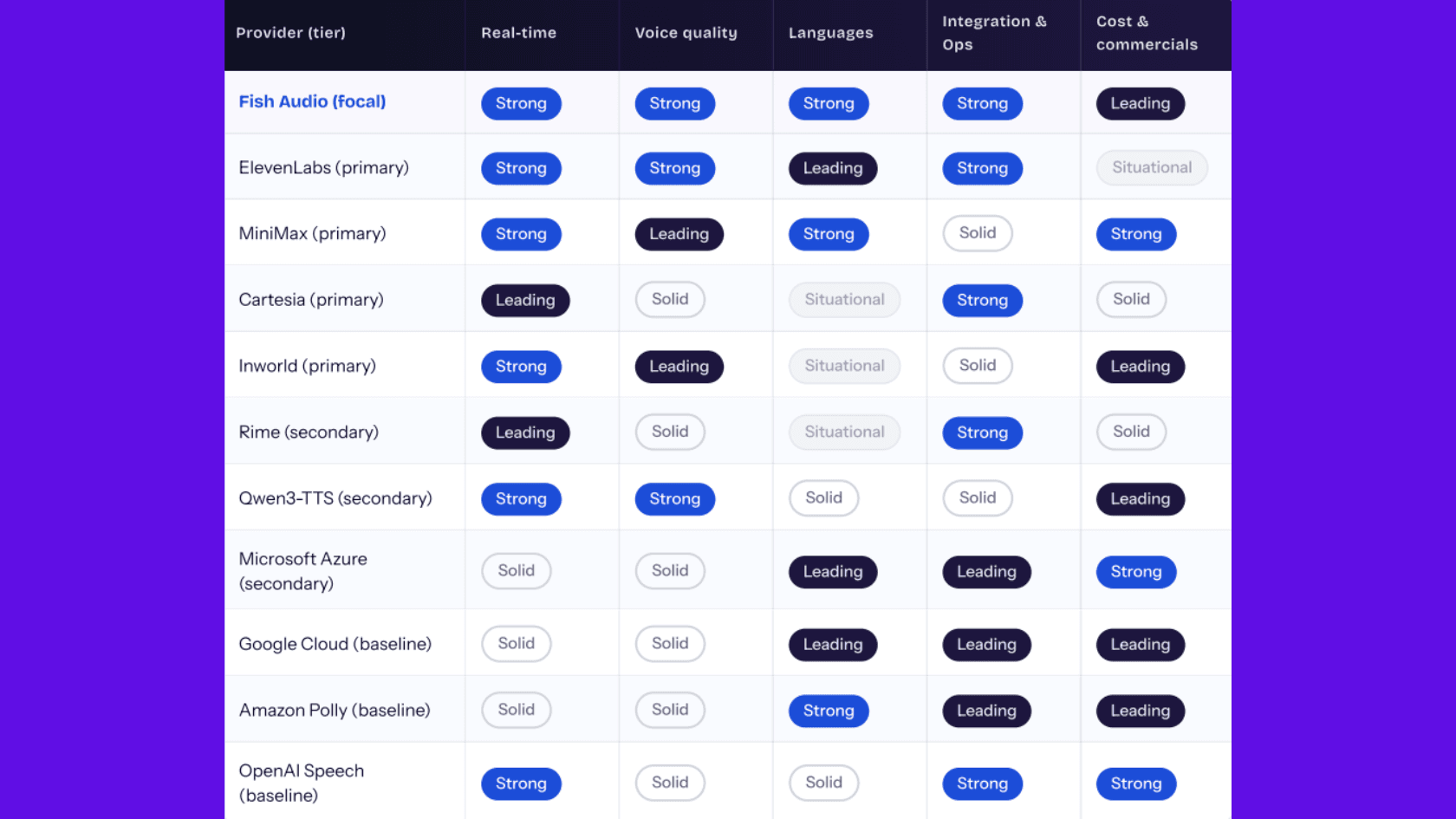
Text-to-speech (TTS) has entered a new era. Today’s leading models can laugh, whisper, switch languages mid-sentence, clone voices, and deliver increasingly human-like emotion. But with every vendor claiming to be the fastest, cheapest, and most natural, choosing the right TTS provider is harder than ever.
That's why Fish Audio contacted CX Foundation to independently evaluate its latest TTS models, compare them against competitors, and cut through the market noise.
Now, CX Foundation, which performed the evaluation alongside Opus Research, is sharing its findings.
How Did We Compare TTS Models?
The analysis reveals a TTS landscape split between enterprise voice infrastructure - where latency, reliability, scalability, and integration matter most - and expressive voice experiences, where emotional nuance, character, and realism can make or break the experience.
Yet, no matter the use case, buyers will evaluate providers across five critical dimensions (just with different weightings):
- Real-time responsiveness
- Voice quality
- Languages and accents
- Integrations and operational flexibility
- Cost
The report evaluates Fish Audio's latest S2 models, alongside models from competitors, including: ElevenLabs, Google Cloud, Microsoft Azure, Amazon Polly, OpenAI, Qwen, Inworld, MiniMax, Cartesia, and Rime.
What You Will Learn from the Report
Those who read the report will discover:
- How the leading TTS providers actually compare across the five critical evaluation criteria.
- Which providers best suit enterprise voice agents versus creative and immersive applications.
- Why many other TTS market evaluations can be misleading
- Where each provider excels, falls short, and what buyers might need to compromise.
- How to identify the TTS provider that best fits the buyer's specific use case.
Ultimately, the results challenge the idea of a single “best” TTS model. Every provider makes trade-offs, and the right choice depends on what the buyer needs its voice AI to actually do.
Inside the full report is a detailed provider-by-provider scorecard designed to better inform TTS investment decisions.