April 29, 2026 • 4 min read
Zoom CX Summit: From Episodic Interactions To Unified Intelligence

CX Analyst & Thought Leader
April 29, 2026
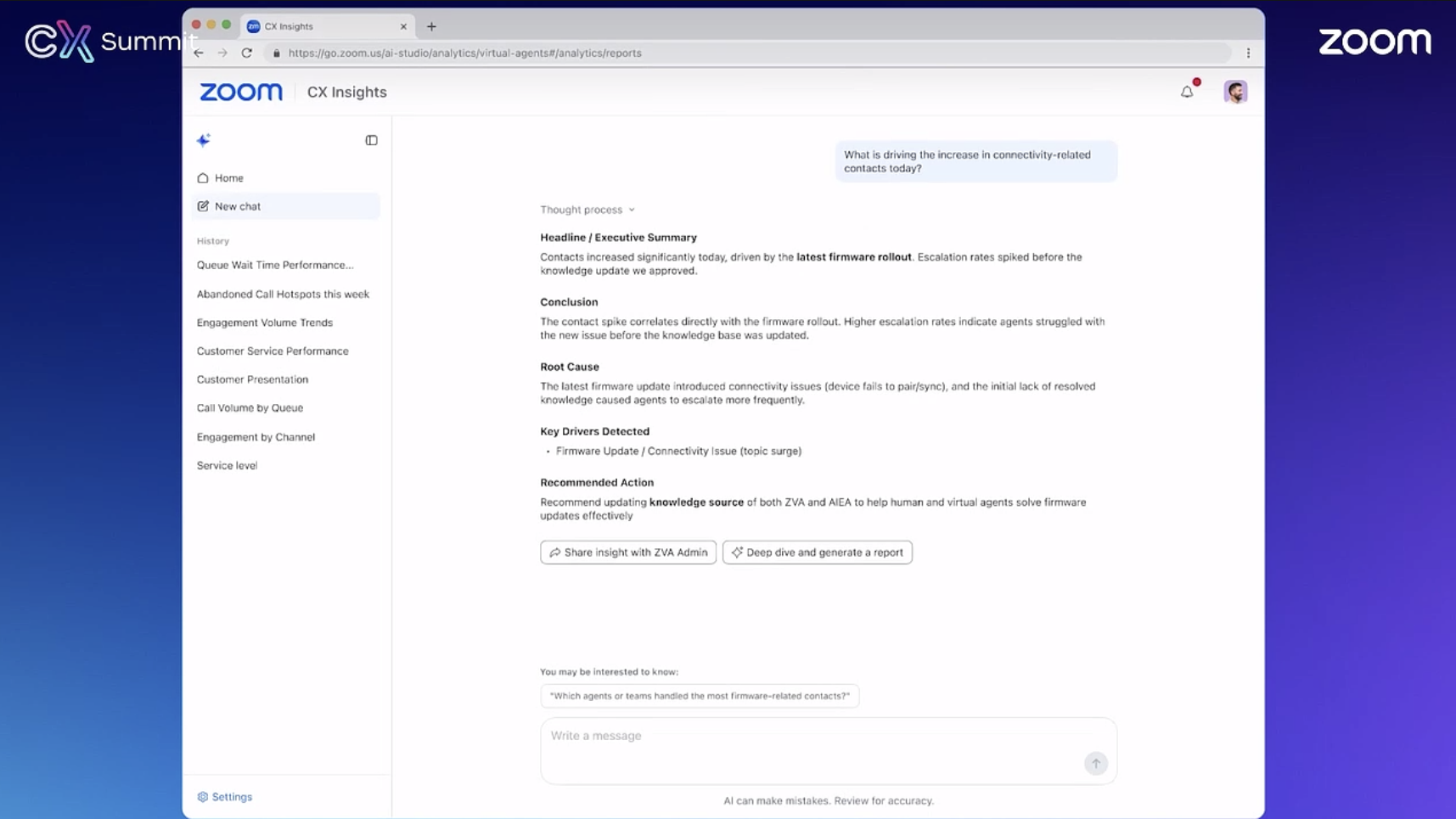
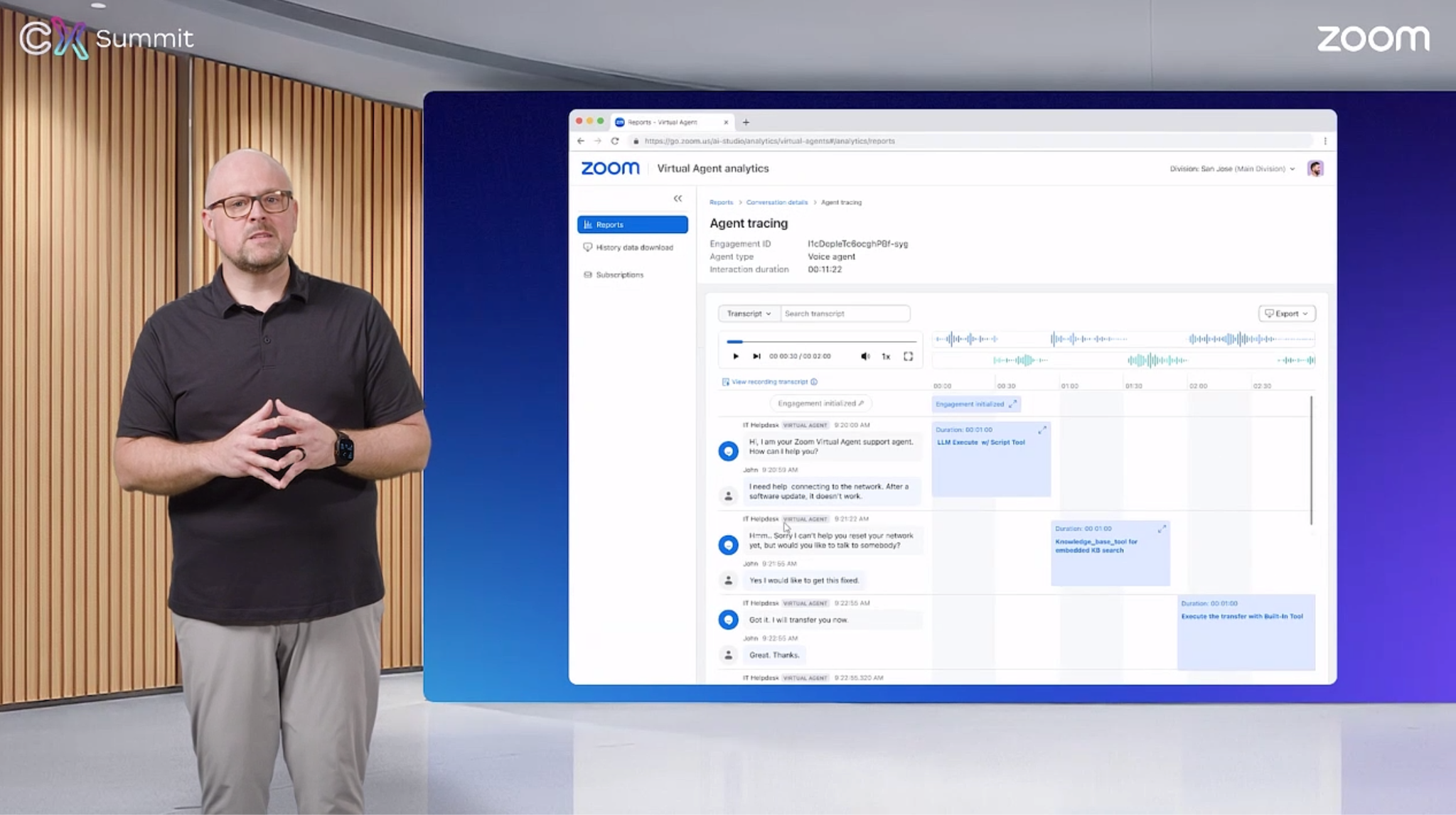
Today’s virtual Zoom CX Summit began with the acknowledgement that although AI has vastly improved the efficiency and productivity of contact center work, it’s also created a huge amount of “work around the work.” AI-powered features themselves aren’t the cause of extended AI ROI timelines, customer frustration, and employee burnout. What’s really stopping AI from reaching its full CX potential is the constant task of managing, monitoring, and optimizing those AI-powered tools.
When conversational context doesn’t carry forward across customer interactions, or when data remains siloed across disconnected applications, customers and agents are forced to compensate for the lack of a unified intelligence layer that brings everything together in one place.
According to Chris Morrissey, General Manager of Zoom CX, enterprises are held back by CX systems that were built for episodic individual interactions, not continuous customer conversations.
If enterprises want to truly move the customer experience needle, they have to move from managing customer conversations to achieving customer resolution. They have to chase outcomes, not interactions.
What Do Customers Really Want From AI?
It’s true that AI has had a major impact on increased customer expectations. Today’s consumers expect every virtual agent they interact with to provide continuity, transparency, speed, convenience, friendliness, error-free suggestions, and institutional memory.
However, as CX Expert Shep Hyken reminded us, what customers want hasn’t really changed over the last thousand or so years: resolution and happiness. What has changed, noted Hyken, is how enterprises provide that resolution and happiness to their customers.
He also highlighted that while customers are now more comfortable with using AI than they were last year, their expectations regarding AI-powered self-service are somewhat contradictory.
57% of customers say they’re frustrated by AI-powered self-service, while 54% of customers believe chatbots have significantly improved. 32% of customers have abandoned companies that didn’t provide adequate self-service, but 59% say they dislike self-service customer support options and only want to talk to a human when they need help. Finally, while 50% of customers have successfully resolved their issues without needing human intervention, 45% say they’re afraid of ChatGPT and AI technologies.[*]
These contradictions suggest that while AI technology is maturing and consumer trust in AI is generally rising, successful implementation of that AI technology is still highly variable. They also reveal that while self-service is now a baseline customer expectation, customers have learned to distinguish between self-service designed to actually resolve their problems and self-service designed primarily to deflect call volume.
Frost & Sullivan's research, presented by Associate Partner and Global VP Alpa Shah, found that improving the customer experience is now the number-one business objective for 69% of businesses, above both efficiency and continuity.[*]
The worry, then, is not a lack of ambition to improve enterprise CX, but rather, clarifying what actually improves the experience for customers.
Zoom Customer Perspectives
Customer perspectives from Andrea Hachey (WHOOP) and Serina Anhorn (Young Living Essential Oils) discussed the Zoom implementation process, as well as what drove them to choose Zoom. Both customers cited Zoom's customization flexibility and scalability as critical adoption drivers.
Anhorn's account of an unplanned migration to Zoom was especially interesting. After originally implementing Zoom for internal softphone use, IT advocated for the switch to Zoom’s contact center solution. This bottom-up adoption suggests Zoom's unified communications heritage may be creating unexpected competitive advantages, particularly as organizations seek to collapse tool sprawl.
Both customers highlighted AI Expert Assist and language capabilities as differentiators, alongside Zoom's responsiveness to feature requests.
Unified Intelligence: The Latest CX Push
The Zoom CX Summit echoed a statement I’m hearing more and more in the CX space: intelligent unification and orchestration is a top priority when evaluating vendors.
Yesterday’s omnichannel contact centers consolidated communication channels under one roof, but still required complex (and often, faulty) integrations with third-party WFM and CRM tools. When contact center platforms started adding WFM capabilities to their SaaS solutions, they became “customer experience platforms.”
Now, we’re entering the era of the “Unified Customer Experience Platform” (or UCXM, as some call it.) UCXM platforms unify applications and hopefully consolidate the number of third-party applications required to power the contact center, yes. But most importantly, they unify AI intelligence itself: orchestrating and connecting all your AI tools, systems, and analytics.
Where previous generations bundled features into suites, unified platforms architect those capabilities to share memory, context, and decision-making across every customer touchpoint and operational system. Zoom’s CX Summit message was loud and clear: true differentiation in an over-crowded market is led by platforms that can deliver genuine unification, not bolt-on point solutions.