September 29, 2026 • 5 min read
Zendesk Goes Industry-Specific with Specialized Agents, Targets Up to 80% Automation

Director of Content & Market Research
September 29, 2026
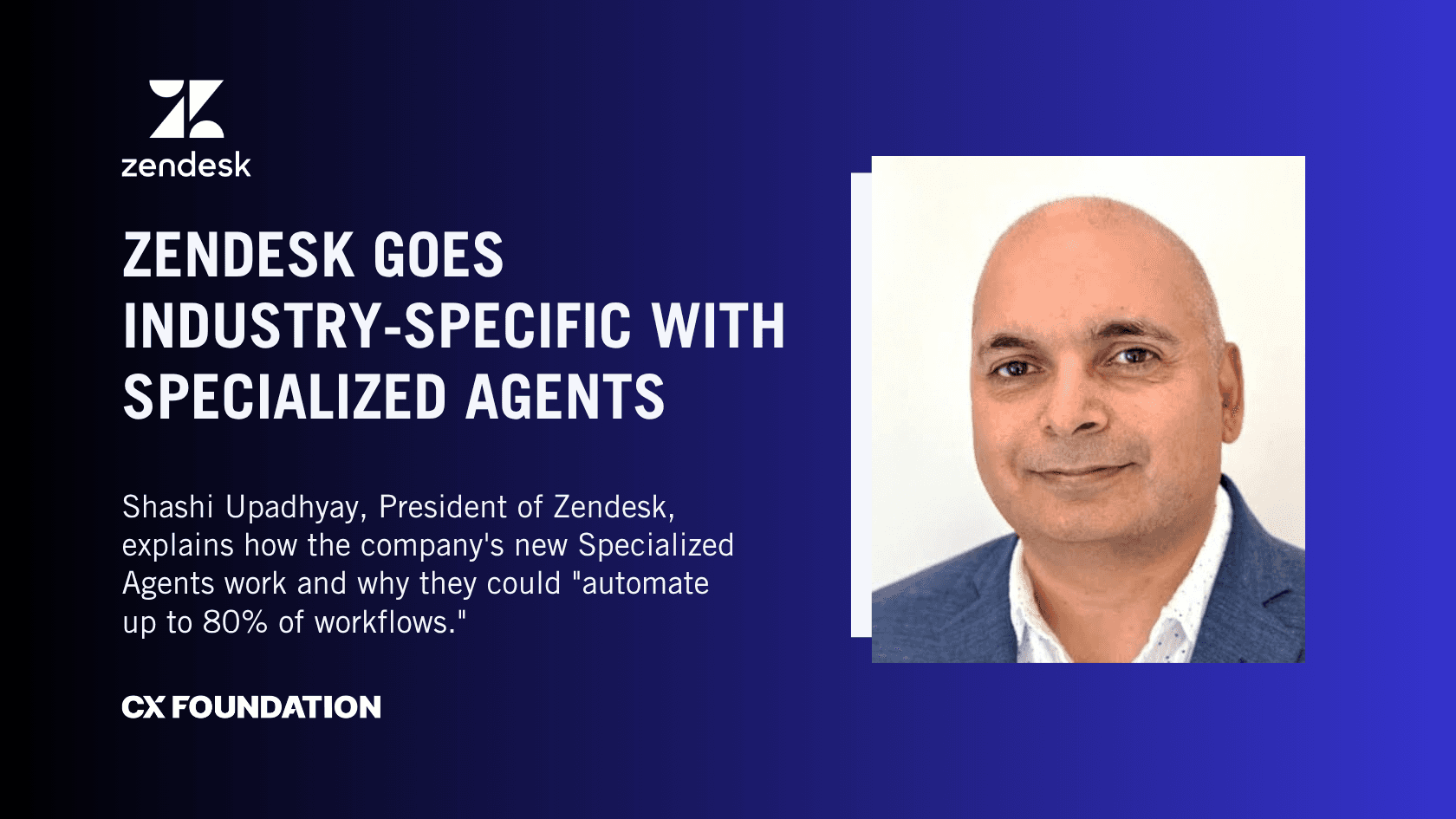
Zendesk recently launched Specialized Agents to help organizations move customer-facing AI agents through production faster.
The Specialized Agents come in two forms: Industry Agents and Custom Agents.
Industry Agents pre-package workflows, integrations, rules, and guardrails tailored to a specific sector and accounting for various regions’ unique regulations. They also come “pre-built” with an understanding of key industry concepts and terminology.
Organizations can also then build Custom Agents for workflows unique to their business.
Beyond speed-to-value, Zendesk's Specialized Agents aim to break through the 30% ceiling on customer contact automation that many brands struggle to push past.
"We quickly found that our agents could automate and resolve a lot of tasks, but they'd get to about 25–30% resolution and start hitting a wall. They knew enough to be generalists, but they couldn't specialize. That’s what we’re addressing."

With Specialized Agents, Zendesk believes organizations can "automate up to 80% of workflows." That’s quite the jump.
Retail businesses can try Industry Agents first. Zendesk then plans to announce Industry Agents for financial services, insurance, and healthcare over the next several months.
How Exactly Do Zendesk's Specialized Agents Work?
Industry Agents aim to resolve common customer issues end-to-end within a specific sector.
In retail, for example, Zendesk's Industry Agents can connect to SAP to update an order, pull billing information from Oracle, and process returns through ServiceNow. Setting all of that up manually takes significant time. Zendesk's pre-integrated components and workflows are designed to cut much of it out.
Interestingly, the pre-built workflows can also help organizations reimagine how they resolve customer contacts, instead of simply automating pre-existing processes.
For instance, if a customer says a product isn't working, a pre-configured Industry Agent might suggest a return and offer three alternatives, blending a returns process with a sales one. That’s potentially a much better process than many retailers currently operate.
In addition, Industry Agents follow rules like a human would. A financial services agent, for example, knows that in almost every country a human must be involved in any money transfer. That regional, regulatory knowledge is built in from day one, so the agent escalates when it reaches the transfer step.
Custom Agents then enter the picture, helping brands automate more unique processes, which can follow both agentic and deterministic pathways.
Why Do Specialized Agents Matter?
Upadhyay believes most customer-facing AI agents hit a ceiling for two reasons:
- Missing context: Agents lack knowledge of each company's specific reality.
- Custom processes: Organizations want agents to manage highly specific processes in their own way.
Industry and Custom Agents address both issues.
Additionally, they help Zendesk stand out in a crowded conversational AI market, where it competes with platform rivals like Salesforce and NiCE, industry stalwarts like Google and Kore.ai, and disruptors like Sierra and Decagon.
How? Through industry-specific innovation and speed-to-value.
Pre-configured integrations, workflows, and guardrails enable more precise problem-solving, support regulatory compliance, and, crucially, speed up deployments.
"With Specialized Agents, you can start to see 50% plus automation in a matter of weeks. Whereas others can take 18 months, 24 months," claimed Upadhyay.
What Does This Announcement Say About the Current Conversational AI Market?
The announcement reflects a broader shift in how conversational AI providers package their offerings.
Most started with a simple pitch: "We'll give you the tools to build the best AI agents." Nevertheless, expectations have recalibrated over the past 12 months. Vendors have realized that agents can rarely run end-to-end without human supervision.
The cause isn't weak AI. It's legacy integrations, data quality, and governance, all of which need work before agents can be unleashed across an organization.
As a result, vendors have changed their tone. Rather than promising the best AI, they now focus on pre-configuring agents for their customers while pulling in additional context.
Upadhyay believes that shift plays to Zendesk's strengths. "As far as CX goes, no one's as deep on this as we are," he said. "We have seen every service problem that's ever happened in the last 20 years."
What's Next for Zendesk?
Beyond releasing new Industry Agents, Zendesk is re-evaluating its AI model for the era of personal AI agents.
Meta's recently released Muse can automate customer support calls, book travel itineraries, send emails, fill in online forms, shop, and even connect with third-party platforms like Spotify to build personalized playlists. Amazon has already blocked Muse from its website, admitting it isn't prepared for a world where customers, not just businesses, have their own AI agents.
Customers will soon expect to use their agents for these tasks, and Upadhyay suggests Zendesk is preparing for a world with four customer service models:
- Human agent to human customer
- Human agent to machine customer
- AI agent to human customer
- AI agent to machine customer
"The service team’s AI agent will have to interact with the consumer's AI agent, and that will completely change how businesses design customer experiences," he said. "That's the world we're preparing for, and it's coming at us very fast."
CX Foundation explored this topic with four independent AI experts earlier this year. Catch up here: Machine Customers and the Future of Customer Service.