
April 20, 2026 • 7 min read
Customer Loyalty in 2026: Findings From The Sogolytics Experience Index

CX Analyst & Thought Leader
April 20, 2026
Today, experience management platform Sogolytics released The Customer Edition of the Q1 2026 Sogolytics Experience Index. The report outlines the latest shifts in customer loyalty and expectations, as well as how AI has changed the way customers view their relationships to businesses.
The report finds that customer loyalty is increasingly conditional, trust and value remain top customer priorities, and that individual interactions often have higher customer satisfaction levels than long-term customer relationships. It also shows that, while companies may be collecting more data than ever, few are meaningfully acting on it.
Findings highlight that transparency, consistency, and empathy are now just as important–and often, more important–to customers as speed and convenience.
Check out our interview with Sogolytics CEO Hamid Farooqui
Customer Loyalty Isn’t What It Used To Be
Value for money and convenience became the top priorities for 2025 customers, starting a general decline in customer loyalty that has seemingly continued in Q1 of 2026. The Sogotlytics report found that fewer customers identify as loyal in 2026 than in 2025, with just 31% describing themselves as “very loyal.”
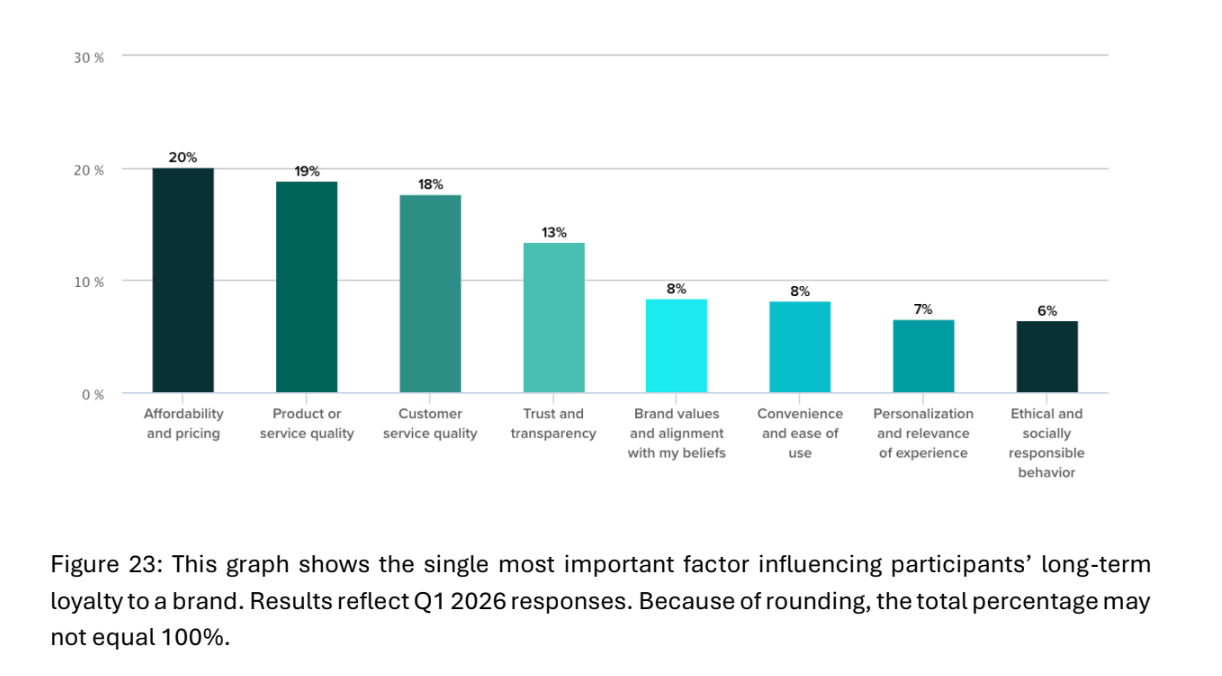
Affordability remains the top factor in long-term loyalty, with product, service, and customer service quality following closely behind. Convenience appears less impactful on long-term loyalty than in 2025, with just 8% of customers ranking it as the most important loyalty factor.
Company values also play a role in customer loyalty - but in Q1 of 2026, politics take a back seat to social and environmental stances. 69% somewhat or strongly agree that a company’s environmental stance impacts their buying decisions, while 64% say a company’s political endorsements, donations, or public posts somewhat or strongly impacts where they shop.
Individual Experience > Overall Experience
The report found that while 68% of customers are satisfied with their overall customer experience across companies, 77% were satisfied with their most recent customer experience. This shows that while it may be easy to make customers happy with a single interaction, maintaining that satisfaction level is more challenging.
Providing a consistent, reliable customer experience is essential, but it’s clearly something companies still struggle with.
For the second year in a row, financial services provided the best overall customer experience, followed by entertainment/media, then healthcare. Travel and hospitality provided the worst overall customer experience, while telecommunications and technology provided the second and third-worst experiences, respectively.
Customer Expectations Aren’t Monolithic
Customer expectations are 9% higher in the first quarter of 2026 than they were during all of 2025. 53% of customers now self-report having higher CX expectations than they did in 2025, while only 13% say they’ve lowered their expectations.
Meeting those expectations isn’t necessarily a challenge because companies don’t recognize the importance of them – it’s a challenge because each customer has different priorities and expectations.
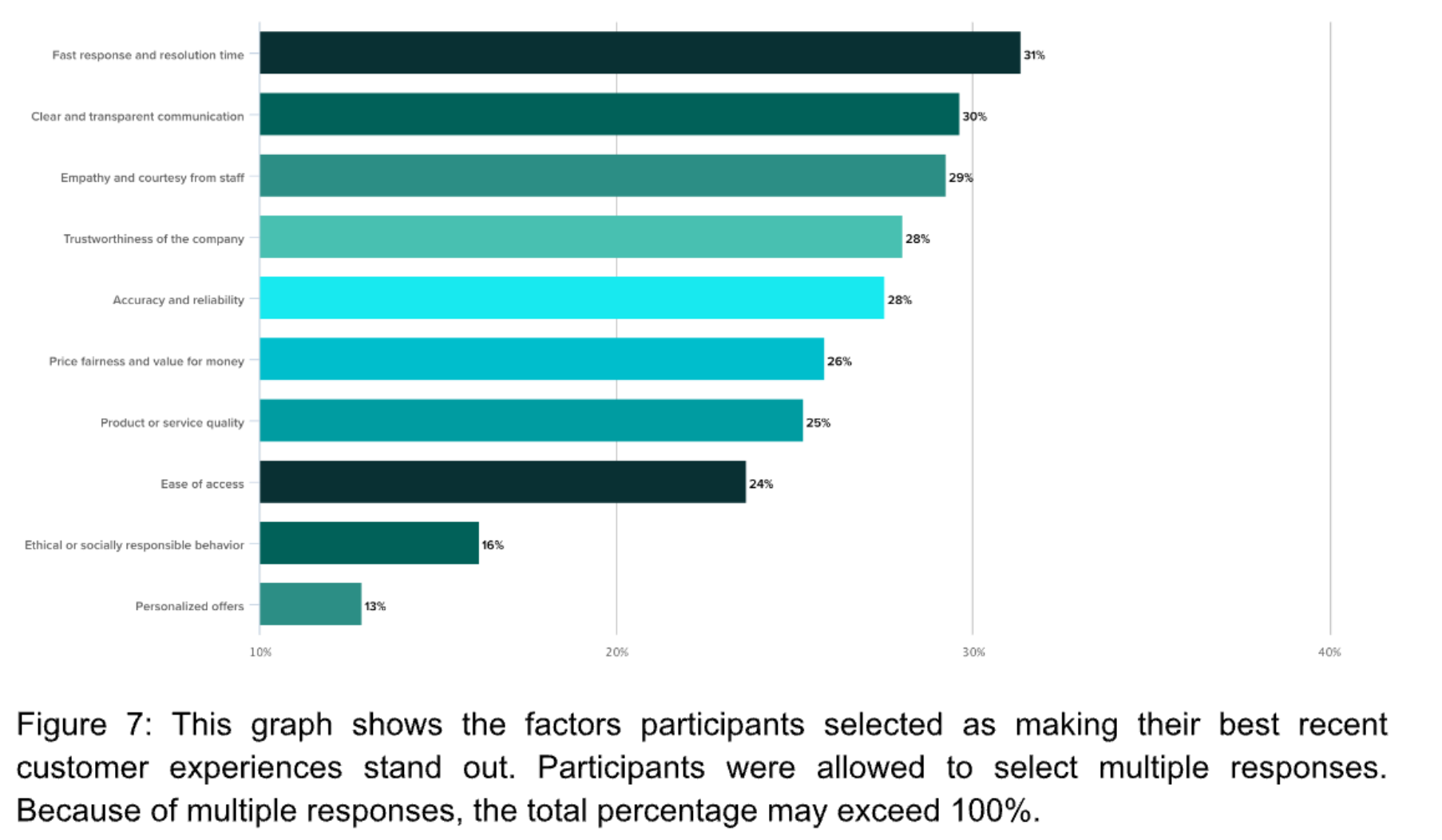
The study demonstrates the lack of a clear “frontrunner” when it comes to what customers want in 2026. For example, while 31% of customers say fast response/resolution times have the biggest positive impact on their experience, 30% say clear, transparent communication matters the most. Empathy, trustworthiness, value for money, accuracy of information, and service quality were also scored similarly. Ironically, personalized offers had the least impact on the customer experience - although identifying which of these values are the most important to individual customers is paramount to improving CX.
The same pattern applies to what customers say makes for a poor experience. While long wait times and unhelpful responses take the top two spots, there’s no runaway frontrunner. Customers report that hidden fees, unresolved issues, a lack of empathy, and unclear processes also negatively impact their experience.
Customers Are Divided on AI
Predictably, customers in Q1 of 2026 are still divided on AI’s customer experience impact: while 22% say AI improves the experience, another 22% say AI harms the experience. The majority of customers (30%) say AI has positive and negative impacts, while 12% say it has no impact at all.
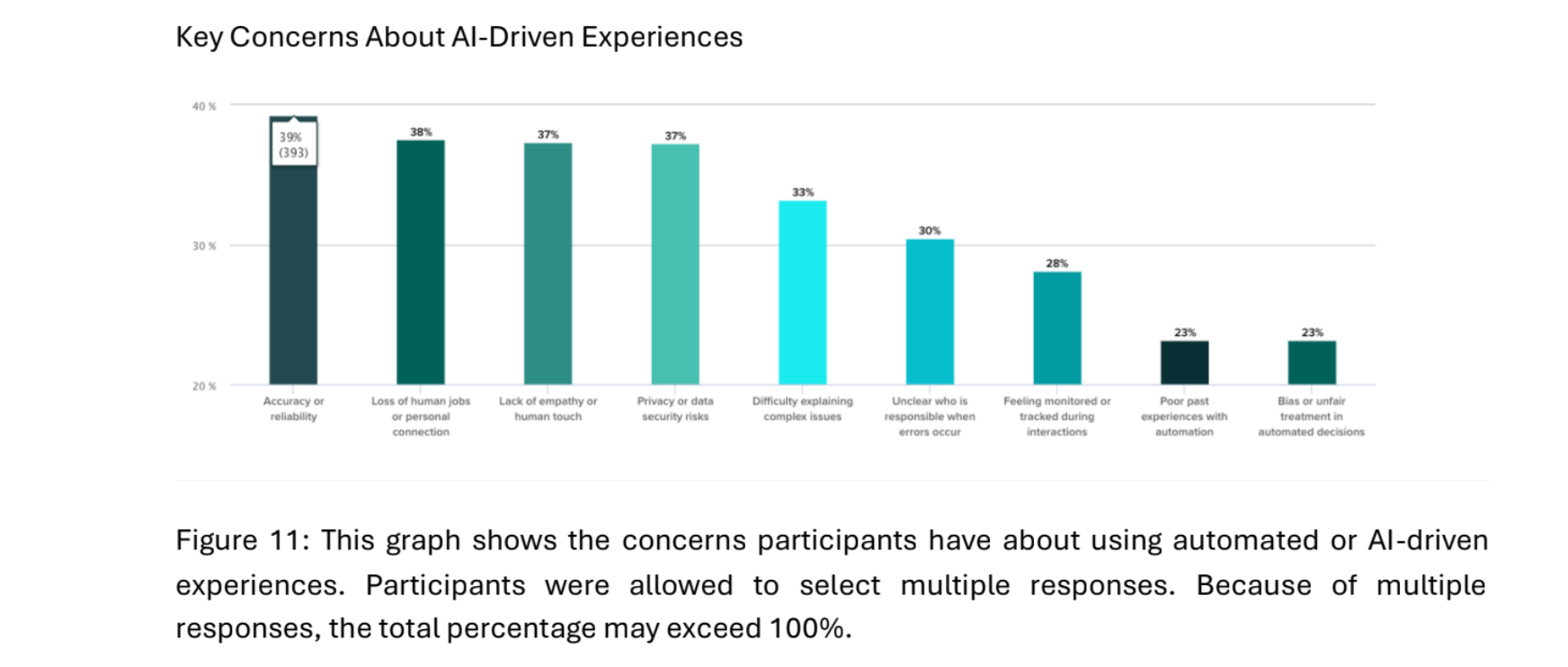
Top customer concerns around AI-driven experiences are accuracy of information (39%), the loss of human jobs and connections (38%), a lack of empathy, and privacy or data security risks (37%.)
But no matter how they feel about it, over half of customers are willing to use AI to improve the speed and convenience of their experience.
That said, customers prefer human interactions in certain situations, including healthcare, financial discussions, and emotional scenarios.
Customers Value Trust + Transparency
The study shows that personalization is still an important part of the customer experience - so much so that customers are now 10% more comfortable sharing their data than they were in 2025.
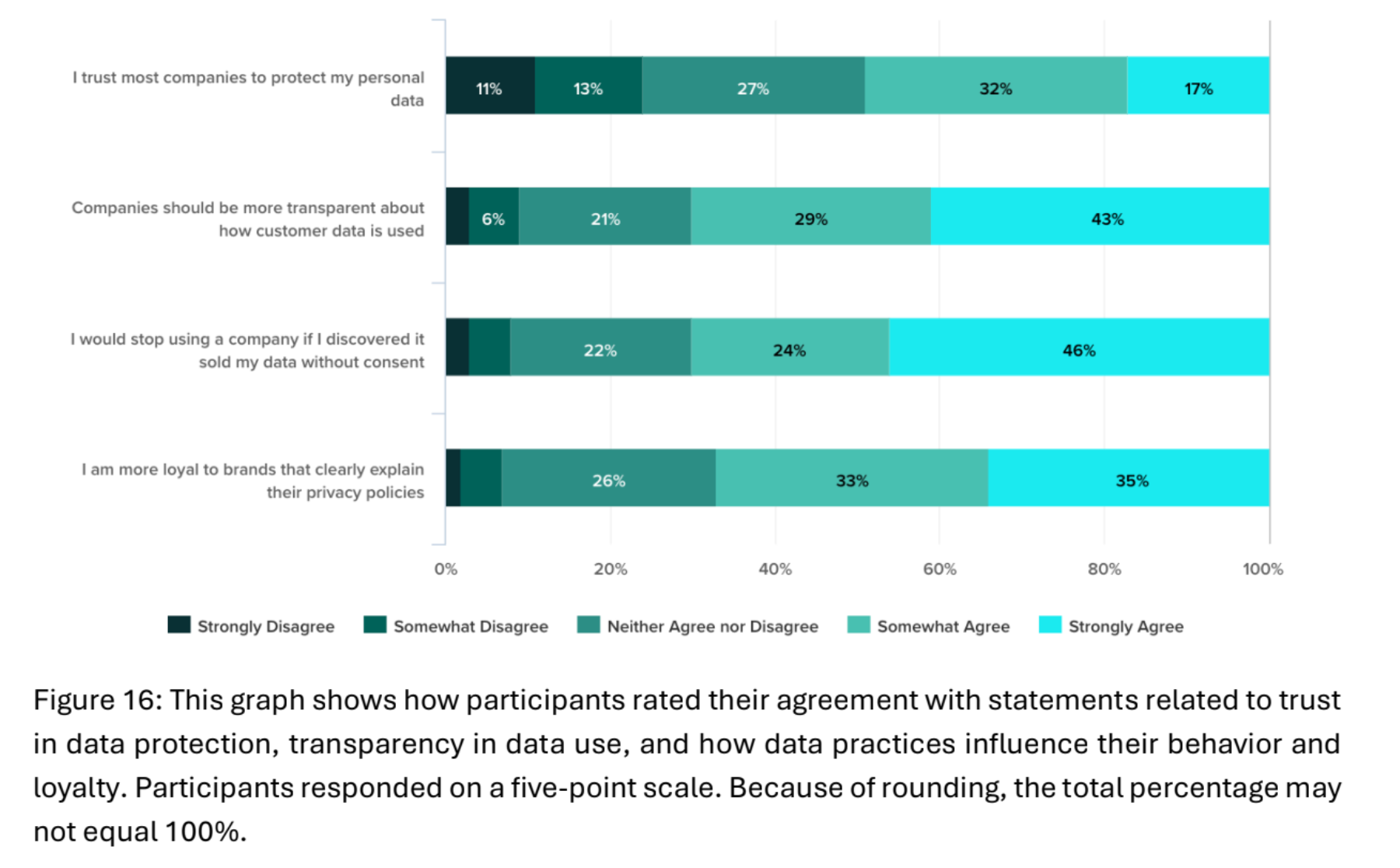
Though they may be more willing to share that data, only about half of customers actually trust companies to use it responsibly. 72% say that companies should be more transparent about how customer data is used.
Trust also impacts customer loyalty: 70% say they’d stop doing business with a company that sold their data without consent, while 68% are more loyal to brands that explain privacy policies clearly.
What makes customers trust a business?
The biggest drivers of consumer trust–and by extension, loyalty–are open and honest communication, respectful treatment, and data protection and privacy safeguards. 44% say that protecting customer data should be the top focus of companies over the next 10 years, while 27-28% say they should focus on improving transparency and building greater brand trust.
Customer Feedback Is Omnichannel, But Underutilized
Sogolytics’ Q1 2026 report found that while email is the most popular channel for customer feedback (43%) it’s become increasingly omnichannel. Today, customers also provide feedback via text messages (29%), phone calls (28%), social media 25%), in-app surveys (23%), and public review sites (22%.) Only 13% say they don’t generally provide customer feedback.
Though customers seem willing to provide feedback on any channel, most don’t feel the impact of that impact. Just 34% feel their feedback led to visible improvements, while 50% saw minor or no changes.
What This Means for CX In 2026
The Q1 2026 data from Sogolytics shows that customers are more demanding, more skeptical, and more conditional in their loyalty than in the past. The findings also indicate high levels of customer awareness around the gap between what companies promise and what they deliver - especially when it comes to implementing feedback.
The biggest surprise is how little it takes to lose a customer. A single negative moment can outweigh a history of positive ones, showing that loyalty isn’t gradually eroded, but can disappear in an instant. Customers are no longer relying on past experiences to guide future decisions. Instead, they’re evaluating brands in real time, making consistency, reliability, and follow-through more important than ever. Loyalty used to be something you built over time, shaped by repeated positive experiences and a sense of familiarity with a brand. But that model is shifting. Today, loyalty is something you have to constantly re-earn, with each interaction carrying a disproportionate weight.

The throughline across every finding here is trust. Yes, customers are fickle and always chasing the best deal, but perhaps the real reason loyalty is fading is because companies give them plenty of reasons to: inconsistent experiences, opaque data practices, feedback loops that go nowhere, and AI deployments that prioritize efficiency over connection.
Customers aren't asking for highly personalized experiences or convenience anymore. They're asking for honesty, consistency, and the basic sense that someone is listening.
Leaders that deploy AI thoughtfully, in the right contexts, with human backup where it matters, will pull ahead of competitors. Those that use it solely as a cost-cutting tool will feel it in their retention numbers.