August 13, 2026 • 5 min read
SAP Shares Its Vision for the Future of Customer Support, Outlines Its Differentiation

Director of Content & Market Research
August 13, 2026
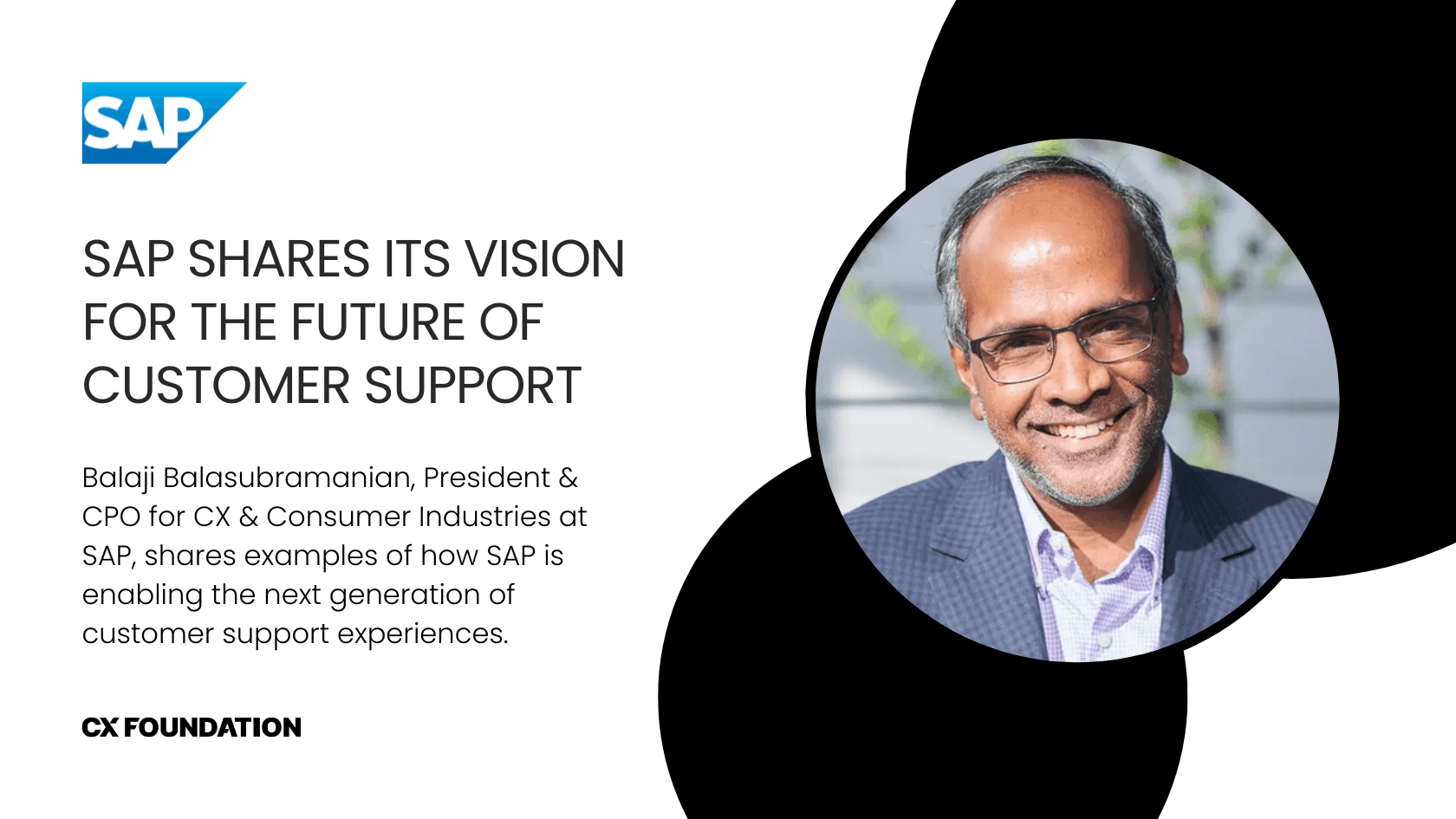
“Customer support should move from: ‘How quickly can we get the customer off the phone?’ to ‘How intelligently can we solve the customer's problem and turn that interaction into loyalty?’”
That’s the vision of Balaji Balasubramanian, President & CPO for CX & Consumer Industries at SAP, for the future of customer support.
At first, it doesn’t sound all that different. Neither do the modes in which SAP aims to support brands in turning interactions into loyalty.
Indeed, Balasubramanian touts more personalized experiences, pre-emptive interventions, and hybrid human-AI support workflows.
Across customer support, hundreds of technology vendors are making similar promises.
Yet, SAP believes its broad, connected ecosystem gives it a unique ability to transform the contact center into a loyalty engine that drives “profitable growth”.
“When you have the full enterprise data and the context, then AI can do a lot better to both assist a human being and take autonomous decisions that can drive a better, more proactive experience.”

But what do these loyalty-driving experiences look like in practice, and how is SAP building an architecture to deliver them? Let’s explore.
SAP’s Vision for the Future of Customer Support in Action
Take two common customer support scenarios: a pricing dispute and a delivery qualm. Here’s how a SAP customer may solve them in the future.
1. The Pricing Dispute
A customer emails about a pricing dispute. Instead of having a human support agent manually investigate everything, SAP puts AI to work.
In doing so, it extracts information from the email and attached documents, identifies the customer, and finds the relevant purchase order, invoice, and payment information.
From there, it checks the customer’s entitlements, applies preconfigured rules, and automatically suggests a solution to the issue, keeping a human in the loop where appropriate.
2. The Delivery Qualm
Consider the most common question asked of online retailers: where’s my order? For those organizations with numerous distribution centers, that’s not always easy to answer.
Yet, within an integrated SAP ecosystem, an AI agent could track delayed orders, where they are in transit, and - if something goes wrong - identify what other options or offers could be made to the customer.
So, instead of responding: “Sorry, your order went wrong," to an angry customer, the service system could take proactive action and contact the customer with a message: "Something has gone wrong with your delivery, we know where the product is, and here's what we're going to do to fix it."
SAP is already working with the likes of H&M to deliver a similar use case.
The Technology Behind the Vision
To bring the examples above to life, SAP is essentially building a three-layer stack.
First is the application layer, with SAP’s CX, finance, procurement, warehouse, supply chain, and order management solutions generating data that feeds into the SAP Business Data Cloud.
The Data Cloud aggregates it all - alongside data from non-SAP systems - into harmonized business entities, i.e., customers, orders, invoices, payments, fulfillment, inventory, etc.
Next is an ontology layer that gives the data meaning and relationships, connecting concepts such as customers, orders, invoices, products, inventory, and payments, while grounding those relationships in the underlying systems and processes.
Finally, a governance layer strictly defines the security measures AI agents need, ensuring safe access to data and strict limits on their actions.
AI agents sit on top of this architecture, taking that context either to recommend an action to a human or to take action and update the underlying applications.
“A customer email goes into the system of data, ontology understands it, AI runs on top. It looks at it, and figures out, okay, this issue can be autonomously resolved, and it will resolve it; it will fire back a message to them, and it will also update the customer service system.”
Yet, a customer contact doesn’t need to be the trigger. Across SAP’s ecosystems, AI could also recognize the patterns in back-office data that imply a customer issue. It may then alert a support agent or take pre-emptive action to remedy the issue before the customer reaches out.
In itself, that capability is significant in driving the next wave of individualized, proactive experiences, without complex system integration work.
What Comes Next?
Still, there is work to do. Even with the full SAP stack in place, realizing the next-generation service experiences outlined above will take significant time, effort, and resources.
Yet, expect SAP to start doing more of the heavy-lifting, pre-configuring the AI agents and assistants that work across its ecosystem.
In March, SAP already made major strides with the release of its Joule Assistants for Service, with three especially notable examples:
- A Self-Service Assistant that either solves contacts independently or passes context onto a human rep.
- An Interaction Management Assistant that supports reps in real time by surfacing data to accelerate time-to-resolution.
- A Case Management Assistant that gathers information, prepares cases for human agents and the Self-Service Assistant, and coordinates AI agents to automate some of the necessary steps to fulfill service requests.
Expect more pre-packaged AI agents and assistants that can access a breadth of cross-department data and act with functional awareness.
As these become available to buy, not just build, SAP will undoubtedly hope to support more of its customers in transforming the contact center into a growth center.
On that note, watch out for SAP Connect in October…