June 10, 2026 • 8 min read
Invoca Report: 7 Rules for AI Interactions With Customers

CX Analyst & Thought Leader
June 10, 2026
While consumers increasingly understand and accept AI agents (at times, begrudgingly) as a part of the customer experience, Invoca’s 2026 B2C Buyer Experience Report uncovers the key ground rules for customer interactions with AI agents.
But while at least 40% of U.S. consumers say they’ve spoken with an AI agent in the past 12 months, 37% say that AI made no difference to the experience at all: an 8-point increase from last year.
It begs the question: are all those AI investments really paying off if they’re not making any CX impact at all?
If you leverage AI the right way, the answer is a resounding yes.
Rule #1: Customers Prefer Human Agents For Service, But Use AI For Research
Consumers still prefer human agents over AI (especially during high-stakes interactions) and prioritize human connection. However, they’re increasingly using Gen AI to research purchases, compare prices, and understand complex topics.
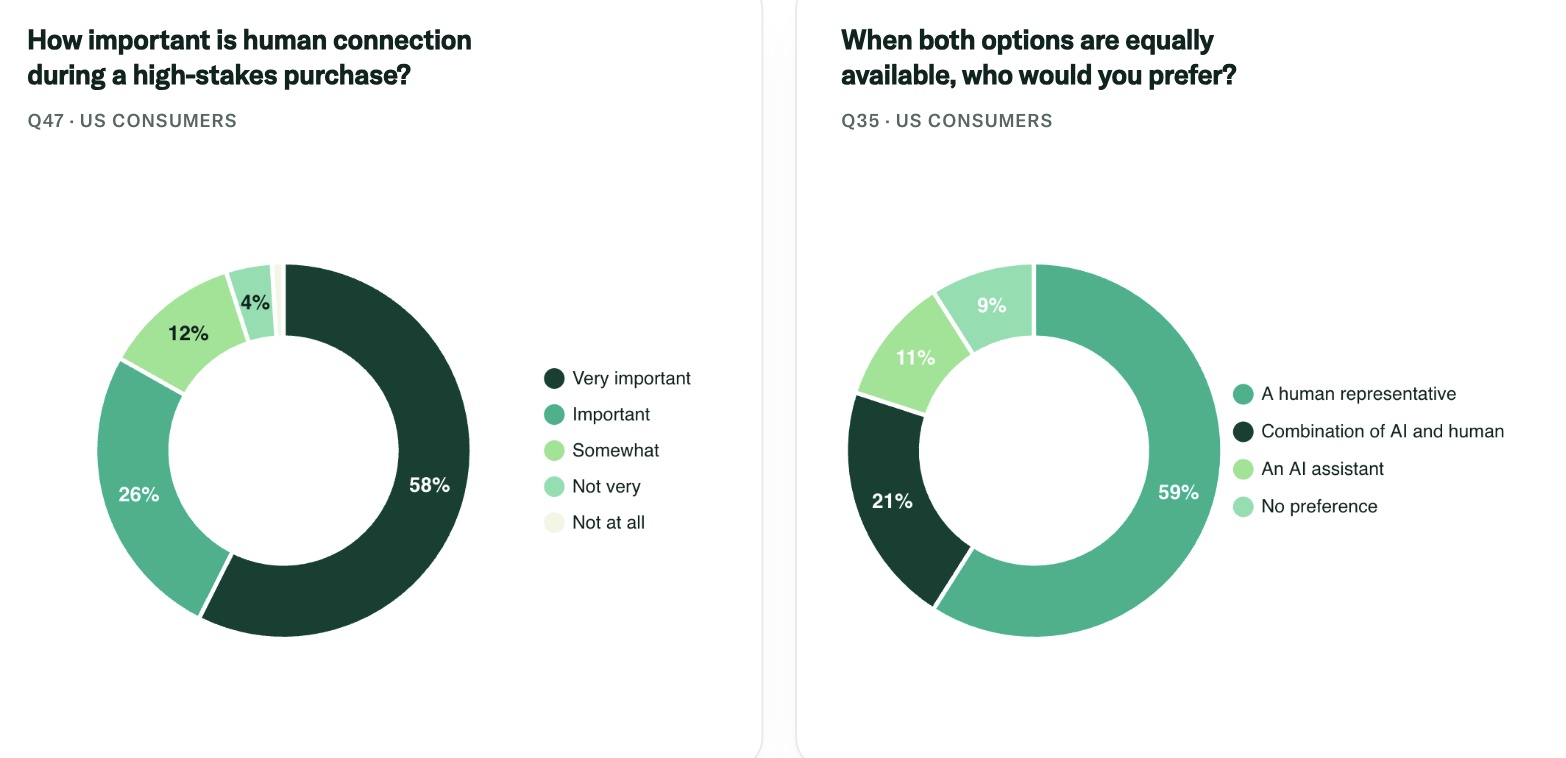
According to the Invoca Report, 59% of U.S. consumers prefer a human representative over an AI agent when both options are available. 43% say they feel less valued when interacting with a brand’s AI.
Clearly, human connection is incredibly important to consumers, especially during more complicated customer service requests or when making high stakes purchases.
Still, Americans are enthusiastic about AI for research purposes, especially during the buying journey.
58% have used Gen AI to research a high stakes purchase (a 17-point increase from last year). Others have used Gen AI to get a quick summary of options (32%), to compare prices and brands (25%), and to understand complex topics (22%).
Even Boomers, once firmly AI skeptics, are coming around: Gen AI use among Boomers grew by 23 points from 2025 to 2026.
AI has raised what people expect; the brands that keep customers use it to make the human moments better instead of trying to replace them.
Ben Sullivan
Rule #2: Use AI For Fast Tier-1 Support
Though human support is critical, consumers are increasingly choosing AI agents over human ones for specific situations: when they need fast support, and when they need basic task resolution.
Generally, U.S. consumers are more familiar with, and more accepting of, AI than ever.
Compared to last year, the number of consumers saying AI made the buying experience better increased to 46%, while the number saying AI makes it worse dropped by 11 points.
Though it may have taken some time for American consumers to warm up to AI, many now realize its benefits: namely, faster service and basic support resolution (and for 22%, to avoid talking to a real person.)
Consumers are more likely to choose an AI agent over a human one when they need help with simple tasks (49%), when they need fast answers (43%), or when they want to avoid long hold queues (35%).
Still, there are limits to what consumers will accept, and a significant 19% of them never prefer an AI agent to a human once (hence why so many executives are currently walking back those disastrous AI-only customer service plans.)
Rule #3: Speed of Response Is The Differentiator
In the age of AI automation, speed of response is crucial to the customer experience, and at times more impactful than the “human vs AI” debate. Customers are more likely to walk over slow service than they were last year, especially over long hold times.
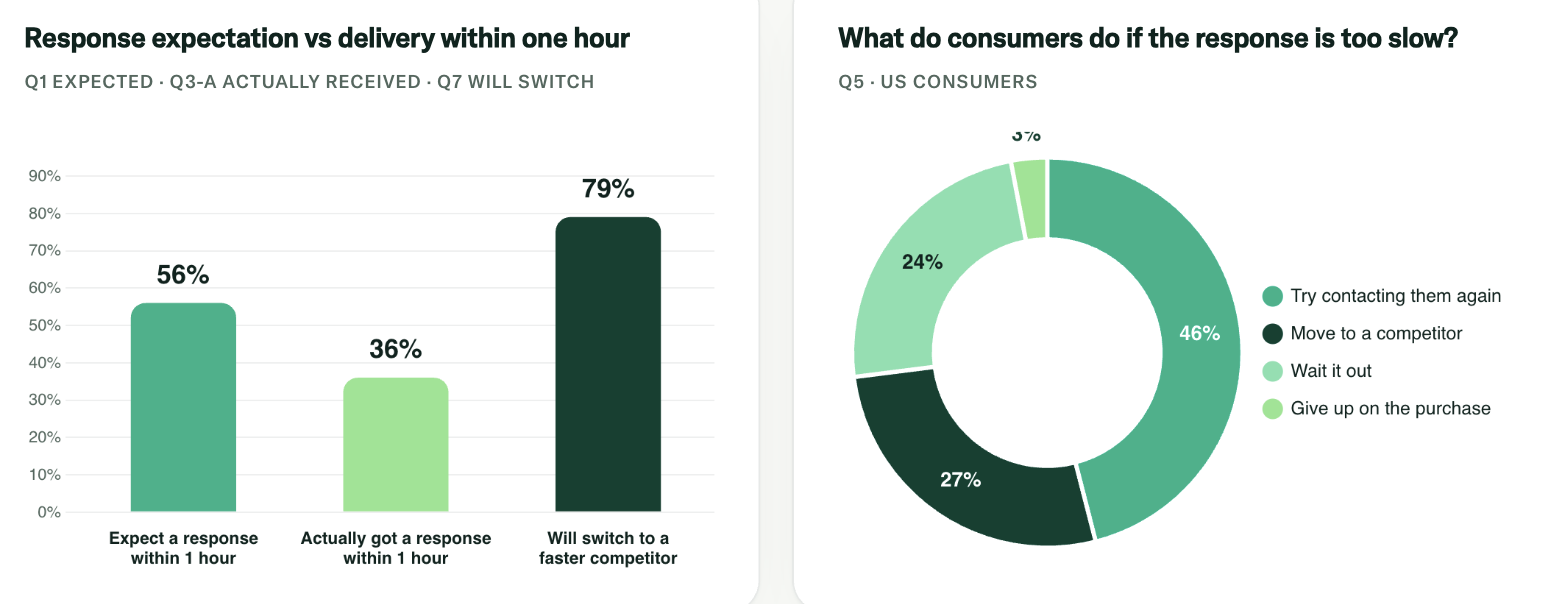
While many companies wrestle with the AI vs human agent debate, too many are forgetting that speed is the truly critical differentiator here.
This year’s customers are less likely to stop doing business with a brand after one bad experience compared to last year, but they’re more likely to walk over long hold times.
75% of consumers now hang up after being placed on hold for too long (a 25-point increase from 2025). 30% either abandon the purchase or switch to a competitor if they don’t receive a response within their expected time frame.
There's no human-only model that answers every form, call, and chat within the hour, every time. But speed alone isn't the answer. Speed without intelligence is just faster noise.
The job of AI is to engage instantly, understand intent in real time, then bring in the right human, with the full context, so the conversation picks up where it left off.
Rule #4: AI Fails At Nuance, Complex Support Needs, and Empathy
Customers are sick of fake AI empathy, incompetent AI agents, and are fed up with AI agents that don’t have conversational history and context. You can’t outsource human traits to AI agents.
When asked what AI fails at the most, consumers voted for uniquely human traits: 43% said AI was worst at nuance and context, while 36% said that empathy is what AI fails at the most.
However, the fact that 42% of consumers feel AI fails the most often at resolving complex support needs is especially alarming.
Clearly, most agentic AI is still unable to autonomously resolve difficult or complicated customer issues
So why continue to force customers to choose AI that doesn’t work and continues to dole out the “fake empathy” customers openly despise?
Again, the importance of easily available human agent is paramount here. Denying them could very easily cost you customers.
In a high-stakes purchase, trust is the whole relationship, and the moment a customer starts to doubt who or what they're dealing with, the experience is already working against them.
The brands getting this right build transparency into the experience itself: the AI is clear about what it is, handles the moment well, and brings in a human the instant the situation calls for it, with the context already in hand so the customer never has to repeat themselves or start over.
Rule #4: When AI Fails, It’s Your Company’s Fault
When your AI fails, consumers are nearly 3 times more likely to blame your company, not the AI tool, than they were last year.
First, the good news: 18% of consumers don’t blame anyone when AI fails.
The bad news is most (38%) blame your company alone, not the AI technology. 30% blame both your business and the AI tool, while only 14% say it’s the AI vendor’s fault.
Rule #5: Customers Expect Companies To Disclose AI Agents
Customers may be more accepting of AI, but 83% expect AI disclosure. Some feel tricked when they don't get one.
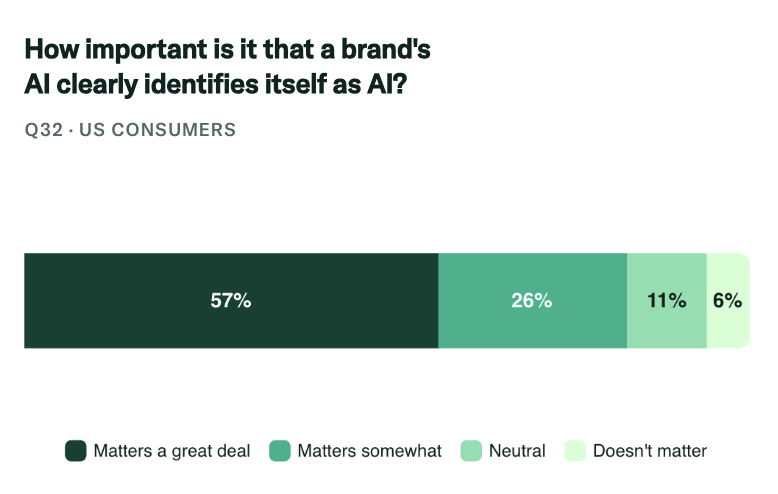
If your customers can’t tell if they’re talking to a human or an AI agent, they expect your company to tell them.
First, 83% of consumers say it’s important for a brand’s AI agent to clearly identify itself as AI, making AI disclosure a clear non-negotiable. AI disclosures should take place unprompted, at the start of every conversation, and without customers having to ask an agent if they‘re human or AI.
This is especially important given that 37% of consumers only realized they’d been talking to an AI agent after a conversation ended (and I have my suspicions about the 49% that claimed they’d “never been fooled” by an AI agent.)
But reconciling consumer desire for AI transparency with consumer desire for a fast, seamless experience is a challenge. While 83% want AI agents to immediately identify themselves, instant AI disclosure makes it impossible for AI to become a "functionally invisible" part of the customer experience.
According to Invoca CRO Ben Sullivan:
'Functionally invisible' doesn't mean entirely undetectable, it means frictionless. The goal isn't to fool anyone, it's to make the experience so fast and so well-informed that the customer never has a reason to stop and wonder who's helping them. Transparency doesn't break that, but a bad handoff does. An AI that can't answer the question, or won't let you reach a person, is where you lose the deal.
Rule #6: Forced Self-Service Remains An Issue
Nearly 100% of consumers feel forced to use brand AI occasionally, and over half feel forced to interact with brand AI “most or all of the time.”
Forced customer self-service, a topic I’ve covered extensively for CX Foundation, remains a serious problem. 97% of consumers feel forced to interact with brand AI at least occasionally, while 56% feel forced to interact with brand AI most or all of the time.
Forcing customers to use your AI agents and limiting access to human support is bad enough, but it’s even worse when that forced AI agent fails.
Make access to a human seamless, easy, and intuitive: stop gatekeeping real people from customers.
Rule #7: Customers Prefer Voice For Complex Issues
Voice is still the most important and trusted communication channel, whether talking to an AI or human agent.
For the third year in a row, and across every generation, voice calling remains the US consumer’s preferred communication channel for high-stakes, urgent, or more complex sales and support needs.
During the buying process, consumers usually call businesses for product or service information (56%), purchasing process information (34%), or because the information they needed wasn’t available online (26%).
If you’re looking to lower call volume, the report suggests, beefing up your customer knowledge base and optimizing your digital AI agents is a great place to start.