January 21, 2026 • 4 min read
Google Debuts a Customer Experience Agent Studio

Director of Content & Market Research
January 21, 2026
At NRF 2026, Google introduced a Customer Experience Agent Studio, which came as part of the new Gemini Enterprise for Customer Experience offering.
Gemini Enterprise for Customer Experience targets retailers with configurable AI agents that assist customers as they search for products online, purchase them, and seek support.
By combining commerce and support AI agents in one offering, with a single interface, Google is essentially encouraging retailers to consider customer experiences more holistically.
Instead of dividing customer-facing AI implementations between departments, which leads to disconnected journeys, Google wants retailers to collaborate internally and enable more fluid experiences.
As they do so, brands can bring “the same powerful agentic capabilities in [Google] AI mode” to their own app or websites, according to Sundar Pichai, CEO of Google.
Google also announced a Shopping Agent and, more pointedly, the Customer Experience Agent Studio, as part of Gemini Enterprise for Customer Experience.
The Shopping Agent aims to replicate a knowledgeable in-store sales associate online or within an app. In doing so, it answers questions and proactively recommends products.
Yet, the Customer Experience Agent Studio is where service leaders’ ears prick up, as this allows them to evolve their AI-led customer support strategies.
What Is the Customer Experience Agent Studio?
The Customer Experience Agent Studio offers a hub for retailers to build, test, and deploy AI agents for customer support.
Brands can apply these agents across their websites and apps. However, they can also scale them across conventional contact center channels, including voice.
As they build agents, retailers can create knowledge content and orchestrate resolution paths to guide AI agents across internal systems, autonomously handling queries.
While agent-to-agent communication must improve to make many of these workflows fully autonomous, Google’s advancing Agent2Agent Protocol shows that this is the direction of travel.
Another standout feature of the Customer Experience Agent Studio is the ability to build multi-modal experiences that blend voice, digital, and video.
Consider a support scenario where a customer is unhappy with a product. During a voice call, the AI agent could present a carousel of alternatives for them to flick through. That’s the future Google seems intent on building.
Additionally, contact centers may customize AI agents in the Studio that offer live guidance to support staff.
Nevertheless, perhaps it's the way the Studio interacts with the broader Gemini Enterprise for Customer Experience offering that’s most unique, allowing brands to blend service and commerce experiences.
For starters, AI agents built on the platform can connect with the Shopping Agent, enriching the service experience with context from the customer’s commerce journey.
More interestingly, however, there’s also a conversational intelligence layer that analyzes contact center conversations, calls into stores, and commerce engagements. Effectively, this enables brands to mine issues across the buying journey and broader customer experience that drive customer contact, and to share those insights beyond the contact center for action.
Again, this signals Google’s intent for brands to consider customer experience as something much bigger than customer support alone.
Google Isn’t Breaking Into the Contact Center Market
Some analysts have claimed that the Customer Experience Agent Studio announcement signals “Google has entered the contact center chat.” However, the cloud giant has delivered contact center solutions for almost a decade.
Still, it’s widely known for its Contact Center AI (CCAI) Suite. Launched in July 2018, this comprised virtual agents (powered by Dialogflow), agent assist, and conversational analytics.
After helping many notable brands overlay their on-premise environments with the suite, the cloud giant launched the Google CCAI Platform in March 2021, modeled on UJET’s CCaaS offering.
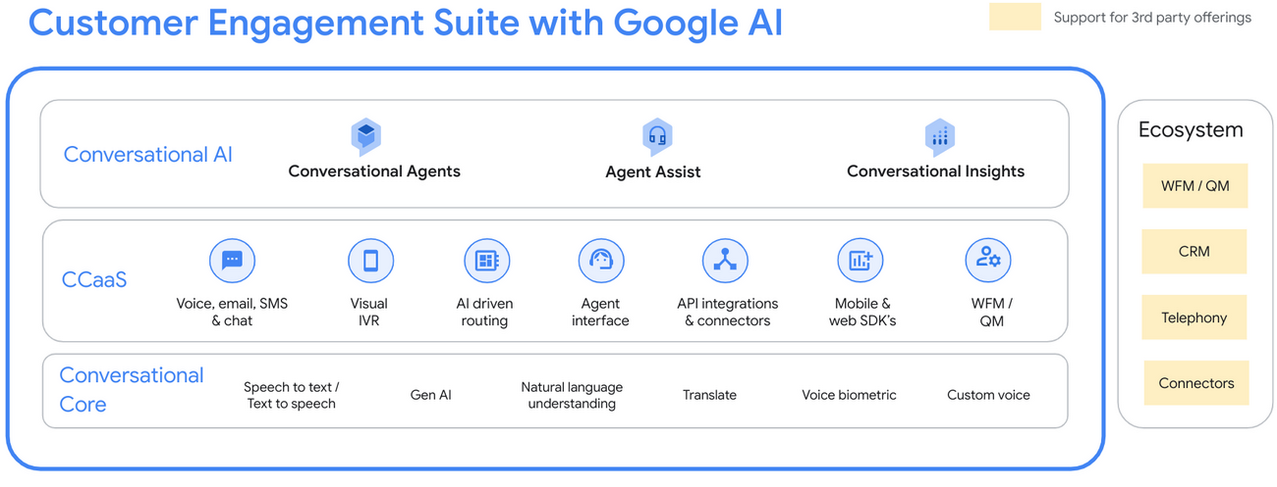
By September 2024, Google drafted the platform into a broader Customer Engagement Suite, which aimed to merge the worlds of conversational AI and CCaaS, per the image below.
As such, Google has a long history in the space. While it hasn’t marketed the Google Customer Engagement Suite in a way to compete for most CCaaS megadeals, this remains its core contact center offering.
So, don’t be confused, Google isn’t ripping up its contact center playbook. Instead, it’s placing a customer experience automation layer over customer service and commerce as part of an offering that primarily targets retailers.
When service teams leverage the solution, they’ll work on top of an existing CCaaS or on-premise contact center infrastructure.
Notably, Google recently teamed up with Five9 to deliver an integrated experience that lets mutual customers combine Five9’s AI with AI from Gemini Enterprise for Customer Experience.
As such, don’t read into this as a big play for Google to take contact center market share. Instead, it’s an attempt to assimilate cross-department customer-facing AI efforts into something more intelligent and fluid.