February 20, 2026 • 5 min read
Elon Musk Eyeballs the Customer Service Outsourcing Market with “Macrohard” Project

Director of Content & Market Research
February 20, 2026
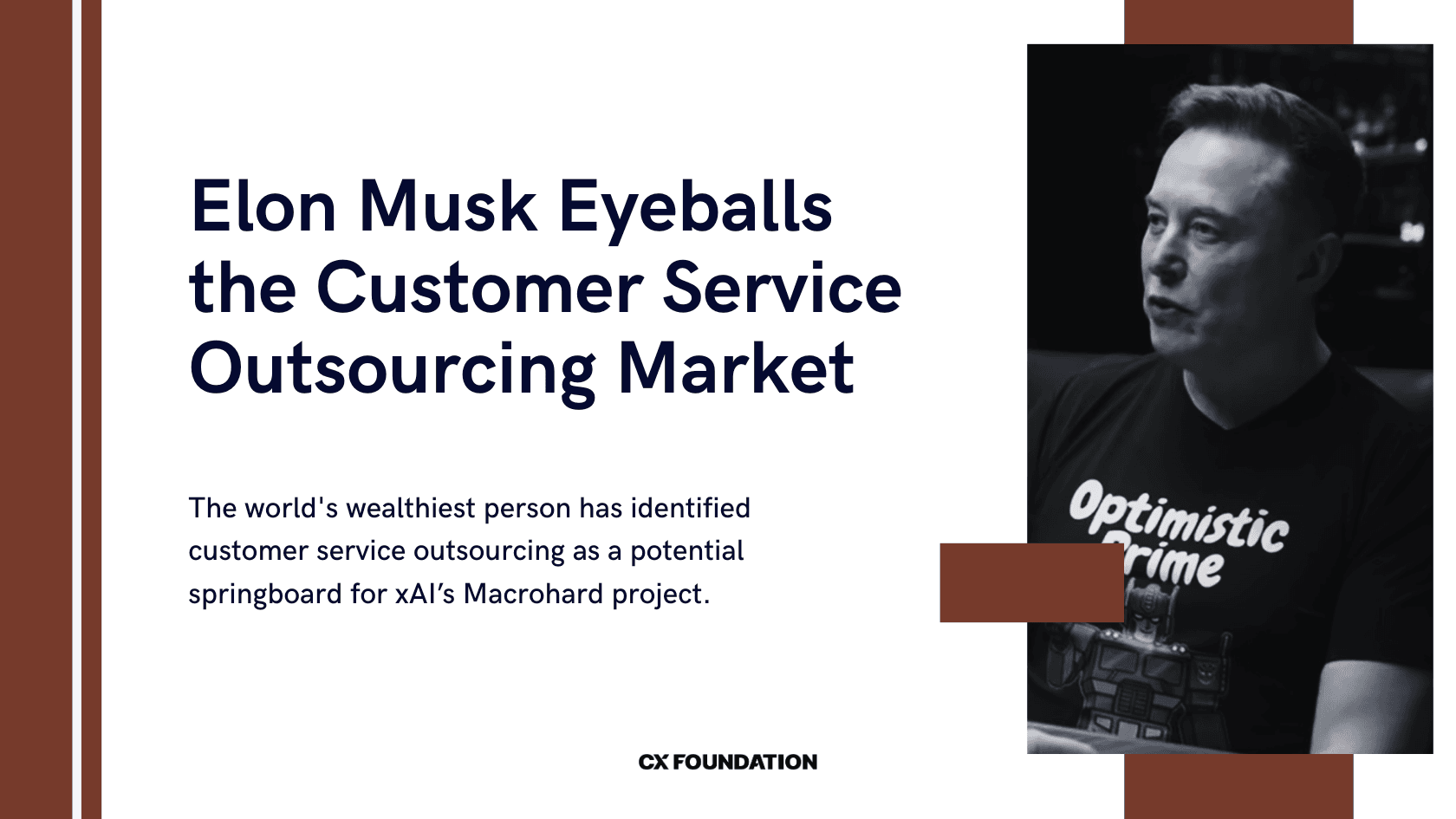
Elon Musk has identified customer service outsourcing as a potential launchpad for xAI’s Macrohard push into the enterprise.
Macrohard is a project Musk launched in June 2025 to develop the next generation of AI agents, which operate computers and work across a desktop just like humans do.
The long-term goal of Macrohard, which is a pun on ‘Microsoft’, is to fully emulate the digital work of entire companies.
At this point, Musk’s ‘human emulators’ are far from ready to deal with the integration complexity and legacy software of internal customer service stacks.
However, he soon sees an opportunity for Macrohard to automate the work contact centers offload to business process outsourcers (BPOs).
“If AI can simply take whatever is given to the outsourced customer service company… and do customer service using the apps they already use, then you can make tremendous headway,” Musk said while making an appearance on the Dwarkesh Podcast earlier this month.
“There are no barriers to entry. You can immediately say: ‘We’ll outsource it for a fraction of the cost,” and there’s no integration needed.”
While this idea may seem futuristic, xAI isn’t the only tech giant experimenting with the technology. Indeed, OpenAI introduced a Computer-Using Agent (CUA) model in January 2025.
Google is also making significant advancements, unveiling SIMA, its Scalable Instructable Multiworld Agent, in November 2025, which has learned to play several video games in 3D.
In doing so, the search engine giant proved that this next generation of agents can learn across domains, thinking through its goals and acting accordingly.
These examples underscore just how quickly the technology is evolving. Yet, the prospect of automating digital work altogether, in customer service and beyond, has received a mixed response online from customer experience professionals.
How Did the Customer Experience Community React?
John Walter, President of the Contact Center AI Association, shared a post after Musk’s podcast appearance, which drew significant attention from the customer experience community.
Some shrugged, with one user commenting: “I don’t see the novelty here. Is it not just RPA (robotic process automation) on steroids, a.k.a. AI-enabled automation?”
However, others showed more enthusiasm. Indeed, Adrian Mercer, Co-Founder of AutoQuill AI, wrote: “The no-API approach is what makes this interesting. Most AI voice deployments right now need deep integrations and custom webhooks.”
“If Macrohard can actually operate existing CX platforms the way a human agent does, that changes the build vs. buy calculation for a lot of companies.”
However, despite the technology’s potential, perhaps the most common response was from those placing doubt over where many customer experience leaders would ever trust X to own their client relationships and access their internal systems...
Blockers to Macrohard & Similar Projects in Customer Service
While AI agents are fast-improving, regulations, rising costs, and enterprise readiness will prove major blockers to projects like Macrohard getting off the ground and augmenting customer service operations.
Regulatory Barriers
The idea of AI agents automating digital work will likely receive pushback from governments eager to protect jobs. Already, there are multiple proposed bills in the U.S. aiming to mandate the right to human customer service.
For instance, in January, a California lawmaker introduced the AB1609 Right to Human Customer Service Act, which would require companies to provide access to a human representative within five minutes across all customer service channels during business hours.
Earlier, a bipartisan bill proposed in the U.S. Senate - the “Keep Call Centers in America Act of 2025” - sought to mandate that companies disclose when customers are interacting with an AI agent and give them the option to be routed to a U.S.-based human service representative.
While these legislative efforts may be a response to AI-driven customer experiences designed primarily to cut costs rather than improve service quality, they could nonetheless throw a spanner in the works for AI giants promising to automate more customer service work.
Rising AI Costs
As customer service AI use cases become more complex, they’ll consume more tokens and require more expensive expertise to maintain. That will add costs to today’s AI implementations.
Additionally, AI providers will start to move from subsidized growth to profitability, while enduring rising data center costs, which will also push prices up on end users.
Gartner pinpointed several of these factors when predicting that by 2030, cost per resolution for generative AI (GenAI) will exceed $3. That is more than many global BPOs pay their staff.
“Full automation will be prohibitively expensive for most organizations; instead, leading organizations will use AI to drive customer engagement rather than to cut costs,” concluded Patrick Quinlan, a Sr. Director Analyst in the Gartner.
Governance Headaches
As AI becomes more capable, governance, accountability, and supervision considerations will become thornier.
For instance, who will take responsibility if an agent ‘clicks’ on the wrong button, and how are such failures reported back to humans?
While the rise of AI supervisors is another trend to watch, it’s hard to consider a future where human leadership and operational structure loosen.
xAI’s Recent Track Record…
xAI has been on the receiving end of many gruesome headlines of late, with onlookers taking aim at its weak content guardrails, which enabled Grok users to share non-consensual, sexualized imagery.
Given these guardrail shortcomings many may smirk at the idea that organizations would ever place customer relationships so firmly into the company’s hands.
Yet, this doesn’t just apply to X, other big tech players should also be mindful of this.
Think back to when Meta tried to enter the CRM space by snapping up Kustomer. One possible reason this endeavor failed is that brands didn’t trust Meta with their customer data, and these perceptions are key.
Go deeper into the latest big shifts in customer service by checking out our article: 15 Contact Center Trends to Watch Out for in 2026