October 1, 2026 • 5 min read
What The ElevenLabs $22B Valuation Means for the Future of CX

CX Analyst & Thought Leader
October 1, 2026
On September 30, Voice AI powerhouse ElevenLabs announced a valuation of $22 billion, roughly 2,444 times its initial 2022 valuation of $9 million and double its Series D valuation on February 4 of this year.
The valuation is based on ElevenLabs’ recent $300 million employee tender offer, about which early conversations began in July of this year. This represents a marked increase from ElevenLabs’ September 2025 $100 million employee tender offer and $6.6 billion valuation.
The $22 billion valuation announcement is the latest in a series of successes for ElevenLabs. In May 2026, ElevenLabs hit over $500 million in ARR and helped its over 10,400 voice creators earn over $22 million. This year, the company also launched Music v2.5 and ElevenLabs for Government.
Enterprise Conversational AI Agents As Major ElevenLab Growth Drivers
While the employee tender is what set the $22 billion valuation, something else has been driving ElevenLabs’ seismic growth in the past year: increased enterprise demand for ElevenAgents, the platform’s conversational agents.
Today, over half (55%) of ElevenLabs revenue comes from enterprise customers. Many of these enterprise customers, including Stripe, SevenRooms, Deutsche Telekom, and the Ukrainian and Greek governments, have ElevenAgents in production.
ElevenAgents now handle over 15 million weekly conversations. Since February, ElevenAgents now handle three times more conversations and have seen an over 3x increase in ARR.
As ElevenLabs has grown its conversational agent business, the combination of research, product, and deployment has proved an important structural advantage. The team is able to make improvements at every layer of the stack, allowing them to execute at high velocity and deliver immediate value for its enterprise clients. The rapid growth of ElevenAgents is a testament to this."

Other Recent ElevenLabs News
The September 30th news comes on the heels of several other major ElevenLabs announcements over the past month, signaling a period of rapid growth.
Eleven v4 and v4 Turbo Models
Two days earlier, ElevenLabs introduced what it calls its “most expressive models yet”: the highly emotive Eleven v4 model and its low-latency counterpart, Eleven v4 Turbo. An Artificial Analysis comparison ranked Eleven v4 as the #1 model, and ElevenLabs beat out competitors like Cartesia Sonic 3.6, Inworld TTS2, and Google Gemini 3.8 Flash + Flash-Lite TTS.
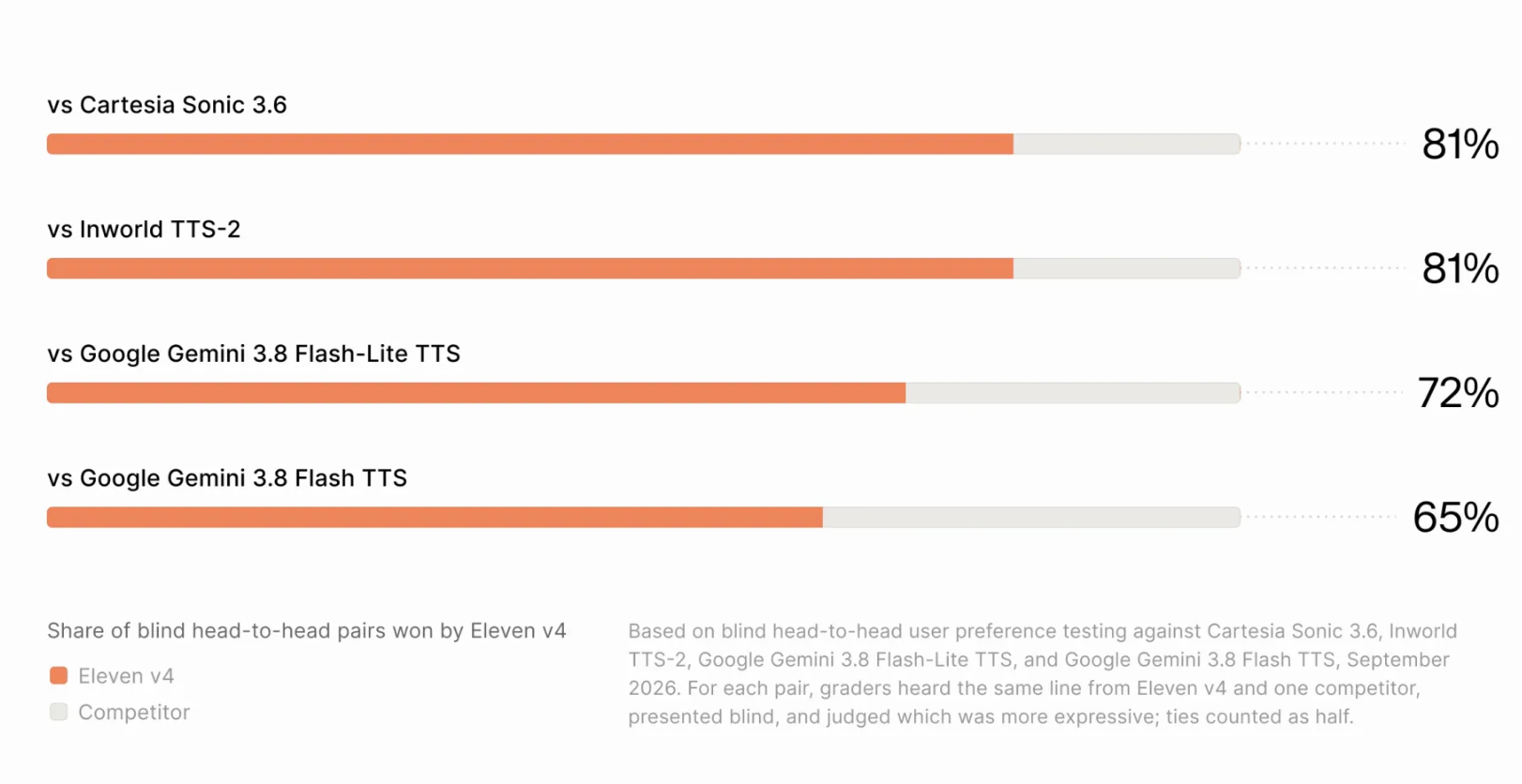
Eleven v4 delivers less mechanical-sounding voices across multi-speaker conversations and is more tone and context-aware. Eleven v4 Turbo is the better option for live customer service conversations, boasting both greater emotion depth and higher speed, with median inference latency of roughly 100ms. Users can add emotion-specific and sound effect inline tags for even more naturalness. Both models offer support for over 90 languages and can clone voices with only 10-second audio samples.
New CRO and CFO Appointments
On September 2, former OpenAI Enterprise VP Ashley Kramer was appointed ElevenLabs Chief Revenue Officer. Kramer brings with her 20+ years of experience at additional tech powerhouses that include GitLab, Alteryx, Amazon, dbt Labs, Seeq, and others. On September 8, ElevenLabs appointed former Adyen CFO Ethan Tandowsky as its Chief Financial Officer. During Tandowsky’s 2016 to August 2026 stay at Ayden, he helped the payments company increase revenue 20x, grow from 400 to 5,000 employees, and go public in 2018.
“AI should interact with people the way we interact with each other. Getting this right will help ensure AI diffuses widely across the economy, and everyone is able to shape and benefit from it, regardless of technical skill. We’re already seeing rapid adoption of expressive voice agents by enterprises and governments, who are deploying them in service of consumers and citizens. As we grow, it’s important to us to let our people share in some of the value they are creating for our customers and the wider world."
Mati Staniszewski

Two days later, ElevenLabs announced a multi-year licensing deal with Universal Music Group, the largest record label in the world. ElevenLabs and UMG are currently developing an AI-powered music platform that will, among other things, legally allow users to remix, mashup, and reinterpret works from UMG artists that opt in.
CX Vendors vs LLM Developers: Who Owns The Future of CX?
The popularity of ElevenAgents reflects one of the most talked-about trends in the space today: are traditional CCaaS and CX vendors at risk of being replaced by the companies actually making the AI models?
Foundational models (OpenAI, Claude, Deepgram, Suno, etc.) are now an inarguable part of the CX equation, giving CCaaS vendors little choice about adopting an open-weight, “bring your own model” approach. While orchestration and decades of industry expertise remain huge advantages for traditional contact center solutions, the reality is that they still require customers to stitch together different tools.
Unlike their CCaaS/CX counterparts, ElevenLabs and other foundational model providers own the full stack: they develop and refine the models, they build the application layer, they control their own pricing…the list goes on, not to mention the competitive funding advantage that Voice AI in particular has today.
This has created a palpable “identity crisis” within the customer experience space: while they’ve largely prevented the SaaS-pocolyse, most traditional vendors still haven’t (at least, in my view) convincingly nailed down how to convince customers of their long-term necessity.
The CX providers I see having the most success right now are those that aren’t ashamed to be transparent about that. Long-term success (survival?) will likely favor traditional CCaaS vendors that embrace the advantages full-stack model providers have to offer their enterprise customers instead of trying to compete with them.