October 2, 2026 • 7 min read
Decagon Dialogues 2026: Preparing For the Agent-to-Agent (A2A) Era

CX Analyst & Thought Leader
October 2, 2026
From provider analyst conferences and CX Guides to frenetically-paced instructional YouTube videos, talk of personal AI assistants and the resulting Agent-to-Agent (A2A) communication is everywhere. These conversations are a blend of anxiety, excitement, and trepidation about how to make way for A2A communication without massively increasing compliance risks and competitor advantages.
Even AI detractors admit to seeing the benefits of having an AI assistant that autonomously books appointments, contacts customer support, finds the best prices, and takes mundane tasks off their plates entirely.
As a result, tech companies are chomping at the bit to come out on top in the latest iteration of the AI Arms Race: personal AI assistants. On September 8, Meta launched Muse. OpenAI announced dots a few weeks later at DevDay. Instinct, Pally, Folk, and Perplexity Computer have also thrown their hats into the ring.
Of course, intelligent personal assistants come with a fair share of failures. News outlets have labeled Meta Muse an “AI Trojan Horse.” Amazon has already blocked Meta Muse. A reporter for Inc. claimed Muse read their private messages without consent. Seemingly intentionally vague opt-in settings have already caused major headaches. The list goes on, and at this point, the general public doesn’t appear to believe the benefits outweigh the risks.
Decagon Launches Personal Agent Gateway
Decagon is looking to change that, and to help businesses prepare for the inevitable A2A reality. On October 1 at Decagon Dialogues, Co-Founder and CEO Jesse Zhang announced Personal Agent Gateway, a communication layer that manages how enterprises can safely and efficiently interact with third-party personal AI assistants.
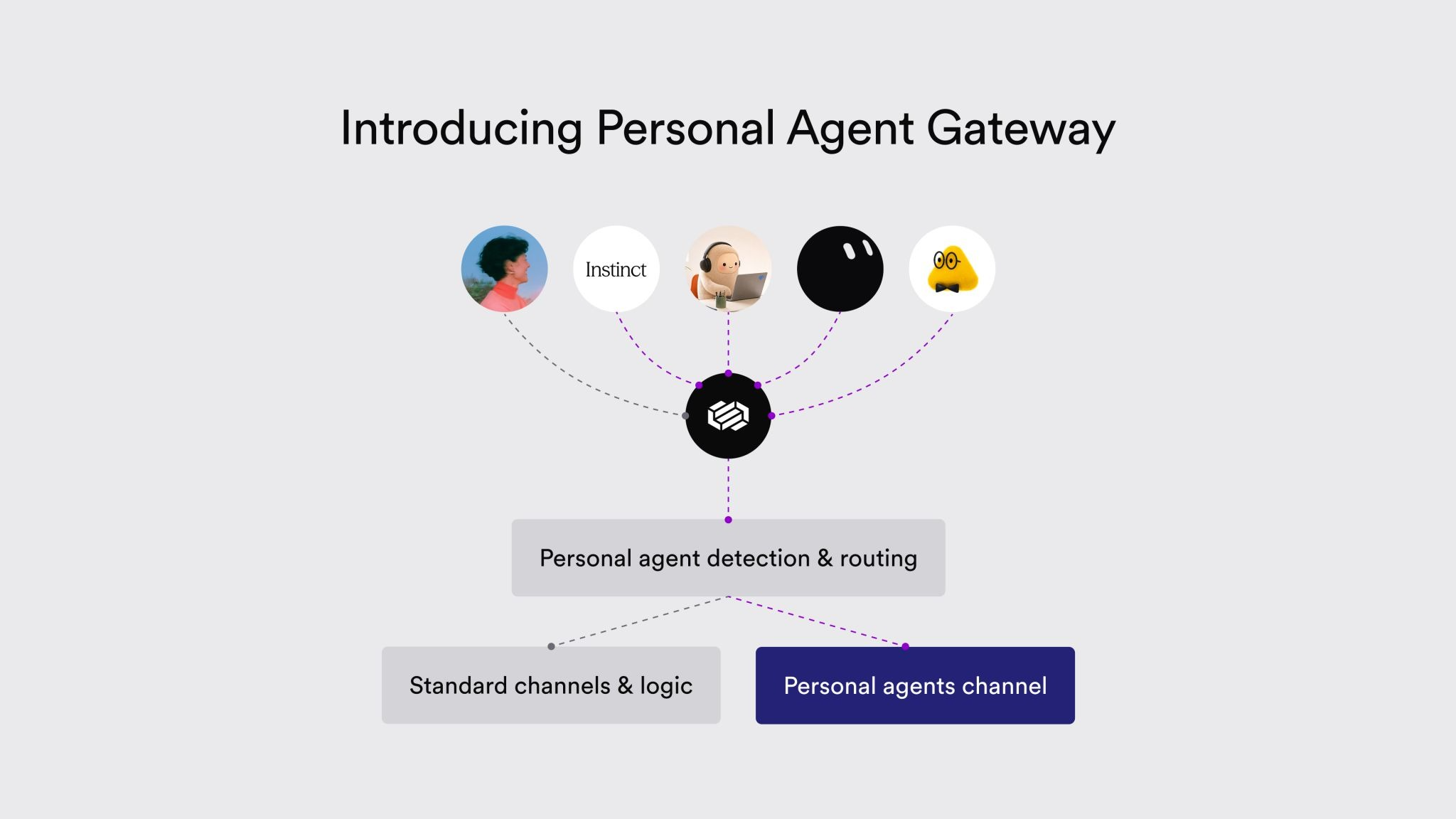
Decagon’s Personal Agent Gateway is designed to address the biggest risks and pain points of enterprise interaction with customers’ personal AI Assistants: proper identification, A2A communication channels and routing, authorization, and resolution that allows for the possibility of human intervention.
To that end, Personal Agent Gateway offers personal agent detection, a clear channel for A2A communications, secure authorization, and permissions.
Personal Agent Detection
Personal Agent Detection identifies likely personal AI assistants across both chat and voice, so agents understand if they’re talking to a human customer or their virtual advocate – whether or not AI personal assistants identify themselves as such.
Personal agents will become a major interface between customers and businesses…As they get better, customers will hand off more of the work of interacting with businesses to them. That creates a new challenge for businesses. Blocking personal agents risks creating a worse customer experience, but letting them interact like any other customer means giving up important control over identity, permissions, and how requests are handled.”
Jesse Zhang
Signals like account history, device fingerprints, and even conversational cadence help with the detection process.
Personal Agent Channel
Once the Personal Agent Gateway identifies that it’s talking to a personal AI concierge, it needs to know where to direct it.
To streamline the process and ensure that agents aren’t endlessly navigating websites and phone trees, Decagon forwards the personal AI Assistant to a channel specifically built for Agent-to-Agent communication.
Conversations between human customers and the personal AI agents representing them should be handled differently. Having a dedicated A2A channel makes that possible.
Agent Operating Procedures (AOPs)
Humans have Standard Operating Procedures (SOPs). Decagon’s Agent Operating Procedures (AOPs) ensures AI agents can execute complex, multi-step workflows with proper guardrails and complete visibility.
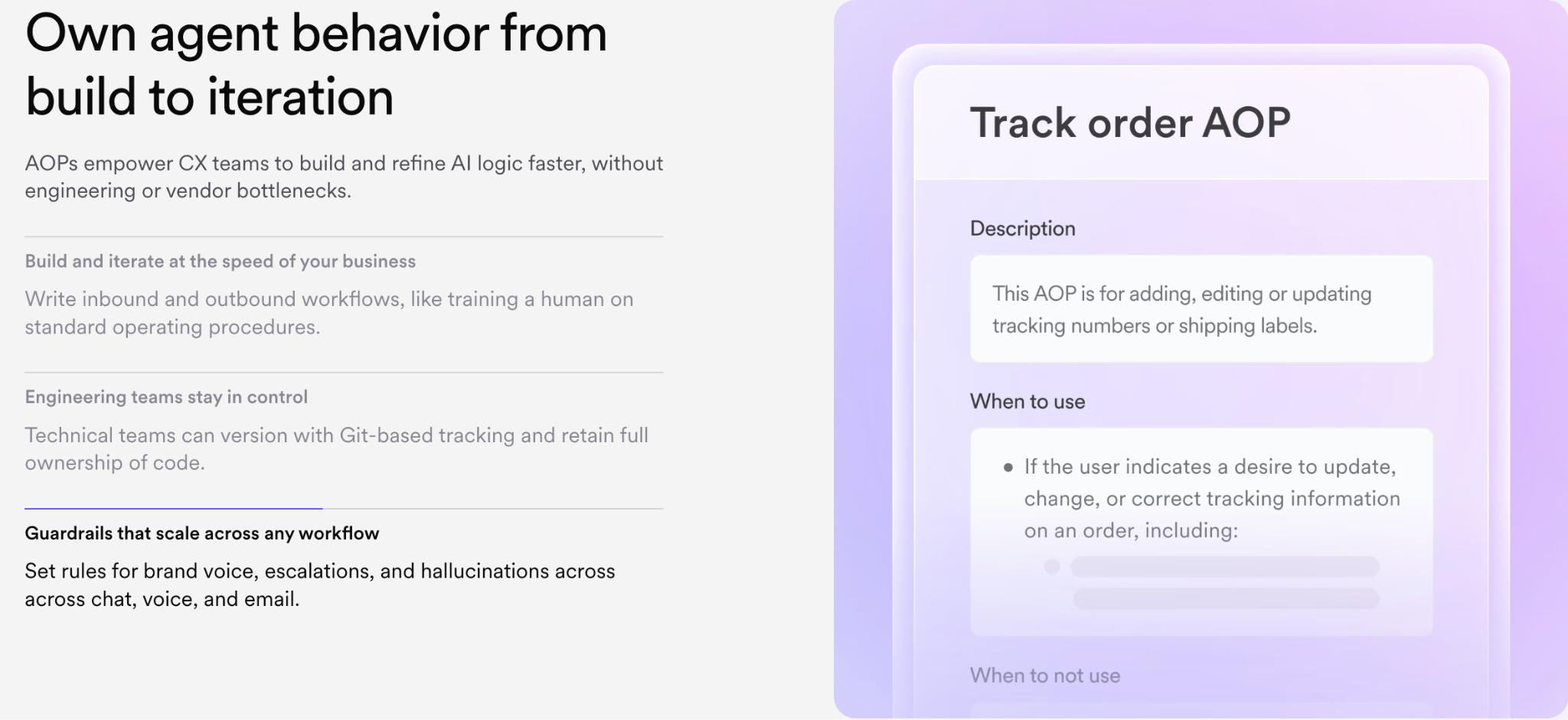
AOPs combine natural language instructions and code. This allows non-technical teams to model basic AI logic, while engineers maintain control, connect to internal systems, and hook in underlying code. Enterprises can test and refine AI agents, pull data and execute workflows across integrated tools, and get clear insight into AI agent decision logic.
AOPs are also where businesses can control permissions, set agent scope, and define what AI agents can and cannot handle.
The result, per Zhang himself, is “secure, reliable, and AI-native CX at scale.
Personal Agent Consent + Trust (PACT)
Decagon’s PACT (Personal Agent Consent and Trust) protocol verifies what the personal AI assistant is allowed to do and who specifically it represents.
While of course, customers themselves define what their own AI assistant can and can’t do on their behalf, PACT uses OAuth 2.0-based delegated authorization. This ensures the AI assistant can actually do what it claims to be able to.
Plus, Because the customer themselves granted the permission, enterprises have a record of stated customer authorization, offering companies another layer of protection.
As of this writing, Decagon is continuously refining the protocol for maximum success.
Additional Decagon Dialogues Announcements
Personal Agent Gateway was far from the only announcement made at Decagon Dialogues, which took place October 1st in San Francisco and included a conversation with Mayor Daniel Lurie.
Decagon also launched Voice 3, Duet Apprentice, and Agent Modules.
Voice 3
Zhang calls Voice 3 “our most advanced voice experience for natural, real time customer conversations.” It combines Chord, Decagon’s voice model post-trained specifically for live customer conversations, with a duplex architecture that lets agents listen, speak, and act simultaneously.
The result? Less dead air, on-the-fly pacing adjustments, better interruption handling, and more human-like conversations.
"Customers have been trained for years to speak in short fragments at these IVRs just to get through to a human. The problem is, an LLM can't do its job without real dialogue and context. But with Decagon the voice sounds like it's actually listening, and it keeps the conversation moving instead of going quiet while it works. People start talking to it naturally without even thinking about it. That's what Decagon delivers."
Christian Niedworok
As of this writing, Voice 3 is available in 70+ languages. In a blind test conducted by Decagon, 90% of listeners could not tell the difference between a human voice and a voice that was run through Chord.
Duet Apprentice
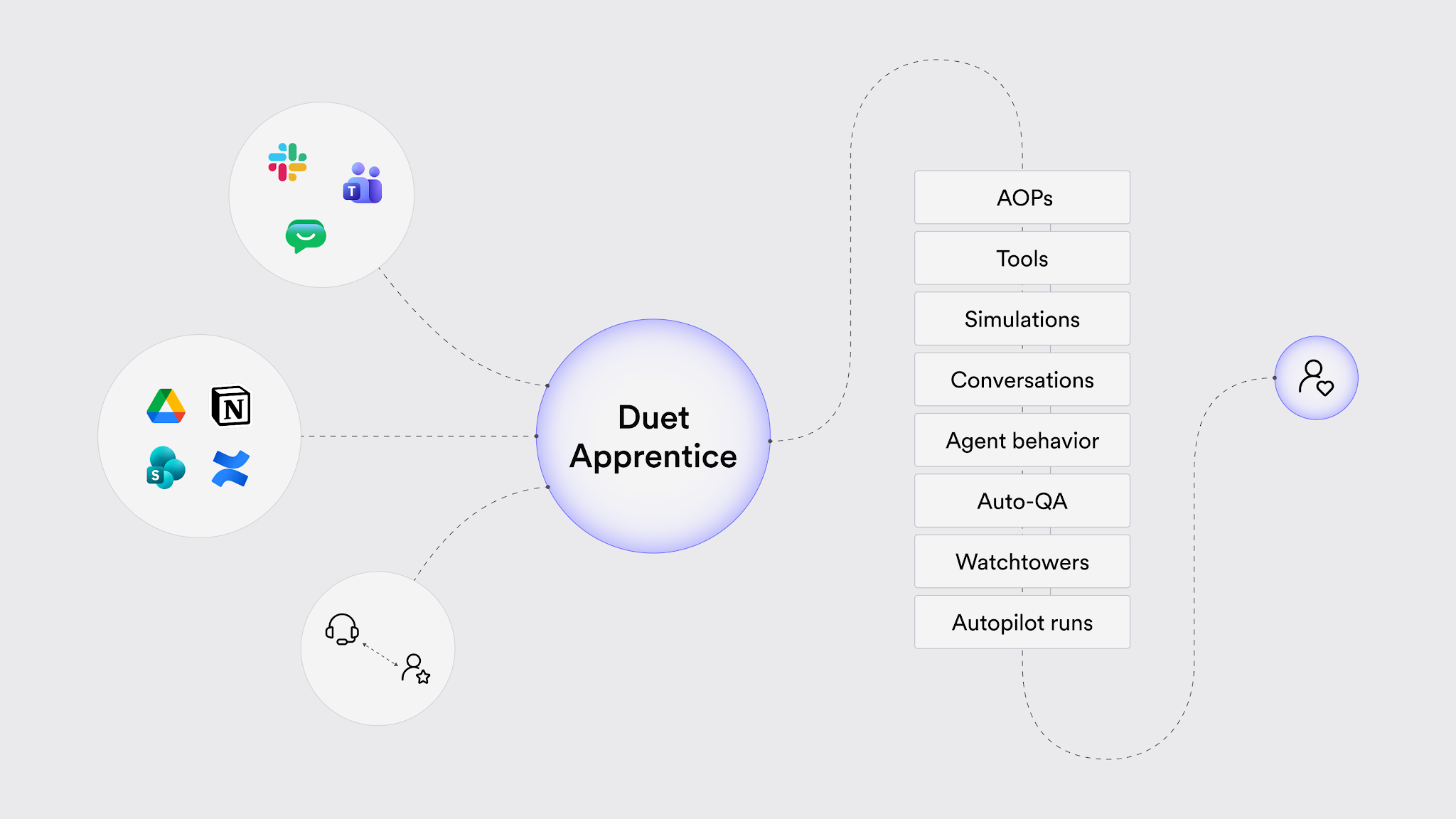
Duet, Decagon’s agent building companion that currently writes over 70% of platform AOPs, also got an upgrade at Decagon Dialogues: Duet Apprentice (currently in beta.)
Duet Apprentice optimizes the onboarding process by allowing Duet to connect to enterprise knowledge systems, onboarding documents, and process wikis in third-party tools like Notion and Google Drive.
Duet Apprentice also analyzes edge cases that were routed to a human representative, learning from your best real-life agents and self-improving accordingly via Duet Autopilot.
“Duet lets our team build and iterate on agent logic without pulling resources away from the roadmap. That matters at Perplexity, where we ship product changes every day and our agent has to keep pace."
Jenn Palk-Cogley
As of this writing, Apprentice offers plugins for Microsoft Teams and Slack to follow real-time decision-making and to message for clarification.
Agent Modules
Your AI agent is increasingly your business’s front door, but today’s reality means that AI agents have to be able to handle much more than just customer support. Enterprises now use AI agents for sales, onboarding, lead qualification, payment collection, upselling…the list goes on.
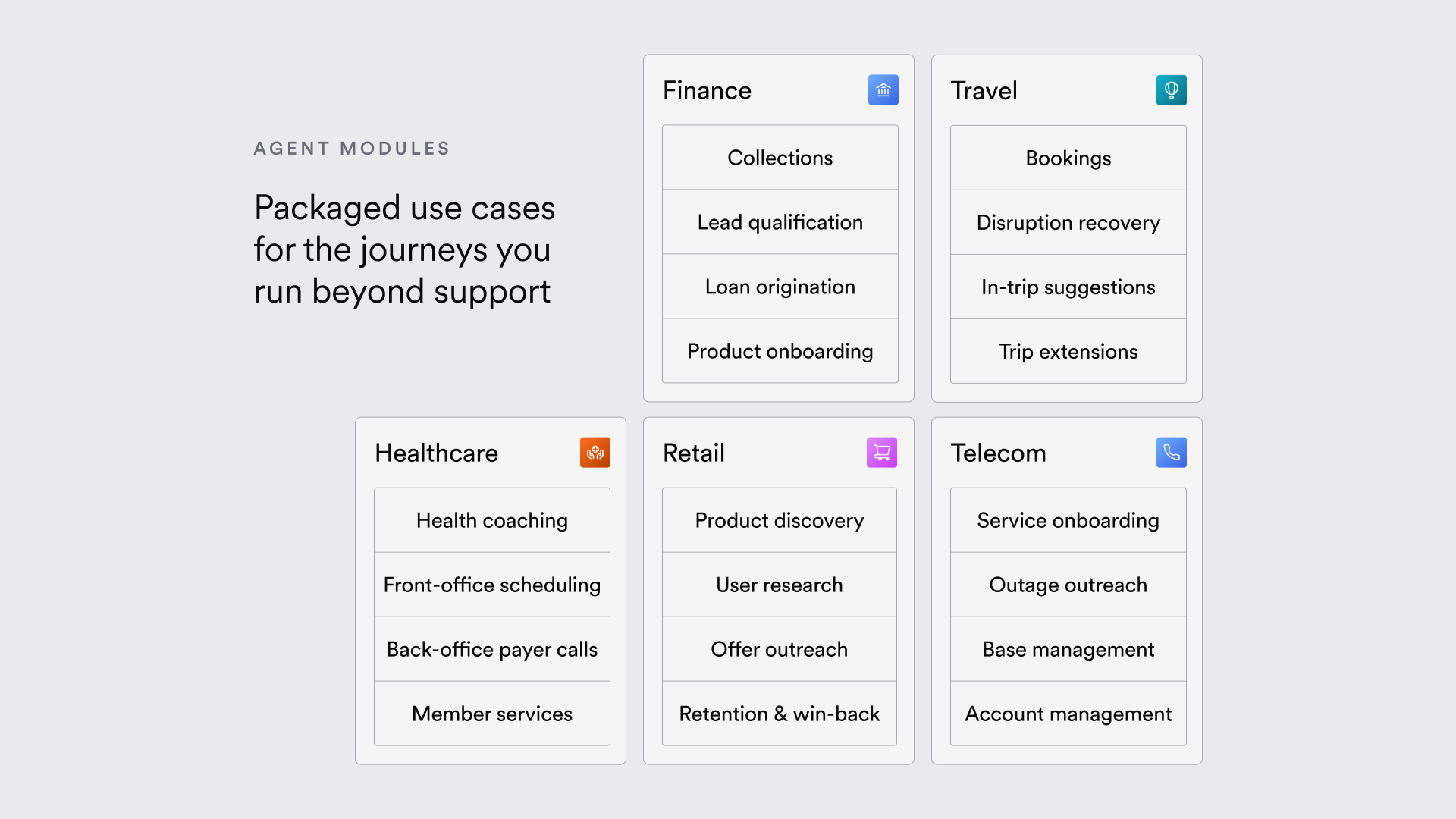
Agent Modules provides the plumbing for AI agent use cases across the complete customer journey, not just support, extending beyond pre-written workflows. In short: enterprises no longer need to build these agents completely from scratch.
Simulations allows for pre-launch testing across different personas and intents, while module-specific analytics measure post-launch outcomes.
Decagon Prepares Enterprises For The A2A World
At Decagon Dialogues this year, Decagon established itself as a trusted platform that enterprises can rely on to help them navigate the influx of agent-to-agent communications.
In a future where customers will increasingly use personal AI assistants to act on their behalf, Decagon offers solutions that let enterprises welcome these agents without relinquishing safety and control.
Whether or not the general public goes all in on A2A remains to be seen, but it’s clear that Decagon doesn’t believe in waiting to see how it all pans out.