
November 16, 2026 • 7 min read
CX News Roundup: AI Orchestration, Memory, and Speed Take Center Stage

CX Analyst & Thought Leader
November 16, 2026
Last week was plagued by Outlook outages, nation-wide flight stoppages, and of course, Jensen. But lots of news came out in the CX space, as well: much of it overshadowed by all the chaos. Vendors are starting to focus less on selling "AI agent platforms," and more on selling what happens between and around interactions (orchestration), persistent AI memory, and low latency.
News from Fish Audio, NiCE Cognigy, Cresta, Retell, and Talkdesk all underscore this:
Fish Audio Launches Live 3, A Full-Duplex Real-Time Voice Model + Fish Agent, A No-Code Voice AI Builder
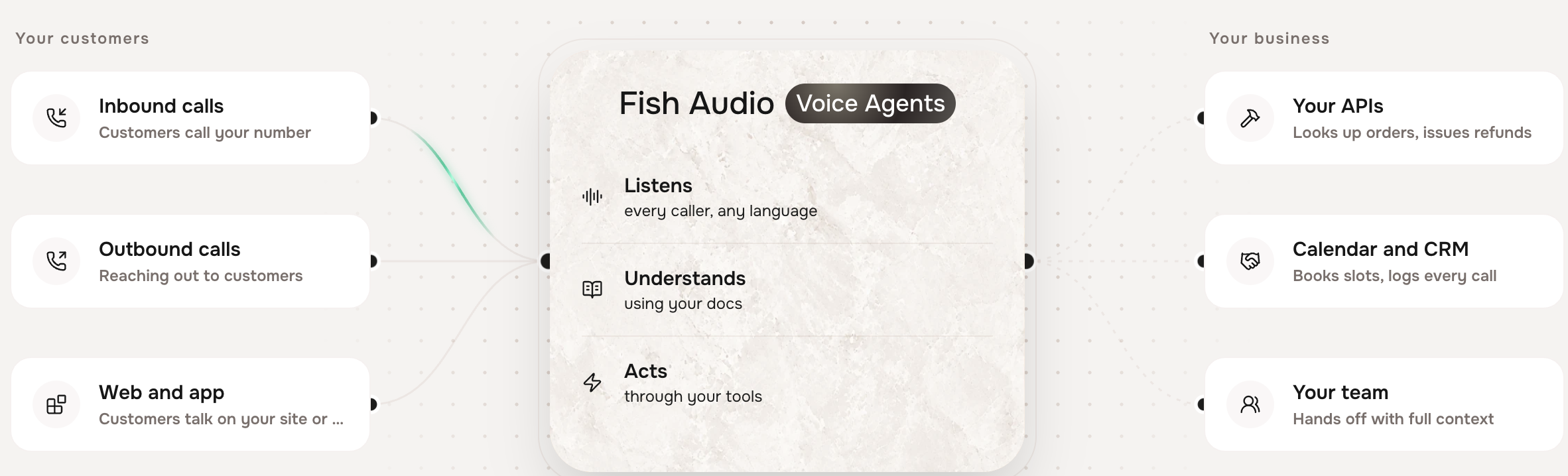
Fish Audio launched Live 3, a full-duplex voice model built for real-time conversations. Live 3 simultaneously listens and speaks, and every call comes with turn-by-turn transcripts, recordings, call summaries, and latency breakdowns that show where delays happen.
Because Live 3 was trained on real human conversations, it understands the right time to acknowledge a caller, wait for them to speak, or stop speaking. It even adds natural conversation fillers ("mm-hmm", "ok", etc.). Fish also says the model can decide to respond in under 200ms.
This fun video from Fish Audio Co-Founders Rissa Cao and Shijia Liao is a great demonstration of how it works.
Live 3 powers Fish Agent, a no-code AI Voice Agent building, testing, and monitoring platform. Users can choose from over 2 million library voices in 30+ languages. Builders write natural prompts for an agent's personality, goals, and guardrails, then add a shared knowledge base, goals, guardrails, and existing tools.
Pricing starts at $0.035 per minute through December 31, 2026 (limited-time 50% off the regular $0.07/minute). Phone calls add $0.01/minute, and the free trial includes 5,000 minutes.
For businesses, the wins here are less robotic-sounding Voice AI agents and a more intuitive, less cluttered way to build, test, and monitor them.
The launch reinforces that Fish Audio is moving up the stack at warp speed: it started as an open-source voice generation project, became a TTS and voice-cloning solution, and raised a $52 million seed round in July. Now, Fish Audio has a full-duplex conversation model and agent-building platform.
Next-Gen NiCE Cognigy is Enterprise CX Agentic AI Operating Model
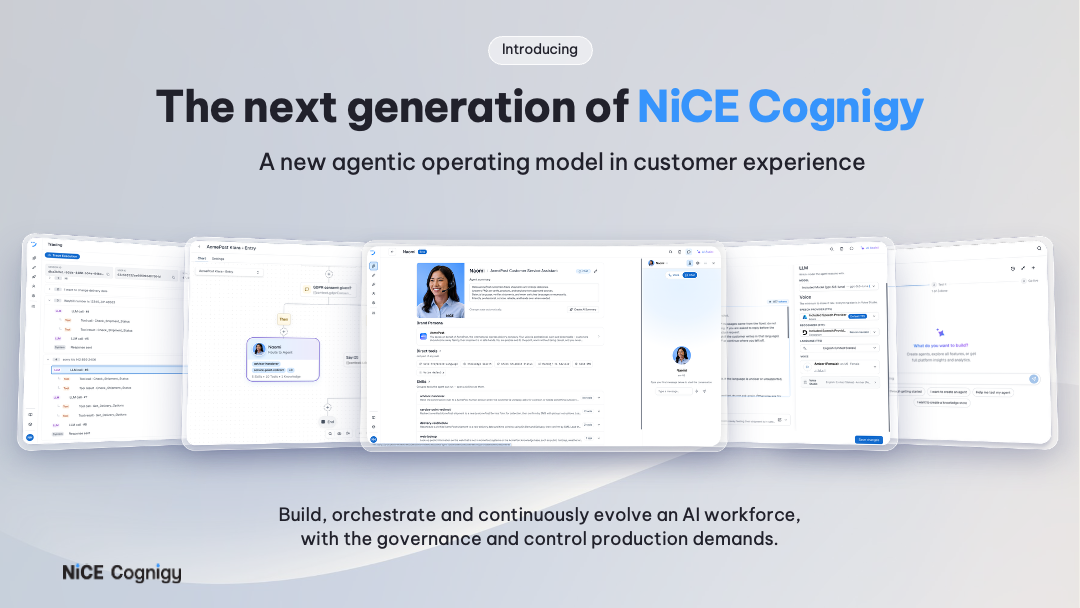
NiCE announced Next-Generation NiCE Cognigy, an agentic CX operating model for enterprise building, orchestrating, and optimizing their AI workforce. The next-generation adds AI-assisted development, reusable skills, decision tracing, and native voice-to-voice interaction.
The interface was rebuilt to be agentic-first and comes with pre-provisioned AI models, so teams don't have to add them before building.
The Agentic Experience Studio includes a built-in voice studio and ensures every agent runs inside an agentic harness that bundles its tools, skills, guardrails, and governance rules. AI Assist is a built-in companion that helps teams build agents from a prompt or a transcript, update them, run simulations against synthetic customers, analyze the results and deploy across channels. Building is a back-and-forth conversation: AI Assist asks a few questions, proposes a plan for approval, then builds the agent and summarizes what it set up.
Next-gen NiCE Cognigy supports MCP, A2A, and Personal Agent Protocol (PAP.) This means the customer decides which agent represents them and what it can access, while your business sets what the Cognigy agent can connect to and what it can automate.
Cognigy remains available as both a standalone (working with any CCaaS platform or CX stack) and as an integration into NICE CXone.
Retell Debuts Tell-1, Native Contact Center LLM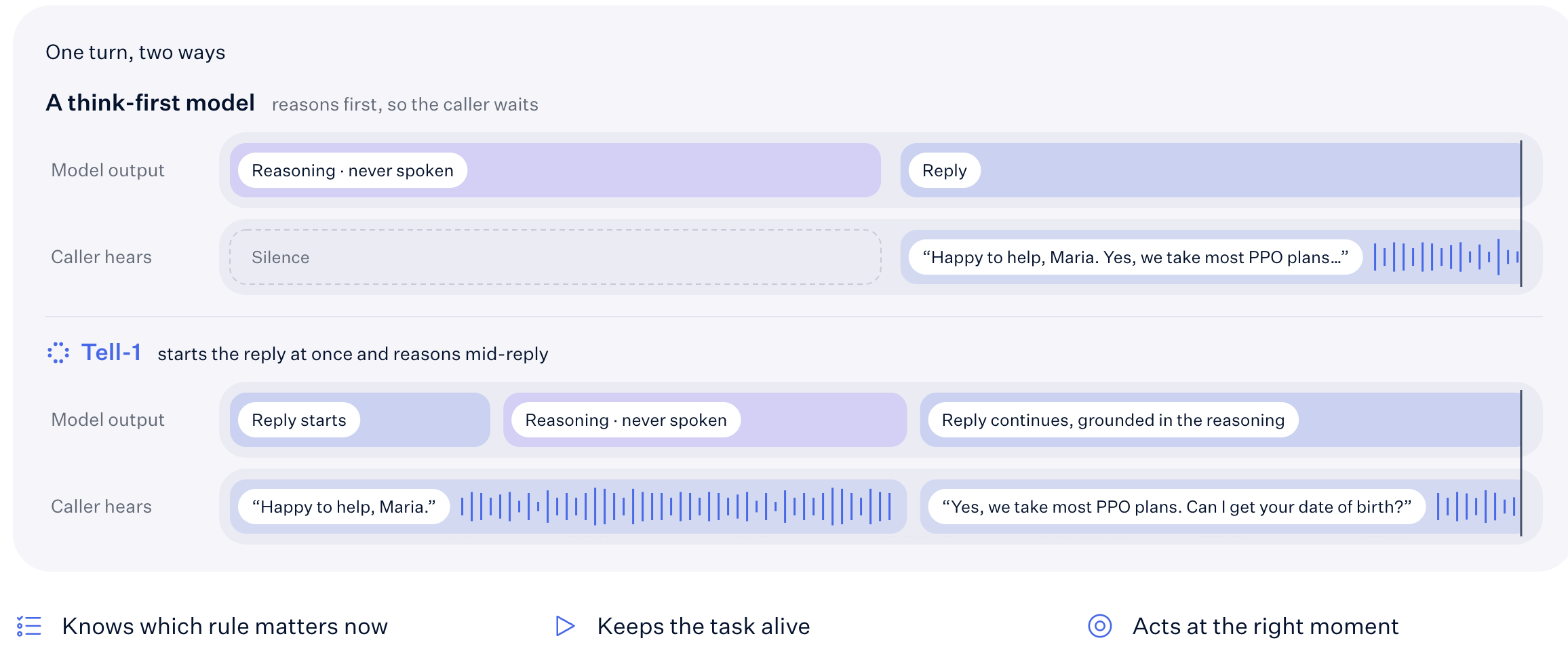
Less than three years after its launch, voice AI platform Retell announced on November 12 that it has crossed $100M in annualized run rate. Retell says enterprise revenue grew ninefold in 2026, serving 4,000 businesses and handling over 100 million connected calls per month (in over 55 languages, no less.)
Alongside the milestone, Retell launched Tell-1, an in-house LLM built specifically for contact centers and trained on hundreds of millions of calls. Tell-1 picks the right procedure out of many possible intents, follows it step by step, decides which rule applies and which information is missing, and connects to existing tools.
Its standout design choice is what Retell calls interleaved reasoning. Instead of thinking first and then speaking, the model starts answering right away and keeps reasoning while it talks. Retell puts time to first token at about 150ms. Tell-1 runs on Retell’s own inference stack and costs $0.035 per minute.
Cresta Journey Intelligence Includes Enhanced AI Memory and Journey Insights, Cresta Opens Tokyo Office
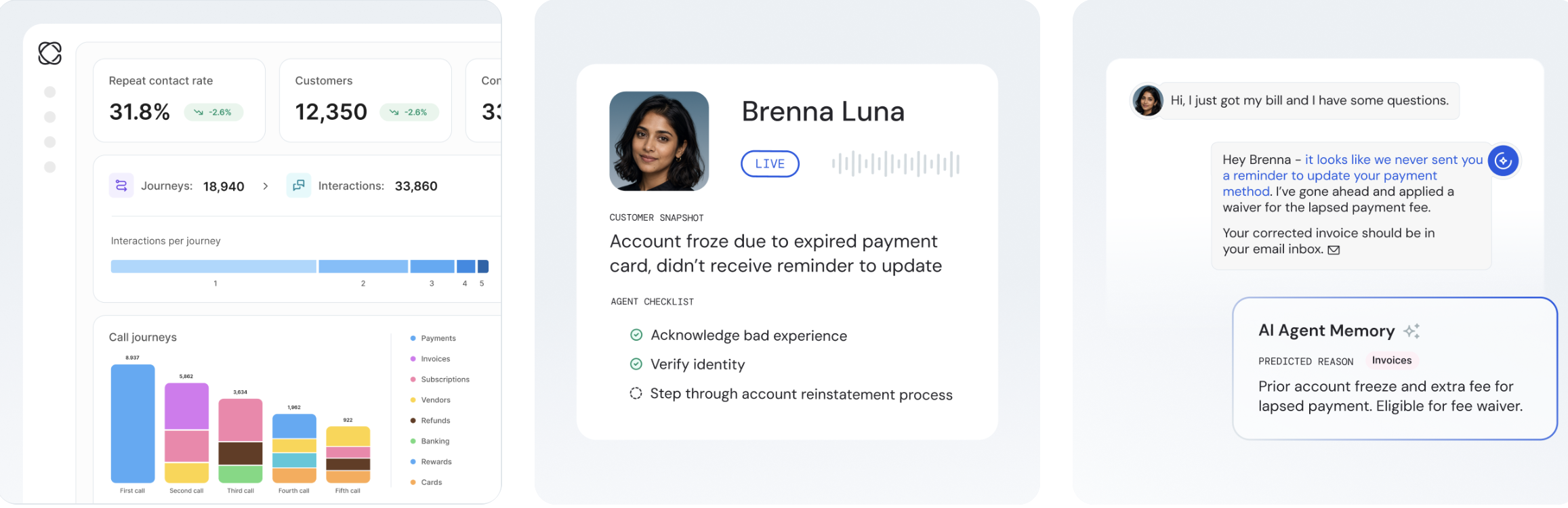
Cresta Journey Intelligence, launched November 12, combines enhanced AI Agent memory, predictive insights, Agentic Assist, omnichannel conversation histories, and intelligent analytics into one platform.
Journey Insights show personalized customer journey views like the reason for calling, the outcome, and even a predicted per-interaction satisfaction score.
Cresta's AI agents can use these insights to predict the next customer contact and prioritize broken journeys. Customer Snapshot gives human agents complete conversational context, so they know exactly why the customer is calling and what they've already tried before speaking to them.
Cresta pitches three big CX payoffs: better experiences by finding and fixing broken processes, lower costs from strategic automation, and better human and AI agent performance thanks to deeper insights,.
Cresta's Tokyo Office , its first in Japan, opened on November 11. Cresta is now available with a Japanese-language interface and Japanese voice capabilities.
Talkdesk Announces Talkdesk Voyager and Life Sciences Experience Cloud
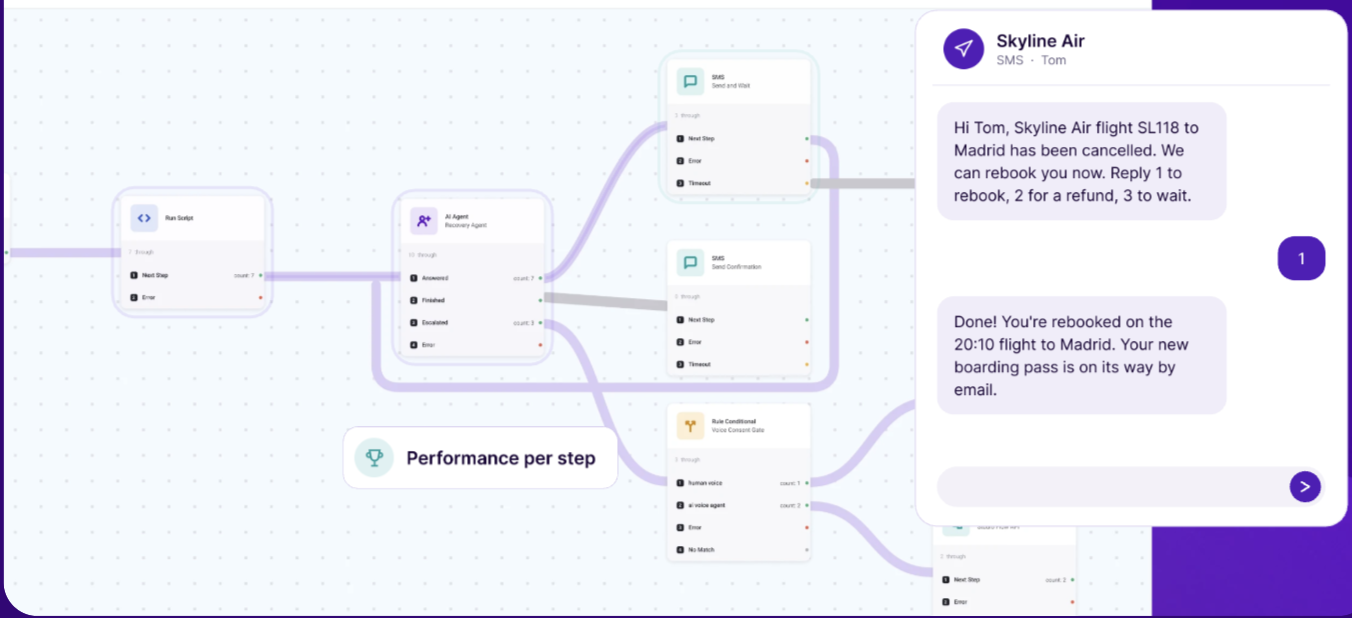
Talkdesk Voyager, announced November 12, is a long horizon orchestration solution that turns disconnected long-term interactions into ongoing customer journeys designed around specific goals and rules.
Voyager ships with pre-built, customizable industry blueprints that come preloaded with the signals, AI agents, workflows, rules and integrations.
It watches for signals, then coordinates specialized AI agents, human employees, and back-end systems to take proactive action. Enterprise governance and guardrails maintain compliance, while managers can handle exceptions across the whole journey.
In practical terms, Talkdesk Voyager can remember remembering a shopper’s fit preferences months after a purchase, wait for an book a customer's preferred appointment time, or reorder essentials before they run out. It keeps context and long-term memory for days, months or even years.
On November 16, Talkdesk announced the Talkdesk Life Sciences Experience Cloud, a platform connecting AI and human agents with workflows and existing systems to improve the patient experience. The first focus is Therapy Access: clearing the administrative roadblocks that delay treatment: program enrollment, prior authorizations, handoffs to specialty pharmacies, etc. It’s built for regulated healthcare, with secure, auditable workflows and support for FDA 21 CFR Part 11-compliant electronic records and signatures.
What It Means For CX
AI is clearly moving from "building one agent, deploying one agent, and monitoring one agent" to building an AI workforce with reusable skills, orchestrating a team of multiple agents, and governing at scale.
Expect "AI Harness," "Personal Agent Protocol," and "context-rich persistent memory" to be the new CX buzzwords. Vendors will likely stress the idea that insight without action is just a dashboard, and action without insight is just automation ad nauseam -- but that doesn't mean its not true.
For customers, the payoff is finally not having to repeat themselves, not getting talked over, and not falling through the cracks between departments. For businesses, it’s fewer repeat contacts, less wasted agent time, and CX that can be measured in outcomes: appointments booked and loans funded instead of calls handled or talk time.