August 13, 2026 • 4 min read
Cisco Q4 2026 Earnings: AI Networking Supercycle Drives $17.3 Billion Total Revenue, $4 Billion in AI Orders, 24% Product Revenue Increase

CX Analyst & Thought Leader
August 13, 2026
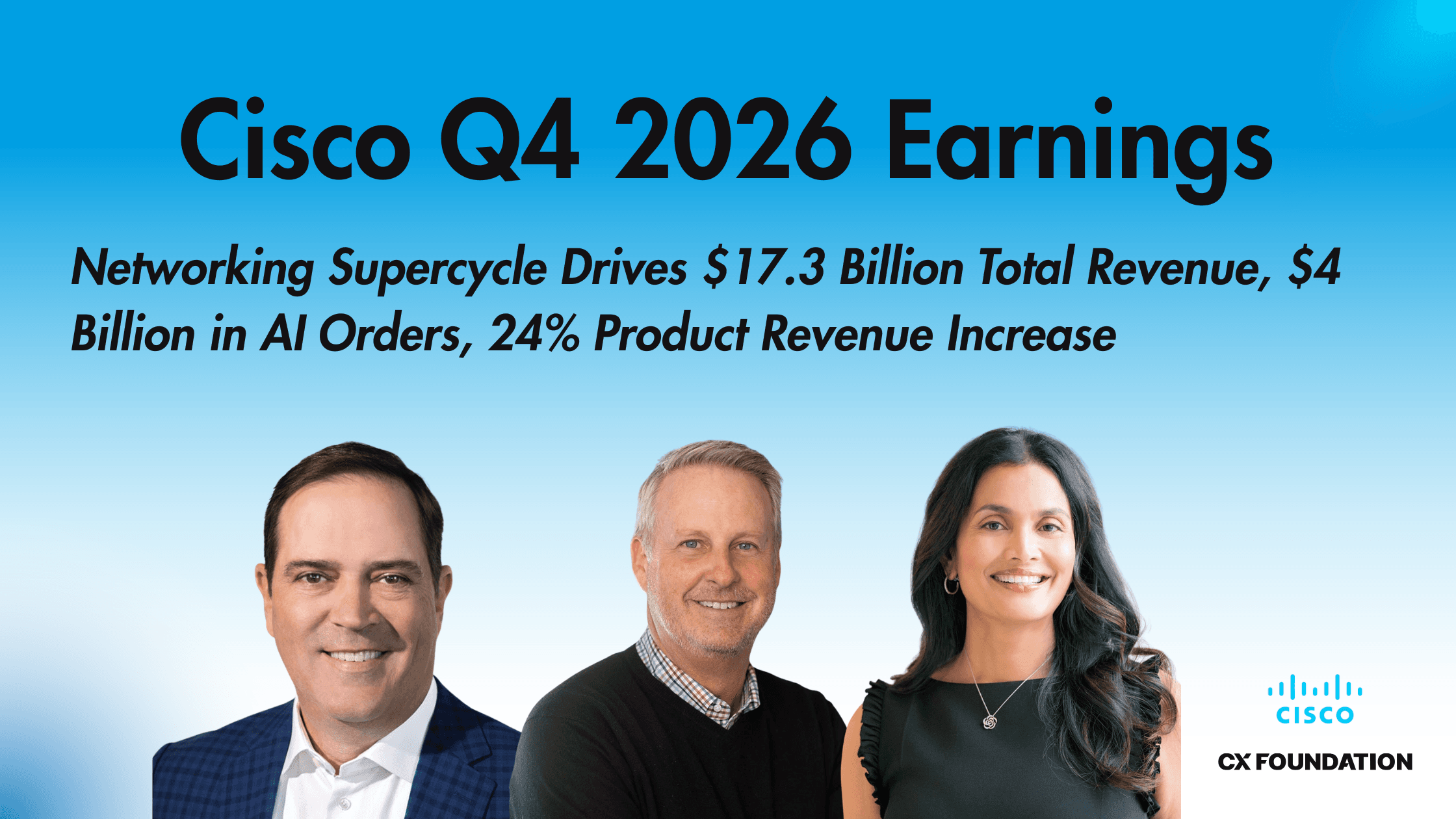
On its August 12 Q4 2026 earnings call, Cisco announced a total Q4 revenue of $17.3 billion (an 18% YoY increase) driven primarily by roughly $4 billion in AI infrastructure orders, a 28% YoY increase in networking revenue, a 24% YoY increase in product revenue, and a 14% YoY increase in security revenue. Collaboration revenue rose 12% YoY to hit its best quarterly performance in 7 years, marked by double-digit revenue growth and a 40% increase in video device orders. Software revenue increased 11% YoY, while Q4 product orders grew 35% YoY. Cisco’s FY 2026 highlights include the highest revenue, operating margin, and earnings per employee in 30 years; $9.3 billion in AI infrastructure orders (a 4.5x increase from FY 2025); and a roughly 25% YoY increase in data center networking orders.
FY 2027 total revenue is expected to be between $72.2-$73.4 billion (15% growth at the midpoint). Cisco’s AI infrastructure revenue is estimated to hit $7.5 billion in FY 2027, with 4 to 5 percentage points of revenue growth expected to come from price increases.
A Closer Look At Cisco’s Q4 2026 Results
Clearly, Cisco had a solid quarter, beating top and bottom line expectations. In Q4, Cisco hit 23% non-GAAP EPS growth and scored three hyperscaler design wins with Silicon One. It also achieved a record non-GAAP operating income of $6.2B, with non-GAAP operating margin of 35.9%.
Q4 marked the 8th consecutive quarter of double-digit networking product order growth, with networking product orders growing 30% YoY. This indicates that Cisco is “in a multi-year, multi-billion dollar networking Supercycle accelerated by AI,” as stated in its Q4 presentation.
We believe the accelerating adoption of agentic AI is fueling a networking super cycle. As customers look to manage increasing traffic and costs, they are investing in Cisco's networking stack for inferencing across cloud, on-premise, and edge environments.
Chuck Robbins
Still, there are things to watch: perhaps the flat, 0% growth in Q4 services revenue most of all. This, plus the fact that services ARR grew by just 2% and total ARR grew only 3%, hints to a visible slow-down in Cisco’s software side, not simply an increase in hardware revenue.
Non-GAAP gross margin also dropped 210 basis points YoY to 66.3% and is expected to fall to 65-66% next quarter. Cisco blames the drop on the massive networking hardware sales (less profitable than software sales) as enterprises begin building their AI infrastructures. That said, Cisco’s Q4 operating margin increased to 35.9%, signaling the margin dip is a trade worth making for future profitability.
The CX Impact of Cisco’s Q4 2026 Results
Cisco’s Q4 2026 results echo the current market signal: enterprises are heavily investing in AI infrastructure, platform unification, and security capabilities as they continue to scale agentic innovation.
What it signals for the cloud market is a notable break: enterprises are now looking to bring AI on-premises, driven particularly by security, data sovereignty concerns, and the high costs of tokenomics.
We achieved record-breaking performance for both the quarter and the fiscal year, with top and bottom line results that exceeded our expectations. This success is a direct result of our accelerated pace of innovation across our portfolio, our strong order momentum, and disciplined expense management. We remain focused on making strategic investments in organic innovation to capitalize on the significant growth opportunities we see ahead, as well as complementary M&A opportunities.
Mark Patterson
EVP and CFO, Cisco

Cisco’s results also indicate a shift from pricing strategy, moving from usage-based revenue to hardware revenue plus subscription revenue; backed by 4-5 points of incoming growth from price increases on memory-heavy solutions.
Then there's the agentic resolution push: in FY 2026, Cisco resolved 145,000 support cases with autonomous agentic AI (no human involvement required.) Not only does it prove Cisco’s solutions are genuinely capable of autonomous resolution, it also proves agentic reasoning works at scale.
Clearly, we’re entering an era where AI-readiness, security, and platform consolidation are now non-negotiable table stakes.