February 10, 2026 • 10 min read
Cisco Announces G300 Networking Chip, AgenticOps & AI Defense

CX Analyst & Thought Leader
February 10, 2026
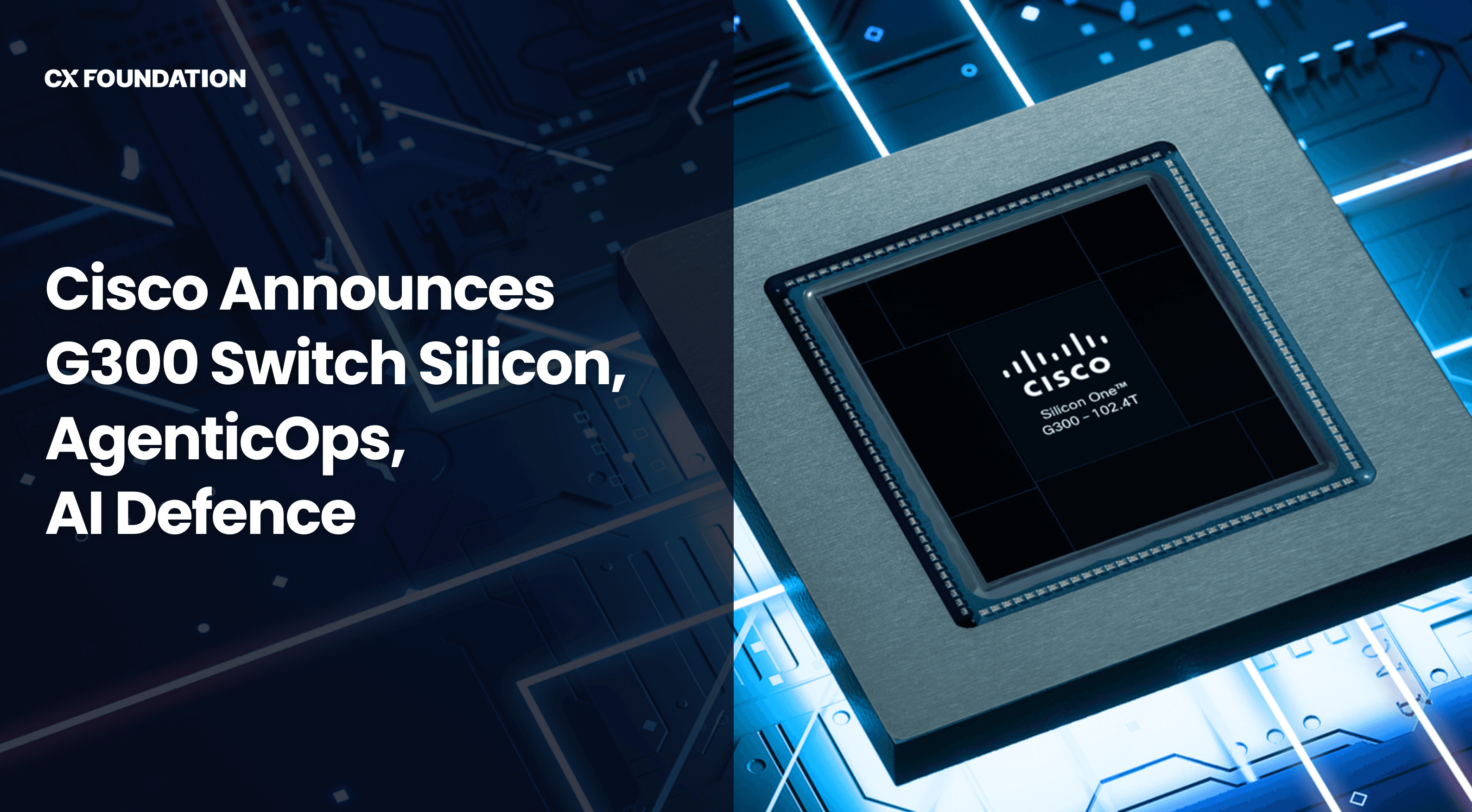
At the Cisco Live Conference in Amsterdam, Cisco announced a series of new solutions built for the Agentic AI Ara: the Cisco Silicon One G300 switch silicon, AgenticOps innovations, upgrades to the Cisco AI Defense Solution, and advances to the Cisco SASE offering.
The Cisco Silicon One G300 Switch Silicon
The Cisco Silicon One G300 networking chip is designed to meet the needs of large-scale AI data centers in the Agentic Era. The Cisco G300 will, in plain English, make massive AI operations easier, faster, and more valuable.
The Cisco Silicon One G300 chip will power new Cisco N9000 and Cisco 8000 systems, which can move 102.4 terabits of data per second – fast enough to move the entire Library of Congress in under a second. Both systems use liquid cooling and high-density optics to improve energy efficiency by up to 70%, and each system contains the computing power of six prior generation systems.
Of particular note is the G300’s Intelligent Collective Networking, a “triple threat” including a flexible data buffer to absorb traffic spikes, path-based load balancing to prevent data traffic jams, and proactive network monitoring to stop packet drops. The result? Networks that can handle 33% more traffic, finish jobs 28% faster, and generate more tokens per GPU hour for increased profitability. The G300 can also be reprogrammed after deployment, meaning it can evolve alongside AI technology – ideal for protecting infrastructure investments down the line.
Cisco’s Nexus One acts as a unified “control panel,” offering greater operational and management flexibility for both cloud-based and on-prem systems. Native Splunk platform integration (arriving in March 2026) will allow for greater network monitoring and network telemetry analysis. This is an especially valuable feature for sovereign cloud deployments and compliance-sensitive environments.
The new G300 reinforces Cisco’s desire to serve as the equipment supplier for everyone building an AI infrastructure, not just the tech giants.
Analyst Perspective: G300 Switch Silicon
What This Means For CX Leaders
On paper, a well-oiled AI infrastructure seems like a CX dream - quicker responses from virtual agents, better personalization, faster support resolutions. But the truth is that even the best hardware can’t fix poor AI implementation or eliminate the need for an extensive AI onboarding strategy.
Customers don't care if your AI runs 28% faster if it still can't solve their problem or understand their question. My concern is that companies will use innovations like Cisco’s as an opportunity to deploy even more half-baked AI agents instead of fixing the ones that are already driving customers crazy.
Efficiency gains in the backend don't automatically translate to better customer experiences. If done incorrectly, they essentially make bad AI fail faster, and fail faster at scale.
What This Means For Enterprises
For Enterprises building an AI infrastructure, the good news is that Cisco’s G300 just made the cost of entry for running serious AI operations lower. The bad news is that when powerful systems like this become more widely available, enterprises are forced to compete with companies already running hyperscale-level infrastructure. This means that if your AI isn’t as fast, as good, as smart, or as valuable as your competitors', your customers will walk.
The "we're still figuring out AI" excuse has a shorter shelf life when the technology enabling large-scale AI deployment is this accessible.
What This Means For Cisco
The G300 announcement shows that Cisco is making an aggressive play to dominate the AI networking infrastructure. Instead of catering to hyperscalers exclusively, Cisco is making a play to democratize enterprise-grade AI infrastructure for neoclouds, service providers, enterprises, and sovereign clouds – before their competitors do.
“AI at scale demands open, standards-based networking that customers can deploy with confidence across diverse environments. Our longstanding collaboration with Cisco helps advance high-performance, standards-based Ethernet fabrics while reinforcing end-to-end interoperability, from GPU and CPU platforms to AI NICs, DPUs, and the software stack. We’re excited to continue to partner with Cisco across our enterprise and AI product stack, as we focus on giving customers the flexibility and choice to build resilient, scalable AI infrastructure.”
For Cisco, I suspect it’s all about getting the timing right. AI infrastructure spending is exploding, but the market hasn’t yet consolidated around “One Vendor To Rule Them All.” Why shouldn’t it be Cisco? However, Cisco may also be anticipating the AI bubble pop. If AI demand plateaus, the programmable chip means their hardware can adapt to new use cases instead of becoming obsolete. Cisco is essentially future-proofing their position in a market that's still figuring itself out.
Cisco AgenticOps Innovations
Cisco also announced extended capabilities for AgenticOps, their AI-driven IT operating model that automates complex network operations. AgenticOps pulls data from across Cisco's entire platform so it understands what's happening everywhere. It can then execute fixes automatically while humans stay in charge of major decisions.
Select features include:
For Campus, Branch, and Industrial Networks:
- Autonomous Troubleshooting: AI agents investigate connectivity and performance issues end-to-end, cutting mean time to repair (MTTR) to minutes instead of hours. The system validates multiple hypotheses simultaneously and executes fixes with "CCIE-grade precision" (that's Cisco's highest certification level)
- Continuous Optimization: The system proactively prevents performance degradation by autonomously tuning network settings based on real-time conditions before users notice problems
- Trusted Validation: AI agents assess network changes against live topology and configuration data, identifying potential impacts before changes are deployed
- Agentic Workflow Creation: IT teams can build custom, repeatable automations through Cisco's AI Assistant for environment-specific tasks.
- Agentic Workflow Creation: IT teams can build custom, repeatable automations through Cisco's AI Assistant for environment-specific tasks
For Data Centers: Spots problems early and tells you how to fix them before performance drops. Works with Cisco Nexus One to give you better visibility into what's happening.
For Security Operations: Watches your firewall traffic and settings, recommends stronger security controls, finds performance bottlenecks, and checks compliance automatically.
For Observability: Tracks how your AI applications are performing, what they're costing you, and whether they're behaving correctly. Integrates with Cisco AI Defense to catch problems like AI hallucinations, data leaks, and security vulnerabilities.
Analyst Perspective: Cisco AgenticOps Innovations
What This Means For Customers
Customers won't directly interact with AgenticOps, but they'll feel its impact through fewer outages, faster problem resolution, and more reliable service. However, if IT teams over-rely on automation without understanding what the AI is actually doing, they risk creating new blind spots.
What This Means For Enterprises
AgenticOps could be a game-changer for stretched IT teams managing increasingly complex, distributed environments.
However, this also means IT teams need to develop new skills outside of network administration, but AI oversight and validation.
The risk is that companies will use AgenticOps as an excuse to cut IT headcount before teams are actually ready to operate in this new model. Sound familiar? It's the same pattern we're seeing with customer service agents and AI.
What This Means For Cisco
AgenticOps positions Cisco as the platform for AI-driven IT operations, not just networking hardware. By integrating agentic capabilities across networking, security, and observability, Cisco is making a play to own the entire operational stack.
“As AI adoption moves beyond hyperscalers and scales across enterprises, neoclouds, and sovereign environments, network architecture is becoming a defining constraint on performance, cost, and sustainability. Cisco’s approach—combining high-performance silicon, liquid-cooled © 2025 Cisco and/or its affiliates. All rights reserved. 2 systems, advanced optics, and integrated operations—speaks directly to the next phase of AI infrastructure, where maximizing GPU utilization, improving energy efficiency, and simplifying operations are critical to realizing real economic value from AI at scale.,”
Cisco AI Defense + AI-Aware SASE
Cisco is rolling out the biggest expansion to AI Defense since its January 2025 launch. AI Defense is designed to protect AI agents and the infrastructure they operate on.
As companies move from AI assistants to autonomous agents that can use tools and access data across hybrid environments, the attack surface expands dramatically. AI Defense addresses this with new features:
- AI BOM (Bill of Materials): Provides centralized visibility and governance for AI software assets, including Model Context Protocol (MCP) servers and third-party dependencies. It’s all about tracking what AI components you're using and where they came from
- MCP Catalog: Discovers, inventories, and manages risk across MCP servers
- Advanced Algorithmic Red Teaming: Expands security assessments with adaptive single and multi-turn testing for models and agents in multiple languages (essentially stress-testing AI to find vulnerabilities before attackers do)
- Real-time Agentic Guardrails: 24/7 monitoring of AI agent interactions to detect manipulation or unsafe behavior
Cisco is also upgrading its Secure Access Service Edge (SASE) offering with AI-aware capabilities designed to secure AI agent interactions and keep AI traffic reliable and fast.
SASE combines networking and security into a cloud service that protects users, devices, and applications regardless of location. Cisco is also announcing IOS XE 26, the latest version of the operating system powering millions of networks globally. It delivers industry-first full-stack post-quantum cryptography (PQC) protections for enterprises, defending against device tampering and data compromise as quantum computing threatens current encryption standards.
New AI-Aware SASE features include:
- AI Traffic Optimization: Detects AI traffic and applies optimization techniques to maintain reliable, low-latency AI interactions during surges/traffic spikes
- MCP Visibility, Logging, and Policy Control: Discovers and governs Model Context Protocol communication with in-path controls to manage agent-to-tool connectivity
- Intent-Aware Inspection: Combines rapid detection with cloud-based analysis to evaluate the intent behind agentic messages and actions
Analyst Perspective: AI Defense + AI-Aware SASE
What This Means For Customers
Customers interacting with AI agents want assurance that virtual agents won't leak their data, get manipulated into doing something harmful, or make decisions based on outdated or confidential information. The worry is that companies will only invest in these safeguards after a march breach makes headlines, not proactively as they should.
What This Means For Enterprises
For enterprises deploying AI agents, AI Defense addresses a critical blind spot: visibility into what AI assets you're actually running and where they came from. The real-time guardrails are also essential for preventing the nightmare scenario where a compromised AI agent accesses sensitive systems or makes unauthorized decisions.
AI-aware SASE addresses a genuine operational challenge: AI workflows are fundamentally different from traditional application traffic, and conventional security tools aren't built to handle them.
Still, this is a security infrastructure that's only as good as the governance strategy–and the IT training–behind it.
What This Means For Cisco
AI Defense and AI-Aware SASE positions Cisco as a leader in enterprise AI security at exactly the right moment – as regulators and enterprises wake up to the risks of unprotected AI deployments.
“At AI-factory scale, performance is no longer determined by the network or the data layer alone— it’s defined by how tightly they work together. Cisco’s Silicon One G300–powered Nexus platforms provide the deterministic, high-bandwidth fabric required for agentic and GPU-dense environments, while DDN’s AI-native data intelligence ensures data is always in the right place, at the right time, at full speed. Together, we remove the hidden bottlenecks that starve GPUs, extend job completion times, and stall production AI. This validation underscores a shared commitment to delivering AI infrastructure that is not just powerful on paper, but proven in real-world, large-scale deployments.”
By establishing AI Defense as critical infrastructure now, Cisco is building a long-term revenue stream regardless of scalable AI adoption timelines. The post-quantum cryptography announcement also signals Cisco is thinking multiple years ahead, positioning their infrastructure as future-proof as encryption standards evolve.
Cisco: A Unified Platform In It For The Long Haul
Cisco's announcements at Cisco Live EMEA represent a coordinated strategy: own AI infrastructure from the data center (G300) to operations (AgenticOps) to security (AI Defense and AI-aware SASE). Cisco is clearly positioning itself as the unified platform for enterprises navigating the AI era. Instead of selling individual products, Cisco offers an integrated ecosystem that becomes harder to leave once adopted.
The environmental cost of this AI infrastructure boom remains the elephant in the room that few seem to want to even acknowledge, let alone debate.
For CX leaders, the question is if companies will use these solutions to actually improve customer experiences, or they'll use them to just deploy more AI faster without fixing the fundamental problems that make customers hate interacting with AI.