
January 27, 2026 • 6 min read
Why Voice AI Demos Lie and Why Production Is the Only Truth That Matters

CEO & Founder
January 27, 2026

Voice AI has reached a point where demos are no longer the problem.
They sound natural. They respond quickly. They handle scripted scenarios with impressive fluency. In a quiet room, with cooperative users and carefully designed prompts, many systems perform beautifully. The conversations feel effortless, almost human.
And yet, the moment those same systems are deployed into real customer environments, a very different reality often emerges.
Conversations stall. Responses arrive late or miss the point. Customers interrupt, change direction, express frustration, and expect to be understood instantly. What felt seamless in a demo begins to feel brittle. The illusion fades quickly.
This growing gap between demo performance and production reality has become one of the most consequential blind spots in modern customer experience.
The Comfort of the Demo
Demos are designed to reassure. They showcase what is possible under ideal conditions. They remove uncertainty, edge cases, and noise. They create confidence in a buying decision.
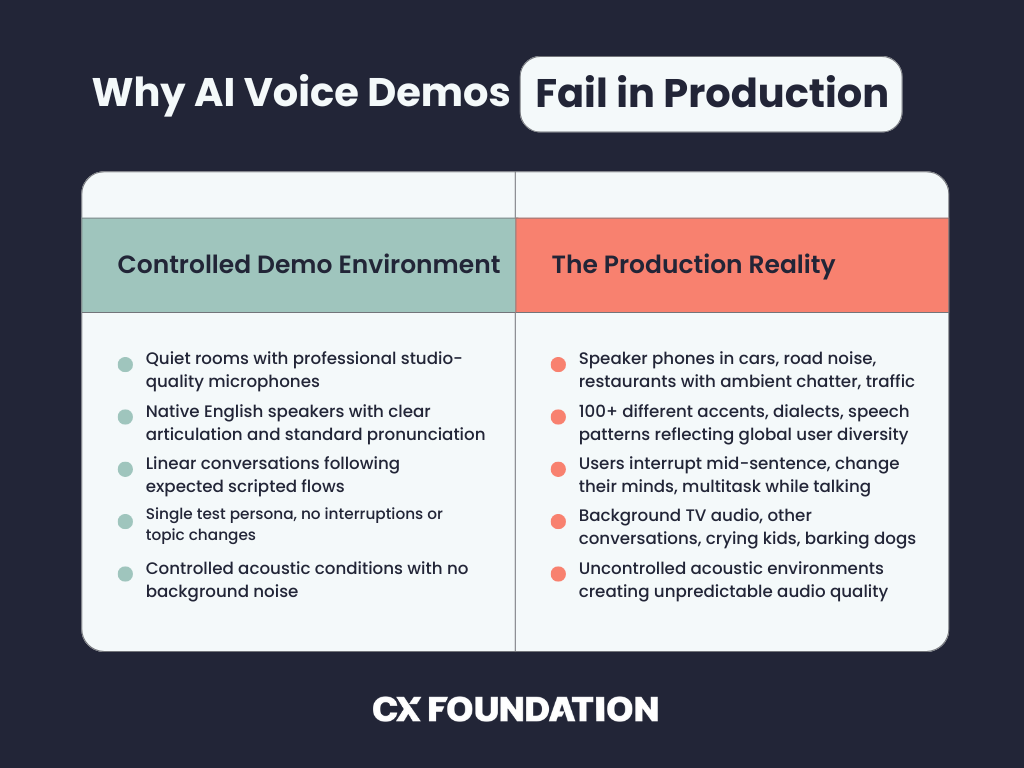
But customer experience does not happen under ideal conditions.
Real voice interactions are messy. People speak over one another. They correct themselves mid-sentence. They use shorthand, accents, emotion, and imperfect phrasing. They expect the conversation to move at human speed and adapt in real time. Silence feels awkward. Delay feels like incompetence. A single incorrect response can undo trust instantly.
Voice is unforgiving in a way no other channel is. There is no interface to soften mistakes, no retry button, no asynchronous buffer. When something goes wrong, it goes wrong out loud.
This is why voice AI systems that appear sophisticated in demos often struggle in production. They are optimized to sound good, not to endure reality.
Where Trust Is Actually Built
One of the most persistent misconceptions in AI-driven CX is that success is defined by how human an agent sounds.
In practice, customers care far less about whether a voice is perfectly natural and far more about whether it is dependable. They want to be understood. They want accurate answers. They want the conversation to progress without friction. When things become complex or sensitive, they want a clear path to a human who can help.
Trust in voice interactions is not built through charm. It is built through consistency.
Production environments reveal whether a system can maintain that consistency when conditions are unpredictable. Latency suddenly matters. Interruptions are unavoidable. Background noise is no longer theoretical. Emotional volatility becomes the norm, not the exception.
These are not edge cases. They are the core of voice-based CX.
Production Is the Real Test
The difference between a demo-ready system and a production-grade system becomes obvious the moment something goes wrong.
Production-grade voice AI is designed with failure in mind. It knows how to slow down, how to ask for clarification, and when to escalate. It enforces business rules and brand standards even when conversations drift off the happy path. It prioritizes accuracy and predictability over improvisation.
Just as importantly, it provides visibility. When an interaction breaks down, CX and operations teams need to understand what happened and why. Without that insight, improvement becomes guesswork and risk accumulates quietly.
Demos rarely expose these qualities. Production always does.
What CX Leaders Should Demand Before Voice AI Reaches Production
If production is the only environment that matters, then the way voice AI is evaluated must fundamentally change.
The most effective CX leaders are no longer asking vendors to “show the demo.” They are asking to see how the system behaves when conditions are imperfect because that is where customer trust is either earned or lost.
Before voice AI is allowed anywhere near live customers, leaders should be able to answer a few critical questions with confidence.
They should understand how the system handles failure. Not whether it avoids failure, but how it responds when something goes wrong. Does it recognize confusion? Does it ask for clarification? Does it know when to stop and escalate? Systems that only work when everything goes right are not CX solutions. They are liabilities.
They should also evaluate latency as an experience, not a statistic. Impressive response times in isolation mean very little if they cannot be sustained under real load. CX leaders should insist on seeing how conversations feel during concurrency, interruptions, and peak demand, not just in clean, single-call scenarios.
Equally important is visibility. If an AI agent takes an unexpected action, someone on the CX or operations team must be able to understand why. Without observability, teams cannot refine experiences, diagnose issues, or manage risk. Black-box systems may look advanced, but they erode internal confidence long before customers ever notice.
Finally, leaders should demand proof that voice is not being treated as a silo. Customers do not experience channels in isolation, and AI systems should not be designed that way either. Context, policies, and memory must persist across interactions, or voice becomes another point of friction rather than a path to resolution.
None of these requirements make for exciting demos. All of them make for reliable customer experiences.
Why Voice Exposes Weak CX Faster Than Any Other Channel
Voice does not allow systems to hide behind interfaces, retries, or asynchronous pacing. Everything happens in real time. Customers experience delays and errors emotionally, not analytically.
This is what makes voice such a powerful diagnostic for CX maturity. Organizations that can deliver calm, accurate, and reliable voice experiences at scale are usually doing many other things right as well. When voice breaks down, it often reveals deeper issues in orchestration, governance, and operational readiness.
As AI becomes more deeply embedded into customer interactions, this distinction will only grow more important. The novelty of AI-powered conversations is fading. Expectations are rising. Customers are no longer impressed that a machine can speak. They care whether it helps.
A Shift CX Leaders Must Make
The way voice AI is evaluated by CX leaders must evolve.
The most important questions are no longer about how impressive a demo sounds. They are about how the system behaves under pressure. How it handles ambiguity. How it fails. How it recovers. And whether the organization can trust it to represent the brand when conditions are far from ideal.
Production is where the truth is revealed.
The next phase of AI-driven CX will belong to companies that design for that truth from the start. Not by chasing the most human-sounding demos, but by building systems that customers can rely on when it matters most.
It is earned in production—one real conversation at a time.