March 18, 2026 • 10 min read
NiCE Cognigy Nexus 2026 CX AI Summit: Vision, Velocity, and a Unified CX AI Platform

CX Analyst & Thought Leader
March 18, 2026
The NiCE Cognigy Nexus 2026 CX AI Summit in Munich, Germany this past March 11-12 seemingly did the impossible. It didn’t force attendees to sit through over-the-top demos and keynotes filled with the same five parroted talking points we’ve already heard 100 times this year. It didn’t present new AI capabilities that looked suspiciously similar to those their competitors announced last week. It didn’t ask us to accept meager product updates as transformative new capabilities.
Instead, Nexus 2026 presented a comprehensive architectural vision for the future of customer experience: a Unified CX AI platform designed to move enterprises from fragmented, bolt-on AI to a closed, continuously improving agentic operating layer.
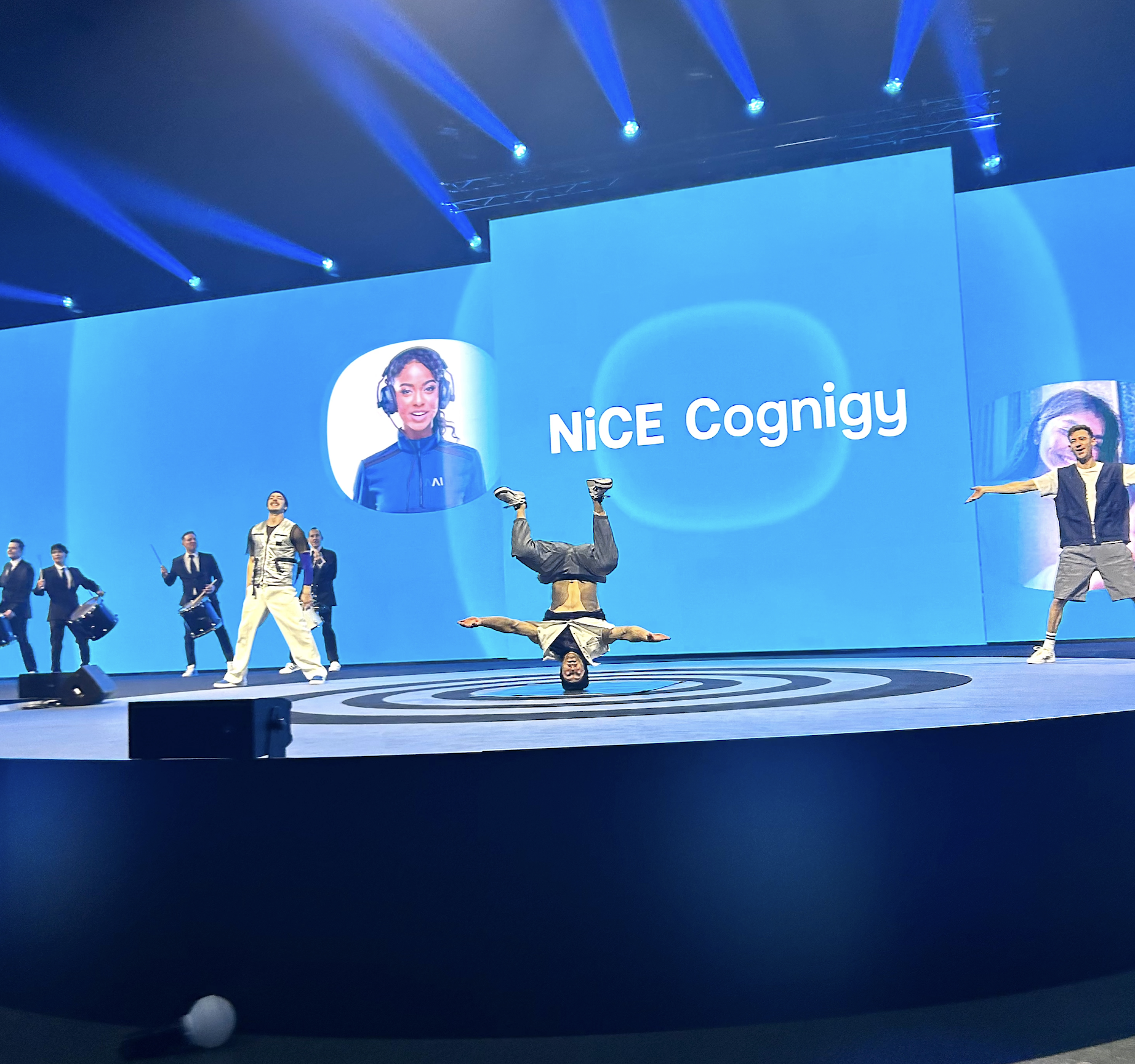
It also had breakdancers.
NiCE Cognigy: A Unified CX AI Platform For Agentic Transformation
In his 2026 Nexus keynote, Philipp “Phil” Heltewig, Chief AI Officer at NiCE and Cognigy Co-Founder, announced that NiCE Cognigy is building a Unified CX AI platform that moves enterprises from defining processes to orchestrating outcomes.
Today, AI agents no longer just talk to you, they work for you. The problem, according to Heltewig, is that while Agentic AI is penetrating and redefining entire workflows, human agents and AI agents are using separate systems and limited by fragmented data. While humans are still required to stitch everything together across these disconnected systems, we increasingly lack control over them.
The solution to this, says Heltewig, is a new agentic operating layer for CX: one where AI agents, human agents, and AI copilots all work with unified knowledge, workflows, and models informed by unified analytics. The Nexus 2026 CX AI Summit positioned NiCE Cognigy’s Unified CX AI platform as that solution.
The Agentic AI Learning Loop
The foundation of NiCE Cognigy’s AI-first CX strategy is the Agentic AI Learning Loop, which Heltewig introduced at Nexus. The loop goes like this:
Start, obviously, by creating the AI agent (ideally using NiCE Cognigy’s new automation discovery tool, but we’ll get to that in a moment.) Then, evaluate the AI agent. Third, deploy the AI agent. Fourth, observe the AI agent. Finally, improve the AI agent – both autonomously and with humans-in-the-loop.
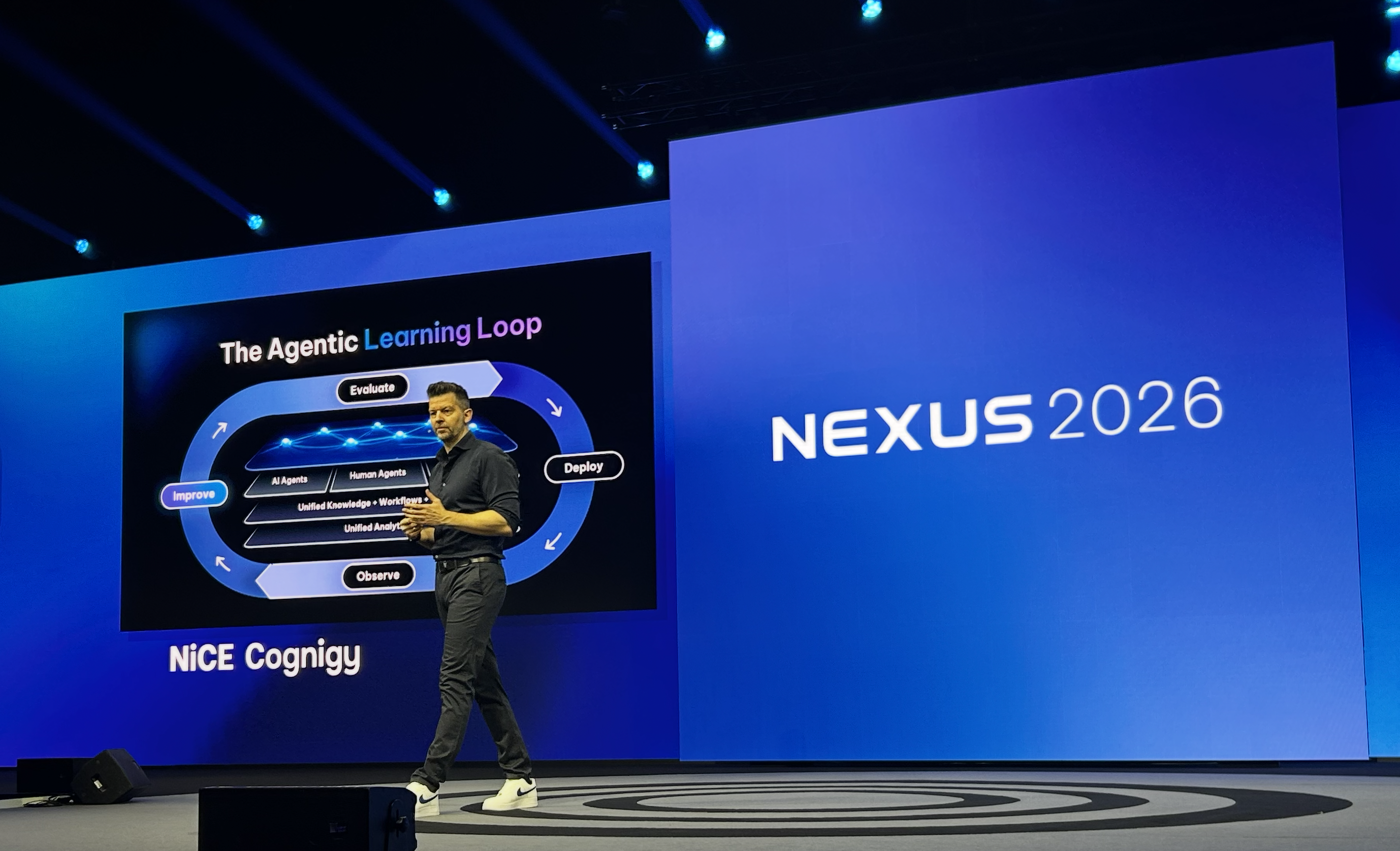
NiCE Cognigy’s Unified CX AI platform is entirely informed by this closed Agentic AI Learning Loop: it’s an architectural solution that continuously improves, not a point solution that starts to degrade almost immediately after deployment.
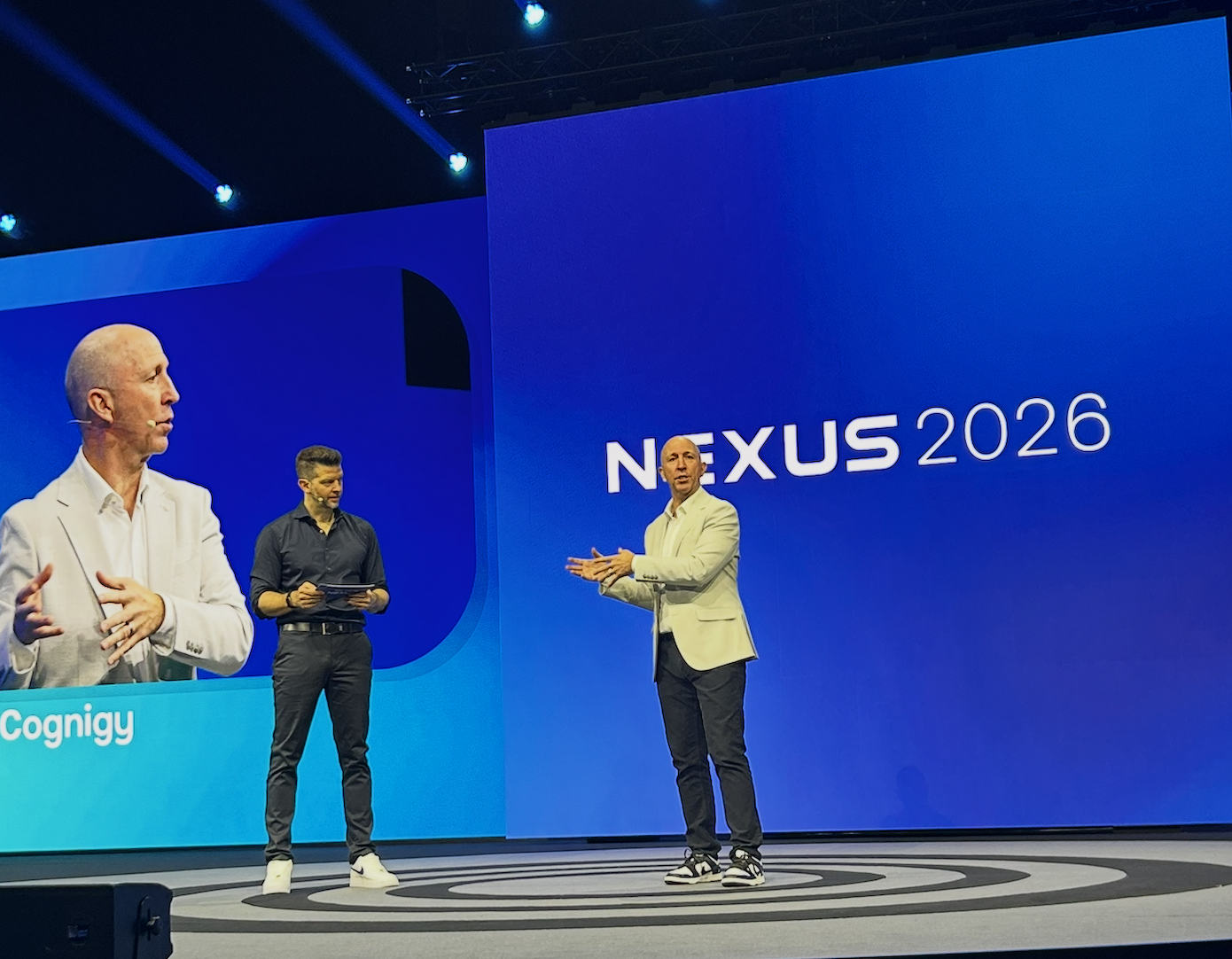
According to NiCE CEO Scott Russell, who called the Cognigy acquisition “The single best decision that I will make in my career at NiCE,” this level of insight is exactly what NiCE was missing. Said Russell, who joined Heltewig onstage during the opening keynote:
When I got on the ground, I realized our platform, our capabilities, our AI progress…where the market was going, we had a clear gap. I researched who the leaders were in the AI CX era. We looked at over 50 different companies. Cognigy was the only choice, because it was the proven platform at enterprise scale to deliver.

Scott and Heltewig’s genuine camaraderie was on full display at Nexus, mirroring the complementary nature of NiCE and Cognigy. Throughout the event, both emphasized just how essential complete process and workflow reinvention is to succeeding with AI. Indeed, the entire CX space has spent the past year and change living with the messy consequences (and lackluster results) of bolt-on AI and disconnected systems. When Heltewig called for “a total rethinking” of the way businesses interact with their customers in the agentic era, it’s safe to say that everyone in the audience agreed.
But for enterprises, the reality of implementing that agentic-driven reinvention–no matter how transformative it promises to be–isn’t so simple.
Jack Roberts, Senior Global Director of Fabletics, called the current demand to augment AI into the CX space “the biggest change we’ve seen in the industry since the cloud migration.” Small changes, Roberts explained to the Nexus audience, quickly morphed into “seismic” projects.
Helping enterprises navigate this reinvention is where technology partners like NiCE Cognigy come in – and, I’ve noticed, where so many of them fail.
What differentiates NiCE Cognigy from its competitors is the speed and breadth of innovation, propelled by a future-focused vision and the genuinely exciting new capabilities shown off in the Nexus Tech Lab.
Tools For The AI Everywhere Approach
During the product keynote, Sebastian Glock (Director of Product Marketing & Technology Evangelist at NiCE Cognigy) and Thys Waanders (Vice President of AI Transformation at NiCE Cognigy) highlighted the platform’s “AI Everywhere” approach. In NiCE Cognigy’s unified platform, AI assists with every aspect of enterprise workflows and processes: building, deploying, monitoring, optimizing, managing, and orchestrating AI agents at scale.
The goal of NiCE Cognigy’s AI Everywhere strategy is to “build once, deploy everywhere” by using a governed library of tools and components with transparency, traceability, and observability baked-in.
NiCE Cognigy’s AI Everywhere approach, strengthened by the closed Agentic AI Learning Loop, allows enterprises to deploy better agents, and achieve faster time-to-market, with greater guidance, flexibility, and control.
Now, let’s talk about some of the new NiCE Cognigy innovations that actually make it happen.
NiCE Cognigy Automation Discovery
The Automation Discovery tool, part of NiCE Cognigy’s broader Automated Insights suite, is designed to take the guesswork out of AI strategy and roadmaps.
Most enterprises today are drowning in mountains of disconnected data, but lack the connective tissue to turn those insights into real-world use cases and business outcomes. Automation Discovery is that connective tissue.
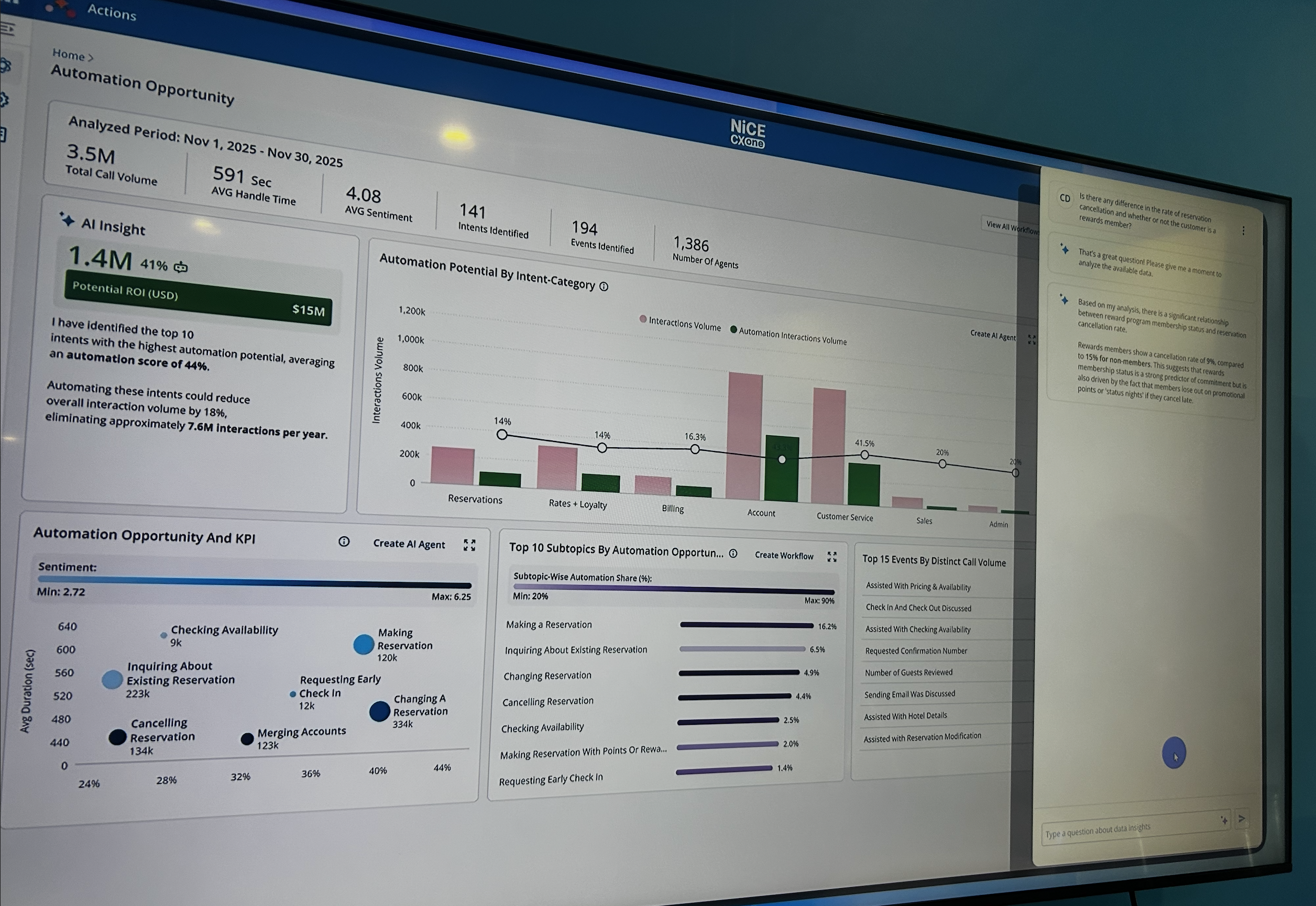
The tool analyzes both structured and unstructured interaction data (think voice transcripts, routing signals, chats, and performance metrics) to identify high-impact and high ROI automation opportunities. This is where it gets truly "agentic." In the past, even after leaders finally identified a good use case, it still took months of design to actually build and deploy an AI agent. The Automation Discovery tool automatically generates and exports production-ready agent journeys in just a few clicks, compressing deployment timelines from months to days.
I had a chance to see it in action firsthand at the Tech Labs, and was shocked by just how granular the insights were. Users are shown multiple intents with the highest automation potential, the percentage and number of interactions AI could handle per year, automation subtopics, and even the potential cost and time savings of automation.
NiCE Cognigy Knowledge Management
NiCE Cognigy Knowledge AI uses RAG to give AI agents access to all essential knowledge base files in one place – even those in a variety of formats and from external third-party content systems. Pre-built and customizable Knowledge Connectors automatically import data from NiCE CXone Expert, document libraries, preferred external knowledge base tools like Confluence or SharePoint, Cognigy CTXT, or web pages.
Knowledge Stores group related knowledge sources together, making it easier and faster for AI agents to retrieve the relevant information from your knowledge base. Advanced synchronization routinely updates knowledge base data to prevent AI agents from providing customers with outdated or incorrect information.
With Knowledge AI, virtual agents can provide customer support that is faster, more context-aware, traceable, governed, conversational, and accurate. For enterprises, Knowledge AI eliminates the need for time-consuming manual file imports and data migration.
NiCE Cognigy Simulator
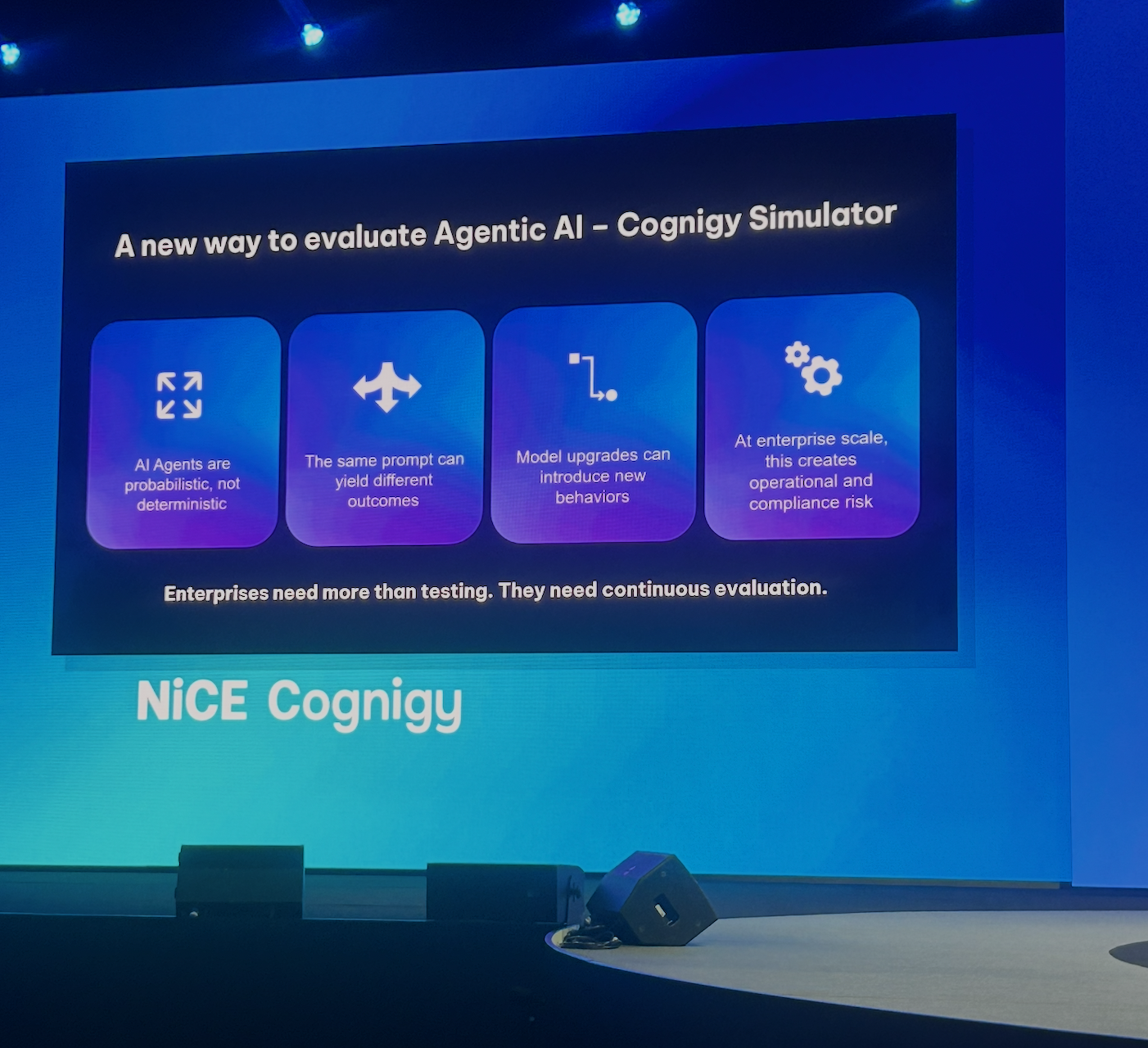
The new NiCE Cognigy Simulator is far from an AI agent testing tool. Rather, it’s a complete, continuous performance lab and testing suite designed for the probabilistic nature of agentic AI.
The Simulator creates digital twins of real audiences and customers, then simulates thousands of realistic, adversarial, and edge-case conversations designed to stress-test AI agent performance before deployment. Users can design their own test scenarios from scratch, or use the AI-powered generated scenarios based on existing customer conversation data. Each testing scenario includes a unique persona, customer mission, custom success criteria, and the ability to set the maximum number of conversation turns.
Once a testing scenario is complete, users can view success rate trends that show the agent’s improvement across simulations, average success rate and number of turns, the percentage of success criteria met, and the average sentiment, among others. Additional granular breakdowns provide complete conversation transcripts across individual runs. After each scenario, users can further optimize and customize the AI agent based on the results, tracking improvements with each run.
The Simulator was my favorite new feature, and I enjoyed pushing an AI agent to the limit when asking about flight reschedule possibilities in the onsite Tech Lab. I was impressed with the production-ready level of the results.
The benefits here are obvious: differentiated outcomes-based evaluations, upcoming multivariate testing, greater deployment confidence, faster development cycles, and risk mitigation, to name a few.
Multimodal and Proactive CX
The Nexus event also highlighted the importance of proactive, multimodal AI agents that move enterprises from reactive, ticket-based customer service to autonomous outcomes driven by context-aware proactive AI agents.
Proactive AI agents are always designed to anticipate customer needs, but NiCE Cognigy differentiators include multi-intent capability, progressive reasoning, and seamless escalation to a live agent. NiCE Cognigy’s agents gather data from multiple systems to determine the ideal moment and channel for outreach, dynamically adapt to and personalize customer conversations, and initiate two-way customer conversations with AI agents.
NiCE Cognigy’s proactive AI agents can lower inbound contact volumes, increase revenue via upselling and cross-selling, and provide the kind of personalized customer experience that drives long-term loyalty.
Model Context Protocol (MCP) Integration
Another exciting, albeit slightly dystopian, topic of conversation at Nexus 2026 was the eventuality of your human customers turning into AI agents. NiCE Cognigy is clearly preparing for this future now by announcing deeper, more advanced MCP integration.
This will allow the NiCE Cognigy platform to easily connect, interoperate, and communicate with external AI tools – giving enterprises the ability to use multiple AI tools in a single conversation.
Advanced MCP integration resolves the “frankenstack” nightmare, eliminates the need for developers to build tedious one-off integrations, and creates a truly vendor-agnostic ecosystem that allows developers to create and manage AI agents on their ideal platform.
These advanced MCP integrations suggest NiCE Cognigy is establishing itself as the definitive agentic operating layer for the enterprise, ensuring businesses are ready for a future where autonomous AI agents orchestrate both service delivery and customer demand.
Nexus 2026: Proof, Not Promises
Kevin Lee, Field CTO and Key Pursuits Leader at NiCE, grounded all of this vision in something the CX industry desperately needs more of: real results.
A financial services company saw a 32% increase in NPS. A government agency improved customer sentiment by 24%. A healthcare provider cut average handle time by 14%. A hospital eliminated 11 vendors from their tech stack. A retailer saw a 15% increase in containment with resolution.
The CX AI space is crowded, noisy, and full of vendors making promises they can't keep. While the breadth of innovation shown at Nexus is impressive and exciting, what really differentiates NiCE Cognigy is the coherence of the vision behind it – and the dedication of the people driving it.
The Agentic AI Learning Loop is an architectural commitment to continuous improvement. Every capability shown at Nexus feeds back into that loop. While many are wasting time stitching together disconnected systems and throwing more useless AI apps onto the CX fire, the agentic operating layer is being built. At Nexus 2026, NiCE Cognigy made a compelling case that it should be theirs.