
November 18, 2026 • 8 min read
7 Lessons from Trademark Global’s Journey to a Growth-Driven Contact Center

Director of Content & Market Research
November 18, 2026
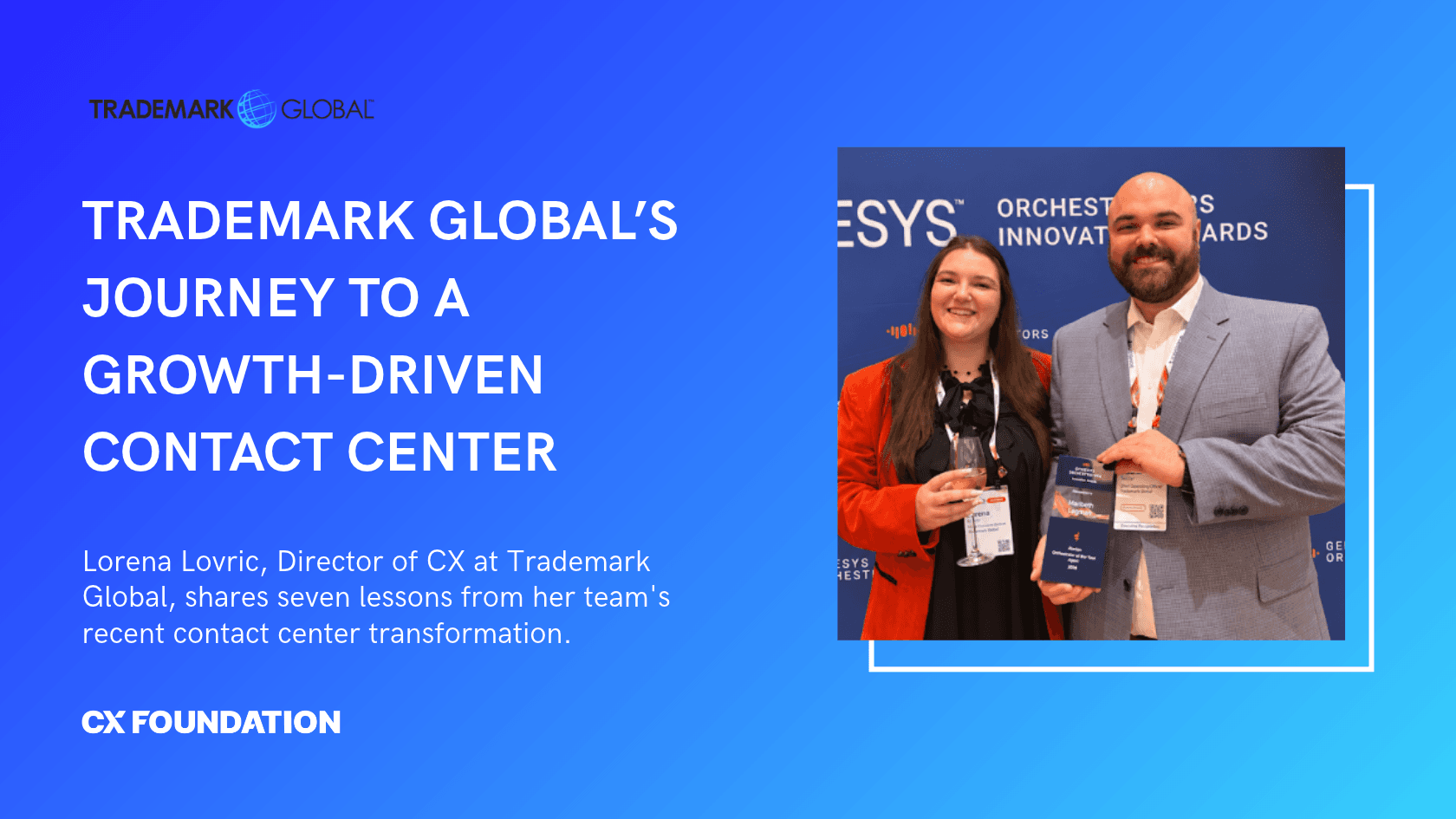
Trademark Global is a major eCommerce company. It sells approximately 8,000 products across marketplaces like Amazon, Target, and Walmart.
That proliferation is a blessing. But from a customer experience perspective, it’s also a curse.
A customer might spot a product on one marketplace, purchase it on another, and then reach out directly for customer support.
Connecting the dots isn’t easy. Meanwhile, marketplaces enforce strict service level requirements to ensure prompt, satisfactory service.
However, where there appeared difficulty, Trademark Global saw opportunity.
It set a new vision for customer support in the enterprise, positioning it as a growth engine.
The company built toward that objective by orchestrating new proactive and reactive experiences, leading with AI, and empowering human agents to solve queries AI can’t.
The result? Trademark Global reported 42% containment, a 111% increase in referral code usage, and an employee Net Promoter Score (NPS) of 82.
Those outcomes didn’t just happen overnight. Alongside a cultural change program, Trademark Global switched platforms, moving to Genesys Cloud to implement its Agentic Virtual Agent (AVA), Copilots, and various other solutions.
Along the way, Lorena Lovric, Director of Customer Experience at Trademark Global, and her team learned many valuable lessons.
In an interview, Lovric shared seven such lessons for her fellow industry professionals.
1. Align CX and IT Teams from the Get Go
AI projects can often be a power struggle. IT understands the AI, but CX understands the customer journeys. That relationship can be tricky to navigate.
As such, when Trademark Global began its transformation, Lovric set IT a challenge: join us in the queue for just 30 minutes and see what it’s like to be an agent.
Thankfully, former CTO Roi Zahut accepted the challenge and soon became very engaged in the transformation project.
“He struggled quite a bit, but it also gave him the opportunity to see where we had technological gaps: which other systems agents still needed to log into, what wasn't yet integrated into Genesys, and where we could improve,” noted Lovric.
Soon, Zahut was spending more time sitting alongside agents, observing where they clicked and what they needed.
Ultimately, that not only supported better front-end automation and more helpful Agent Copilots, but also assisted Trademark Global in bringing scattered knowledge into the core contact center environment.
2. Seek Agent Feedback Early and Often
Even before its COO sat alongside agents to understand their experience, Trademark Global realized the importance of engaging agents early and often in its transformation.
That lesson was learned the hard way.
One of the first workflows built on the new platform alerted managers whenever customers raised particularly sensitive issues, ensuring agents received the additional support they needed to handle them.
To detect such threats, Trademark Global created a list of triggers. One of those was the word “die.”
Fast-forward to the middle of the night in the US and early morning in Europe, when the company’s German customers woke up, and things went awry.
Why? Because in German, “die” is an article, and it appears in practically every email.
“All of a sudden, we had 500 cases labelled as deaths coming in within a matter of hours,” said Lovric. “It woke up the entire executive team because we suddenly had an emergency on our hands.”
If agents had been consulted beforehand, they would have likely pointed out something important: “What about our German queue? Don’t include that, right?”
“That was a very important lesson for us. We now involve agents in absolutely everything we do with AVA, our flows, and all our other initiatives.”

3. Don’t Pin Your Hopes on Customer Journey Maps
When designing future state customer experiences, customer journey maps are the default for many. Yet, Lovric warns that this is no longer enough.
“I actually describe journey maps as being like Google Maps,” said Lovric. “They tell you where to go and how to get there, but they don't fix the traffic. And the traffic is your organization. So, ultimately, the organization is what you need to fix first.”
To this point, it’s better to work with the broader business to solve issues at the root, rather than react after something has gone wrong.
Moreover, once those contacts reach a human it’s incredibly difficult to anticipate the outcome. As such, forcing customers down one pre-set route takes customer support into the realms of clumsy automation.
“I think journey mapping stops being enough right at the beginning. You need much more than simply knowing where your customers go, where they click and what you think they're trying to achieve.”
Summing up, Lovric suggested that today’s customer experience leaders should embrace more flexible approaches to customer journey orchestration.
4. Frame Virtual Agents as Human Assistants
Only 49% of customers would be willing to use a chatbot, if a company provides one, according to 2026 Gartner research.
That shows how negative perceptions of old, NLU-based chatbots still linger.
Trademark Global experienced this pushback when it first launched AVA across voice, with customers repeatedly requesting a human before giving the AI a chance.
Recognizing this, it positioned AVA as the human’s assistant.
When a customer calls and immediately asks to speak to a human, the AI reassures them that they will be transferred to an agent. It then explains that, in the meantime, it would like to gather information to help the agent resolve their query more effectively.
In doing so, AVA leads the human agent to the answer, while enabling an escalation that keeps the customer happy. All the while, customer confidence in AI grows.
Lovric also recommends another best practice: have AI play the sound of computer typing as it runs multi-step tasks. That helps avoid awkward pauses and again reassures the customer that their matter is being resolved.
These are simple conversational design tips, but Trademark Global’s success demonstrates their effectiveness.
5. Connect the Virtual Agent and Copilot Strategy
With one provider for AVA and its Agent Copilot, Trademark Global can funnel customer context and intelligence from the initial AI conversation through to a human in case of an escalation.
Often referred to as a “warm transfer”, that intelligence helps humans resolve the interaction without asking customers to repeat themselves.
Yet, Trademark Global’s Copilot can also fetch additional context related to the intent. That additional context can pop up as agents navigate the call, reducing agent “swivel-chairing” between solutions.
While that is advanced in itself, the connection is also powerful when considering how contact center interactions may change in the future.
AVA may currently hand over a query to a human agent for resolution. In the future, however, it could go a step further by delegating specific tasks to agents to complete in the background, before handing control back to AVA to close the conversation.
With AI becoming increasingly advanced, that’s likely what tomorrow’s contact center interactions will look like and Trademark Global appears well set.
6. Democratize Customer Insights Through Claude
Contact center conversations contain valuable insights that can benefit other departments across the business. For example:
- Competitor mentions can be valuable to marketing teams.
- Upsell patterns can be useful for sales and commerce teams.
- Product complaints can aid product design.
- Agent performance data can inform HR evaluations.
However, historically, that has meant building insight pipelines across departments, tricky integration work, and creating custom reports and dashboards.
Fortunately, Trademark Global found a better way by wiring contact center data into Claude via the Genesys Cloud MCP Server.
As a result, department leaders can ask questions about customer trends, emerging risks, and whatever else matters to them, getting answers right aways.
Ultimately, this has helped reposition the contact center as not just a “growth engine,” but an “intelligence hub,” with colleagues across Legal, Compliance and Engineering also leveraging the platform.
7. Engage Other Departments in Friday Workshops
While product, finance, and operations leaders can now access contact center insight via Claude, Trademark Global wanted to go further in repositioning customer support.
So, it kickstarted Friday workshops to understand how other departments work, build cross-functional relationships, and develop skills beyond customer service.
In doing so, Trademark Global invites leaders from Product, Finance, Operations, and beyond to share their knowledge, explain their processes, and highlight how their teams contribute to CX.
Meanwhile, Lovric encourages agents to lead sessions too, sharing practical knowledge that isn’t documented elsewhere that they believe could help those departments.
Since running these sessions, Trademark Global believes it has helped teams better understand the challenges contact centers face, and agents see the bigger picture behind customer interactions.
And its employee NPS score of 82 speaks for itself…
Thanks to Lovric and the Trademark Global team for sharing their insights with us. Get in touch if you’re a CX leader and wish to share your experiences too!