
October 22, 2026 • 10 min read
The Economic Risks of AI in Customer Support

Director of Content & Market Research
October 22, 2026
For years, buying customer support software was simple. Vendors charged per seat, per month, and that was that.
That era is slowly fading. Vendors are changing tactics, launching new pricing models, and protecting themselves in a world where AI could shrink seat counts (and their revenues).
The trouble? Many organizations liked per-seat pricing because it was predictable.
Now, a bill can depend on how much AI they consume and what outcomes they achieve.
As a result, the cost equation is not only more complex, but AI success may be the most expensive scenario of all.
Terra Higginson, Principal Analyst at Info-Tech Research Group, warns: "The more you use AI, the more it will cost. If it really works very, very well, all of a sudden your pricing is going to see this exponential increase."
Still, both enterprises and vendors are navigating an uncertain pricing transition.
As they do, service leaders should keep five key risks in mind.
Risk 1: AI Agents Cost More Than Outsourced Contact Center Agents
AI doesn't automatically beat human labor on cost.
In its research Goldman Sachs found that, when normalized to a human workday, an AI agent cost an average of $92.90 per day.
That was more than its $90.00 US benchmark for human labor.
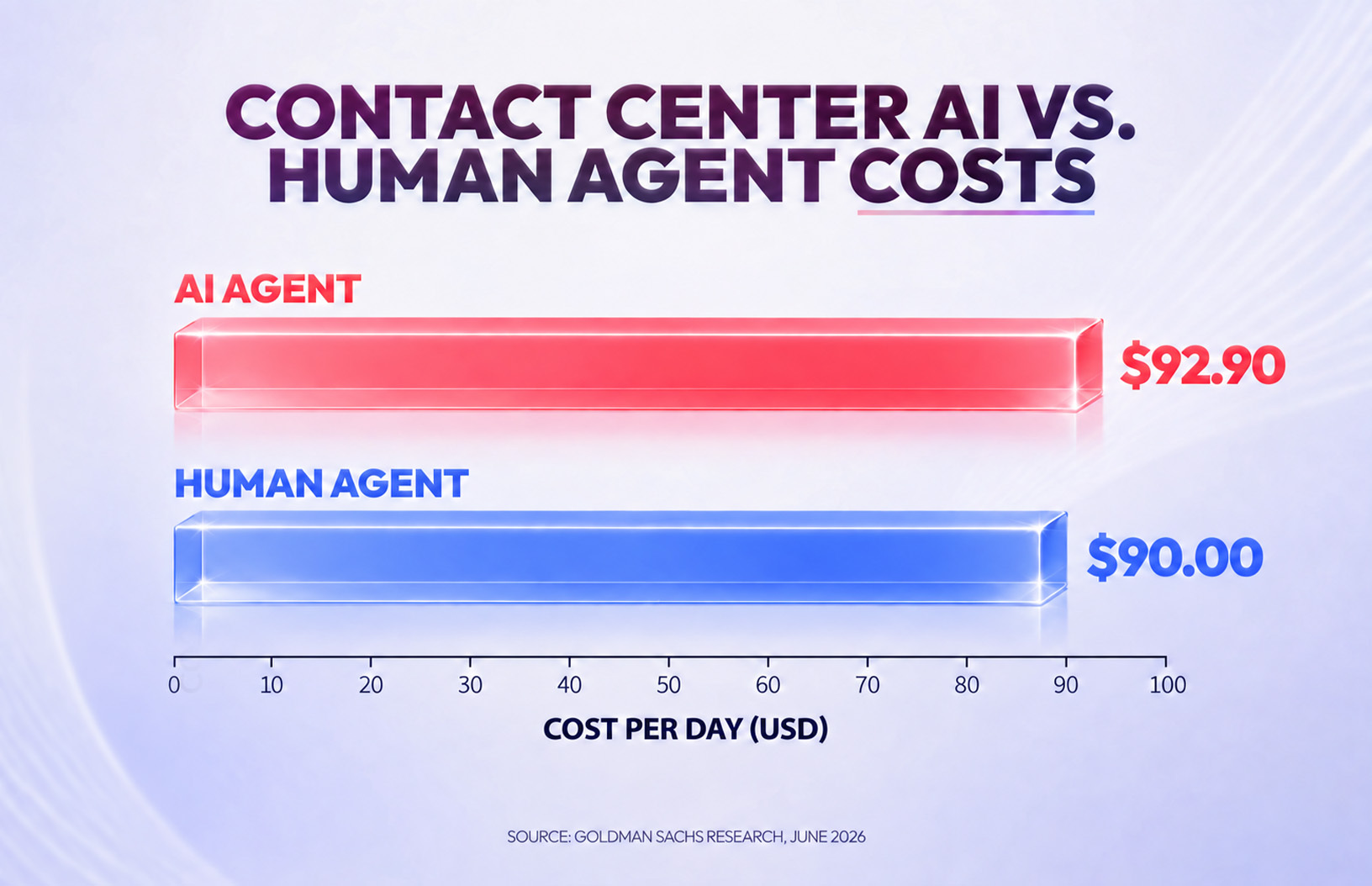
What’s more, outsourced agents in most other countries cost even less than the US benchmark, widening the price differential.
Citing this statistic, Ian Jacobs, VP & Lead Analyst at Opus Research, calls for deeper consideration of where brands deploy AI for self-service.
"If automating 15 minutes of a 30-minute call is equivalent to automating five tier-one password resets, it's perhaps more worthwhile to reduce the workload there, rather than to automate the simplest interactions."

In other words, there’s a case for starting with complex voice AI tasks and then running the numbers.
Risk 2: Customer-Facing AI Implementations Hike Other Costs
When AI takes a leading role in self-service, it also changes the cost dynamics elsewhere in the contact center.
Adrian Swinscoe, Founder of PunkCX, points to Gartner's modeling of a scenario where a contact center achieves a 50%+ automation rate on largely simple queries.
"Once you factor in the savings on headcount, but also the added costs of licensing, usage, and the extra human skills needed (to consistently deal with more complex queries), you could end up with an operation that's more expensive than the one you had before."

There is also the matter of hiking salaries to support employees with those “extra” skills.
Given this, support leaders must total every line item before declaring AI success. Meanwhile, to Jacobs’ previous point, it’s perhaps worth reconsidering where AI is first applied.
Risk 3: New Pricing Models Obscure Contact Center Costs
New pricing methods add a level of complexity, especially as contact centers recognize the need to balance multiple types of models.
Take outcome-based pricing. So far, it’s largely been limited to customer-facing AI agents. But service teams also rely on solutions ranging from workforce engagement tools to voice of the customer solutions. These tools are difficult to price based on outcomes. As such, outcome-based pricing is often layered onto the traditional seat-based model.
Meanwhile, consumption pricing varies across different components of the customer support stack, meaning brands can’t yet tell the CFO their entire CX program costs a set rate per minute, week, month, or other period.
Then, there are the additional pricing mechanics vendors are experimenting with, which add another layer of complexity.
“Consider vendors that sell tokens for specific use cases,” said Jacobs. “Token consumption is the vendor’s concern because it’s their compute spend. The CFO shouldn’t have to think about it, but unfortunately, it still comes up.”
Risk 4: Rising AI Model Costs Pass Onto the End-User
Today's AI prices may not reflect tomorrow’s reality.
"What's clear is that we don't know the true economics of using large language models (LLMs),” cautions Swinscoe. “Right now, the cost of running a query or an analysis is heavily subsidized."
Indeed, as model providers shift from subsidized growth to prioritizing profitability, there is a risk those costs will ultimately land on customers.
Outside of AI, software bundling presents a similar cost risk. As customer experience technologies converge and vendors rely more heavily on a single provider’s software, the contact center’s cost models become increasingly vulnerable to price hikes.
As Nick Travers, COO at SmartSurvey (the company behind the VoC platform SmartCX), said: "The broader the capability, the richer the feature set, the more it costs vendors to provide, and - therefore - they pass that on to the customer.’’
“What we've seen is a number of customers paying for things they're never going to use just to access the things that they actually wanted."
Risk 5: Vendor Definitions and Inference Costs Cause Confusion
What is an outcome? In AI self-service, it’s often whether a query was resolved. But that raises another question: What counts as a resolution?
Today, many customer support teams define resolution as “no repeat contact within 30 days.” Vendors also track repeat contacts, but typically use a much shorter window: “No repeat contact within 24–72 hours.” That gap can create confusion and must be addressed upfront.
Consumption-based pricing can create cost uncertainty, too.
After all, brands can’t control what customers ask at the front end. As Swinscoe puts it: “I might ask a really complex query, and it blows up your token budget.”
Without visibility into what drives inference spend - or the ability to shape demand - budgeting for AI-powered support becomes part guesswork, with surprises likely.
A Hard Truth: Vendors Are Still Figuring This Out
Buyers aren't the only ones in unfamiliar territory. Vendors are navigating the shift too, and it's harder than it looks.
"In any industry, in any tech, changing your commercial model is way, way harder than it sounds. You end up with historical customers on one plan and new customers on another, and it gets really messy."

Old habits also die hard. "Salespeople always take the path of least resistance, and if the procurement person is used to a certain model because that's how he did his last three contracts, they'll go down that route," added Butterfield.
As such, the market should expect bumps and inconsistent deals as it settles.
5 Lessons for Customer Support Leaders to Take Forward
The risks are real, but so is the risk of doing nothing.
With that in mind, here are five practical moves customer support teams can make before signing their next contract to keep AI spending under control and tied to value.
1. Systematically Remove Failure Demand, Don't Just Automate It
Contact center 101: Don’t use AI as a sticky plaster. Rather than automating an issue, identify its root cause, work with other teams to eliminate it, and systematically reduce failure demand.
After all, there’s no need to spend money on AI if the query never arises in the first instance.
Not every query will be failure demand, of course. But analyzing contact reasons and customer feedback can identify those with a clear root cause that add little value in terms of resolving the issue and strengthening the customer relationship.
2. Don't Discount Older, Cheaper Forms of AI, Like Robotic Process Automation (RPA)
Not every problem needs generative or agentic AI.
"Right now, generative and agentic AI is being spread across everything like jam. Everyone's rushing to do something AI-powered without stopping to ask what problem they're trying to solve, where they are now, and what the best solution is."
Sometimes the answer is far simpler. Given your current infrastructure, "you might connect an RPA connector, send a notification that confirms it's done and closes the loop,” said Swinscoe. That's cheap as chips."
Of course, the test is whether it's as effective and scales economically. However, applying the latest AI to the simplest workflows is not necessarily the smart approach.
3. Consider: Does an AI Resolution Cost More Than a Failure?
Some fixes cost more than the problem.
"Let's pretend there's $2 charged per successful outcome, but each new journey costs at least $5,000 to build, and $5,000 is a really low amount in reality. That means you need 2,500 cases over the year to break even. If you only get 100 a month, it doesn't make sense."
The brand saves money by skipping the build, but customers pay for it. "The end customer still gets the short end of the stick. They still have all of those edge cases."
As such, brands should weigh build costs against volume and review customer feedback to see how significant the issue is to key customer experience and business metrics.
4. Don't Waste Budget on Tracking What You Already Know
AI analytics platforms shouldn't exist to confirm a hypothesis. Travers has seen it happen:
"Try to avoid paying for things that will just tell you what you already knew. We've seen that a few times, where they come with a hypothesis and almost use a platform to prove they were right. That's the wrong way round."

Instead, use analytics to untangle new insight into CX journeys. And keep perspective: "Try not to get too carried away with edge cases,” said Travers. “Focus on where the insight is new, and the pattern is widespread.”
5. Make a Compelling Case for Additional Budget
Until organizations see the contact center as a real-time data goldmine that adds ongoing value, it will keep battling over budget.
After all, while contact centers may have more funding for AI and automation, they still need to make the case for funding that supports a deeper transformation, not just to secure their own budget, but to win investment from the parts of the business that stand to benefit.
Often, the best place to start is with the CMO, who typically holds one of the largest budgets in the C-suite.
Pitch a partnership where the contact center surfaces customer insights marketing isn't seeing, and marketing invests in a project that benefits both.
Ultimately, that’s the likely best way to shift from cost center to revenue center.
A Final Lesson for the Tech Vendors...
Buyers are under pressure, with budgets rising only marginally as more vendors compete for that spend, expanding into new areas, and squeezing others out.
Swinscoe suggests a path forward: “Vendors could build connections to other parts of the business that might fund some of the transformation work for support teams.”
In doing so, they can break down the silos organizations often talk about removing but rarely do.
Meanwhile, they could also help larger enterprises reduce significant professional services costs, creating room for further investment.
For vendors, that - and caution around token-based pricing models - may be the biggest takeaway in a climate where pricing is proving just as challenging for them as it is for customer support leaders.