February 3, 2026 • 13 min read
Contact Center Workforce Management: 11 Best Practices for 2026

Director of Content & Market Research
February 3, 2026
In 2026, contact center workforce management teams face a mix of familiar pressures and emerging challenges.
Business leaders expect them to maintain service levels with limited staff, handle sustained contact volumes without affecting key metrics, and avoid attrition. Meanwhile, customer expectations continue to rise.
Additionally, there are new hurdles in integrating AI, forecasting demand for human vs. AI agents, and understanding changes in the cost base.
WFM professionals constantly navigate these challenges and make trade-offs.
The workforce management best practices outlined below aim to help them do so. But first, here’s a refresher of the fundamentals.
What Is Contact Center Workforce Management?
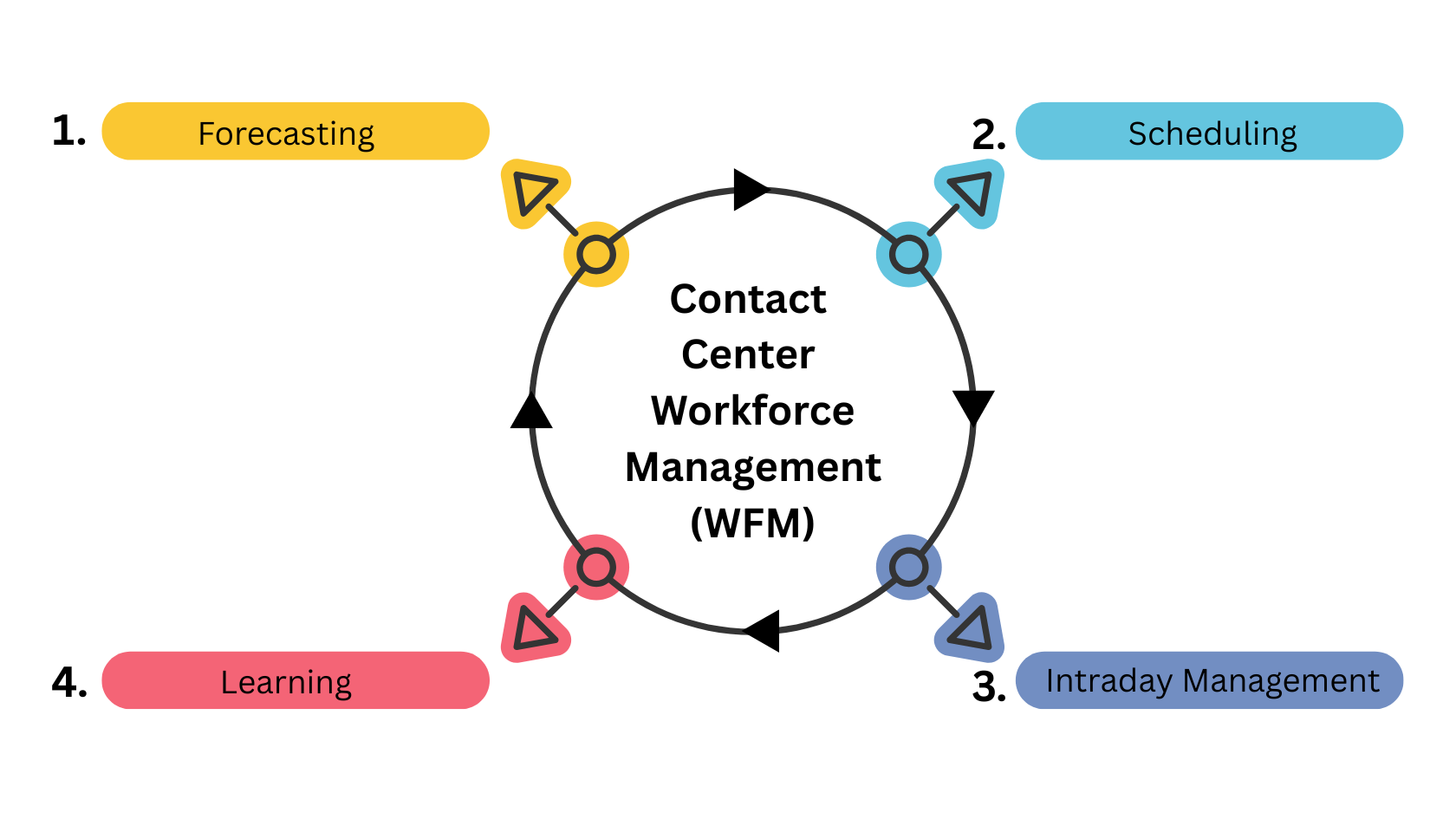
Contact center workforce management (WFM) comprises four core elements: forecasting, scheduling, intraday management, and learning.
Forecasting involves predicting the number of inbound calls, emails, chats, and messages the contact center will receive over a given period.
Scheduling aligns forecasts with employee contracts and preferences to ensure the contact center has the right number of people available at the right time to meet demand.
Intraday management entails monitoring incoming contact volumes, service levels, and agent availability to ensure customers aren’t waiting too long and that reps aren’t overburdened. In either case (or both), planners may take mitigating actions such as reassigning reps across channels or calling in additional staff for coverage.
Then, there’s learning, where WFM teams review their forecast accuracy, schedule adherence, and other metrics, unpack lessons, and refine their process.
In this sense, WFM is cyclical, as showcased in the graphic below.
Alongside managing this cycle, there are other tasks WFM teams must follow. These include managing holidays, supporting recruitment drives, and planning for “what-if scenarios”, such as system outages, weather emergencies, and strikes.
Finally, it’s becoming increasingly crucial for WFM to collaborate across the business, engaging with everyone from the C-suite to HR, coaching, and digital teams to align planning with broader business objectives.
11 Contact Center Workforce Management Best Practices
Contact center workforce management best practices vary by environment. Nevertheless, there are general pieces of advice that resonate with the broad community, such as those outlined below.
1. Pull External Data Sources Into Your WFM Environment
Many planners export forecasts and overlay additional data externally to improve accuracy.
For instance, energy and insurance providers often incorporate weather data, which can have a direct impact on contact volumes.
Another example is mortgage providers accounting for interest rate changes. Why? Because when interest rates fall, mortgage activity typically rises and so does demand for customer service.
Across industries, there are many such variables to consider.
Yet, instead of laying this data over exported forecasts, there’s a growing push to bring that enriched data back into the WFM solution itself.
Fortunately, vendors are opening up APIs that allow brands to integrate this data into their environments and manage these variables more effectively.
“Historically, forecasting was mainly demand-driven, looking at historical data. But the world isn’t static anymore; there’s more volatility due to societal changes, spending patterns, and other factors, so planners need to account for more variables.”

2. Build Helpful Extensions to Your WFM Application
When planning teams move from one WFM solution to another, such as Aspect to Calabrio, they’ll likely notice that helpful features from their old tools are missing.
Yet, using AI and Vibe Coding, people with minimal technical skills can recreate features and automations themselves.
For example, if a tool doesn’t capture personal preferences, WFM teams can create a side app that lets agents input them. Then, the system might reserve the top ten people for their preferred schedules, while everyone else goes through the normal shift bid. Nowadays, planners can much more easily build such functionality themselves.
“Essentially, AI allows teams to be creative outside the limitations of the enterprise tool.”

3. Use Third-Party Machine Learning Models for Forecasting
Increasingly, planners are pulling external machine-learning models into their WFM systems to improve their forecasts.
AXA Insurance Ireland, for example, slots advanced forecasting models from CCmath into its WFM environment. “Their forecasting is amazing because they focus exclusively on that; they actually develop the algorithms used by many systems,” said John Casey, Strategic Workforce Planning Manager at AXA Insurance Ireland.
This approach reflects a broader shift away from relying solely on the WFM providers’ built-in forecasting algorithms. While those tools perform well at a general market level, no two contact centers operate in exactly the same way.
“My advice to anyone in a workforce planning role is: Don’t rely entirely on your workforce management system,” Casey added. “For us, even on the worst days, our forecast is usually within a percent or two of reality.”
By incorporating third-party forecasting models into the WFM system, teams can manage end-to-end planning within a single environment, which spans long-term strategic planning through to intraday management.
4. Leverage AI as a Personal Assistant
An AI assistant, like Gemini, can review meeting notes, summarize them, and add them to a master document, giving it memory. Planners may then interact with it as a personal assistant that “knows” all their meetings.
“In WFM, this aligns perfectly because we’re always thinking about optimization, how to do things faster, easier, better,” said Smitely, who recommends this tactic. “AI is just an enhanced version of Excel macros or custom tools we’ve always created.”
Beyond AI as a copilot, many organizations ultimately aspire to use it as a full-scale forecasting engine.
In the future, planners will tell such an engine: “Here are my priorities. Decide which algorithm and calculation system will best achieve my goals.” The AI may then do all the math and come back with a recommendation. That’s an exciting prospect!
5. Engage New Recruits Early & Keep Communications Lines Open
Today’s contact center teams expect flexibility. As such, planners must take a more people-centric approach to scheduling.
For AXA Insurance Ireland, this means discussing preferences, hobbies, and lifestyle choices with new hires during onboarding, then building schedules that closely align with them, their expectations, and their lives.
“Most recruits usually wish to avoid a specific shift or day, which we can accommodate by balancing capacity across teams, considering local events, holidays, etc. The difference this makes to the performance and well-being of the team is measured in many ways, but at its core, we have happier customers and better customer outcomes.”

After initial onboarding, Casey and his team proactively monitor problems and publish schedules five to eight weeks in advance. “This lets our colleagues plan their lives, which improves loyalty and performance,” he concluded.
6. Schedule Across Various Shift Types
Previously, contact centers used fixed shifts and rotational patterns. Now, dynamic scheduling across different shift types is becoming more of a requirement than a “nice to have.”
These shift types may include:
- Split shifts: A single workday split into two segments, separated by a long, unpaid break. This arrangement is often preferred by parents who want to pick up their children and resume work afterward.
- Micro shifts: Short shifts of one or two hours typically appeal to remote, part-time workers looking to maximize their income. They are particularly effective for contact centers that experience sharp peaks in demand.
- Stair-step schedules: Often referred to as “slant schedules”, stair-step schedules involve a rep working ten hours on Monday and one hour fewer until the end of the week. Reps often like this as, while they still work a 40-hour week, it eases them into the weekend. It also aligns well with demand patterns in many contact centers, where volumes typically decline as the work week progresses.
- Four-day work weeks: Compressed 10-hour days mean that reps still work a 40-hour week, but can enjoy a three-day weekend, which is often a preference of younger employees.
- Student shifts: Contact center demand typically peaks between 10AM and 3PM. Offering short shifts during this period, tailored for university or college students balancing work and study, continues to be an effective staffing approach. The shift type can also appeal to some stay-at-home parents who work remotely.
- Banked hours: When demand is high, reps work overtime and “bank” those hours, which they can later redeem during specified quieter periods throughout the year.
Particular shift patterns will work better for some contact centers than others. Ultimately, choosing the right approach is less about rules and more about understanding your people and their preferences, offering flexibility wherever possible.
“There’s no single ‘best practice’, it’s about listening to employee needs and aligning them with business requirements. Some agents might work unusual schedules if it works for them and the staffing plan.”
7. Let Service Reps Choose Their Own Breaks
More contact centers are allowing employees to adjust their start times and breaks without penalty, as long as they respect capacity rules.
Again, AXA Ireland is one such organization. “Colleagues get about 7% of their shift as break time (30–31 minutes), which they can take as needed, based on workload or personal recharge,” said Casey.
While some may worry that reps will take their breaks at the same time, Casey has found that mature colleagues manage themselves. Meanwhile, the approach has reportedly improved service levels as the team has expanded, while reps have enjoyed the opportunity to give themselves a moment to reset after a difficult interaction.
AXA Ireland has also found that this method helps reinforce trust in employees, rather than relying on “big brother” oversight. Breaks are still tracked, but only to flag extreme deviations, allowing teams to operate with more autonomy, just as their supervisors do.
8. Proactively Manage Your Holiday “Hot Spots”
WFM teams have long struggled with holiday governance, particularly around “hot spots”, i.e., the peak periods that everyone wants off. Managing these windows effectively is critical.
The solution lies in setting clear limits during high-demand periods, while offering greater flexibility at other times of the year.
“Encourage early holiday booking, e.g., “Book by January 5 and get guaranteed dates.” This prevents end-of-year bottlenecks where too many employees have unused leave.”
The challenge, of course, is that younger employees are less likely to plan their lives 12 months in advance, and they’ve become more pragmatic. Rather than requesting time off and risking rejection, some simply call in sick, leaving no paper trail.
Recognizing this, AXA Ireland analyzed patterns of high sickness and proactively added half of the anticipated ‘excess’ sick days into its holiday pool. As a result, total absence dropped significantly, and the organization was able to mitigate staffing shortages.
9. Think of Intraday Management as a Strategic Operation, Not a Firefight
In the past, the default response to pressure was simple: get everyone online as quickly as possible. Today, teams are thinking more carefully about impact and trade-offs, rather than reacting on autopilot.
This matters because WFM teams are under sustained pressure: budgets are tight, service-level expectations keep rising, and there’s often no extra headcount to fall back on.
Against that backdrop, pushing everyone onto the phones can be counterproductive. If an unexpected event means the day can’t realistically be recovered, forcing short-term fixes often just creates longer-term problems.
In these situations, the smarter move may be to protect, or even increase, offline activities such as training, coaching, or project work.
“Once service levels have already dropped, shifting focus to employee support can reduce burnout and lower the risk of absence the following day. It’s about managing future risk, not just reacting to the present moment.”
10. Refresh Your Standard Operating Procedures (SOPs)
SOPs define how frontline teams should respond when the unexpected occurs, such as sudden spikes or drops in contact volumes.
To be effective, planners must ensure frontline staff have the autonomy to act within clearly defined SOP boundaries, supported by well-documented escalation paths.
Strong SOPs are built on a few foundational principles: they clarify what matters most, outline trade-offs, and translate guidance into clear, actionable steps.
For example, during peak periods, SOPs might prioritize sales calls over service interactions and specify escalation points if initial actions fail to stabilize performance.
Encouragingly, more organizations are investing in dedicated SOPs and decision-making authority, rather than leaving it fragmented across team leaders.
Ultimately, this strategic approach to intraday management enables contact centers to better balance employee well-being with business performance, representing a significant step forward for the function.
11. Force Your Way Into Budget Discussions
For too long, budgets have been set in isolation and handed down to WFM teams to “make work.” Planners would run the numbers and quickly see the problem: the budget didn’t support the forecasted demand. The result was predictable: teams starting the year behind target, with service levels under pressure from day one.
That’s why WFM planners need to push their way into budget conversations earlier.
When leadership sets service-level targets without testing them against demand and cost realities, the numbers often don’t add up. WFM is uniquely positioned to challenge those assumptions, showing what is and isn’t achievable within a given budget, and what trade-offs are required.
In doing so, they’re changing the question from: Can we make this work? To: Given the budget we have, what level of service can we realistically deliver over the next six or twelve months?
As they answer that question, planners can also stress that operational forecasts must be revisited regularly as budgets, demand, and priorities shift.
“This more dynamic approach allows teams to absorb pressure earlier in the year and then reallocate capacity to recover performance later on. Instead of locking into a static 12-month forecast, planners are continually re-calibrating, balancing what can be delivered today with what’s achievable tomorrow, and making smarter use of the budget over time.”
Contact Center Workforce Management In 2026: A Final Lesson
Historically, WFM has been viewed as a boxed-in tactical function. Today, however, leaders must partner closely with AI and digital transformation teams to understand how technology will reshape capacity requirements, training needs, HR strategy, and the types of employees the business requires.
“You still need tactical WFM; it’s essential, but to make an impact, you need a strategic perspective. You need a seat at the table with CFOs, CTOs, COOs, and digital leaders, because AI, scheduling, and resourcing directly affect the organization’s performance and profitability.”

That’s critical as organizations often overlook the downstream effects of AI implementation. While automation reduces volume, the interactions that remain tend to be more complex, often driving up average handle time.
As a result, the profile of the contact center agent is changing. New roles may require more specialized skills or higher qualifications. Without aligning AI initiatives with workforce planning, organizations risk missing ROI targets and facing unplanned retraining or redeployment challenges.
So, perhaps that’s the key takeaway for WFM leaders: in 2026, it’s time to shift from being a workforce planner and become what Coley would call a “true workforce strategist.”