
February 26, 2026 • 11 min read
The Ultimate Guide To Contact Center Pricing Models

CX Analyst & Thought Leader
February 26, 2026
As contact centers continue to advance their AI initiatives in maturity and scale, “business as usual” becomes more and more impossible – for enterprise customers and CCaaS vendors alike. For businesses, organization-wide employee reskilling, complete workflow redesign, and robust governance strategies have become non-negotiable. Vendors have accepted that native AI capabilities, new agentic product offerings, and unified “all-in-one” systems are now table stakes.
These dramatic changes – and the speed at which they have happened – have necessitated a complete, industry-wide shift in Contact Center as a Service (CCaaS) pricing and monetization strategies. 63% of software leaders now believe AI will entirely change their business model within 3-5 years.[*] As AI agents increasingly automate entire multi-step workflows and autonomously resolve end-to-end customer support issues, enterprises are seeking more value-driven pricing options. Traditional seat-based pricing may soon become a thing of the past, replaced by newer models like consumption-based, interaction-based, outcome-based, and hybrid pricing models. By 2030, at least 40% of enterprise SaaS spend will shift toward usage-based or outcome-based pricing.[*]
Which CCaaS pricing model works best for your business, what are the pros and cons of each, and what do these seismic shifts mean for the future of contact center software as a whole?
Seat-Based Pricing: Traditional Subscription Model
What It Is
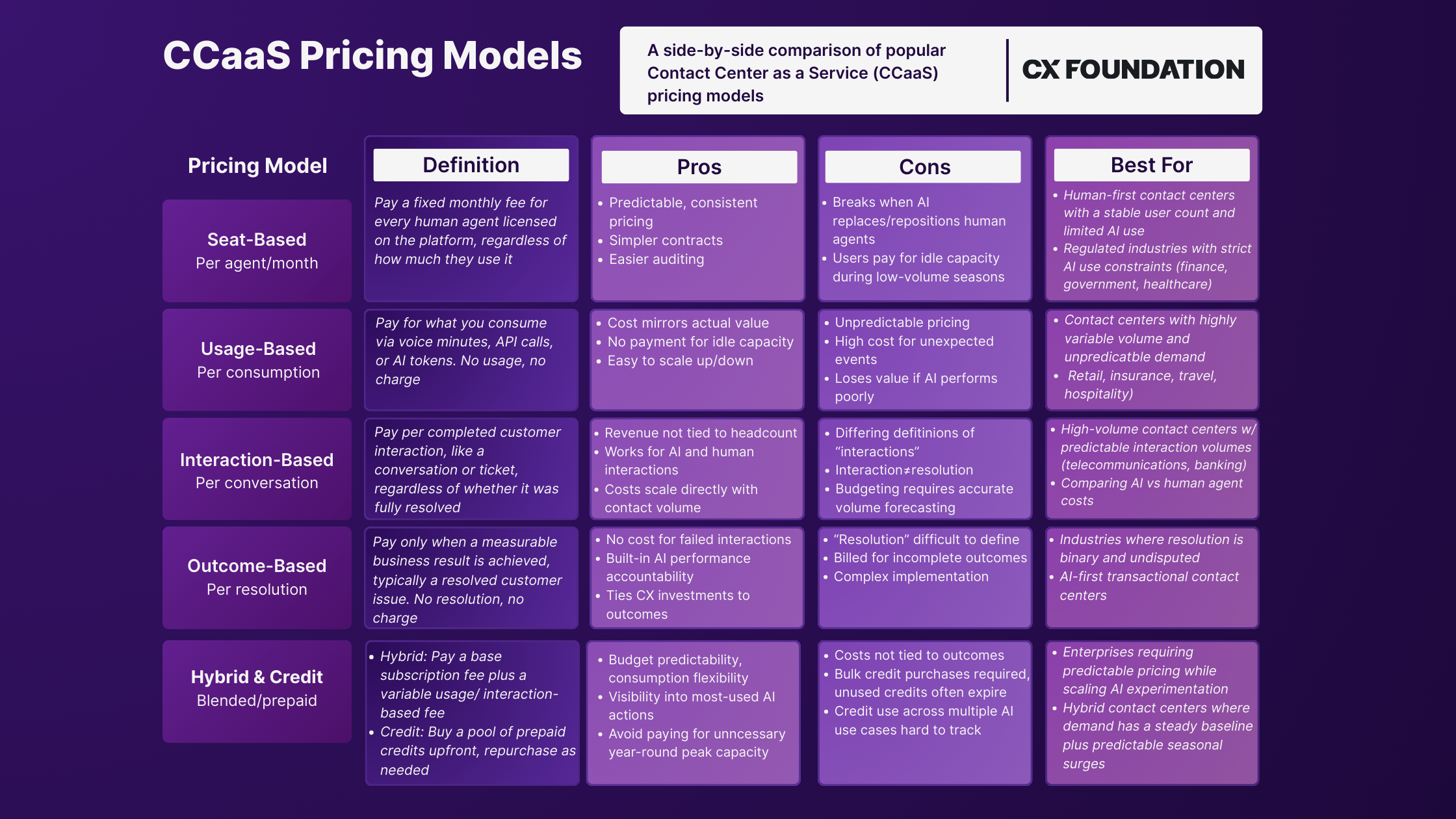
Seat-based pricing is when businesses pay a monthly or annual subscription fee based on the number of human users. Seat-based pricing models have long been the norm in CCaaS, known for tier-based pricing, volume discounts, and of course, often lengthy, hard-to-break contracts. Each tier includes different features and caps on the number of users, with price increases for more advanced features and higher seat numbers.
Pros+Cons
Pros
- Predictable pricing with flexible annual/monthly options means simpler budgeting
- Easy to scale up/down depending on required features/number of seats
- Quick onboarding process requiring minimal technical knowledge
Cons
- Loses value quickly when AI resolves issues without escalating to a live agent
- Pay the same amount for every active user every month regardless of interaction/agent volume. Companies often end up paying for features they never use
- Vendors can suddenly decide to increase rates while using yearslong contracts with exorbitant early termination fees to “trap” existing customers
Best For
- Human-centric contact centers that haven’t or don’t plan to fully integrate agentic AI into daily workflows
- Contact centers with a relatively stable number of users, most of whom consistently need access to complete platform capabilities
- Heavily regulated industries (finance, government, healthcare) where AI agent use is limited/requires human oversight
Vendors Offering Seat-Based Pricing
NiCE CXone
Although NiCE CXone offers flexible pricing options, it’s best known for its traditional seat-based model, which includes 5 plans from $110-$249+/agent/month. NiCE also offers 5 industry-specific solutions for banking, insurance, healthcare, retail, and government – all from $249/agent/month. Note, however, that some NiCE AI features, including AI routing and outbound campaign management, use consumption-based pricing.
RingCentral Contact Center
RingCentral Contact Center offers monthly and annual seat-based pricing for its base plan, plus available AI add-ons with seat-based pricing. The Standard Plan starts at $65/user/month, the Professional Plan starts at $95/user/month, the Elite Plan starts at $145/user/month, and the Enterprise Plan is quote-based.
Usage-Based Pricing: Pay-As-You-Go, Token Consumption
What It Is
Usage-based pricing charges contact centers for raw resource consumption. Pricing is tied to metrics like voice call minutes,the number of text messages sent, API calls, or the number of tokens used for AI tasks. Usage-based pricing has no fixed seat fees, no minimum monthly commitments, and no charge during periods of zero activity. Contact centers only pay for what they actually use, and are billed in arrears at the end of each period. 83% of AI-native SaaS companies currently offer usage-based pricing.[*]
Pros+Cons
Pros
- Costs can scale up/down according to fluctuating demand/interaction volume
- No long-term contract/commitment required
- Cost mirrors actual value delivered
Cons
- Because costs are hard to predict in advance (especially without highly accurate volume forecasting), unexpectedly high bills are a serious risk. This can make it harder to get executive approval for investments in usage-based platforms
- If the AI tools or the platform as a whole don’t perform as expected, the value of consumption-based pricing evaporates
- Unexpected “viral moments” (positive or negative) can cause a sudden and huge cost increase
Best For
- Contact centers with unpredictable or seasonal volume fluctuations (retail, travel+hospitality, insurance companies managing catastrophic events)
- Teams experimenting with new workflows or AI tools
- Contact centers with the financial stability to handle sudden or unexpected cost increase
Vendors Offering Usage-Based Pricing
Amazon Connect (AWS)
Amazon’s CX solution, Amazon Connect, offers pay-as-you-go usage-based pricing with no required minimum monthly fees, long-term commitments, or upfront license charges. Voice pricing starts at $0.038/minute, chat at $0.010/message, messaging at $0.014/message, and email at $0.080/email.
Twilio Flex
Twilio’s Customer Engagement Platform provides usage-based pricing for its Communication Authentication, and Conversational AI tools. Pricing options include Conversational Intelligence from $0.0350/min for transcription, Verify from $0.05/user verification, and Voice APIs from $0.0085/minute for inbound calls.
Interaction-Based Pricing:Pay-Per-Task or Per-Conversation
What It Is
Interaction-based pricing is a consumption-based pricing model where enterprises pay each time an AI or human agent takes an action or completes a task – even if the issue was not fully resolved. These tasks/actions can include an AI-powered customer support conversation, a created ticket, a handled call, or an executed workflow. This pricing model is a natural middle ground between seat-based and outcome-based pricing. Unlike seat-based pricing, interaction-based pricing decouples cost from headcount. It also avoids the definitional complexity of "resolution,” unlike outcome-based pricing.
***NOTE: Interaction-based pricing is almost exclusively used for AI-powered interactions (like Virtual AI Agent customer support conversations( or tasks (like automated workflow execution, appointment confirmations, placing orders, etc.) As such, at the time of this writing the majority of vendors offering interaction-based pricing and outcome-based pricing are agentic AI vendors designed to integrate with existing CX/CCaaS tools, not all-in-one CCaaS vendors. However, many CCaaS vendors now include interaction/resolution-based pricing for their native AI agents, in addition to charging a per-user base price for their platform.
Pros+Cons
Pros
- Works whether the interaction is AI-handled or human-handled, provides one consistent billing unit across entire operation
- Costs scale directly with contact volume
- No debates with vendors about what constitutes a “resolution”
Cons
- Interactions don’t equate to resolutions, meaning businesses may end up paying for poor-performing AI tools that provide no value
- Differing definitions between customers and vendors of what constitutes a task or conversation
- Difficult to reliably budget, especially as bills don’t reflect which interactions the platform resolved, and which ones live agents resolved
Best For
- Contact centers with a predictable, often high-volume number of monthly interactions
- Tier-1 automation, such as using AI agents for password resets, order status inquiries, or appointment scheduling (as these issues are often resolved on first contact)
- Contact centers looking to accurately compare the costs of human agents vs AI agents
Vendors Offering Interaction-Based Pricing
Decagon
Decagon offers both per-resolution and per-conversation pricing, but touts the latter as the most popular model among its customer base. Available interactions/conversations include virtual agents across voice, email, and chat; live A/B testing, AI assist, reporting, and more. All pricing is custom.
Five9 Genius AI
Five9’s Genius AI tool is included in all but one of the provider’s contact center plans. The four AI-inclusive plans come with 3,000 minutes/bundled seat, which users can scale up as needed. Available AI interactions include voice and digital agentic AI-led conversations, AI authentication, AI assist, AI transcription, and more.
Outcome-Based Pricing: Pay-Per-Resolution For Better Value
What It Is
Outcome-based pricing charges customers only when a measurable, agreed-upon business result is achieved. No resolution, no charge. In CCaaS, this typically means paying per resolved customer issue. However, some vendors AI define "outcome" more granularly: a saved cancellation, a completed subscription change, an upsell, a cross-sell, or a fully resolved support conversation all constitute separately priced outcomes.
This outcome-based model represents the most radical realignment of vendor-customer incentives in enterprise software pricing. Instead of paying for access or consumption regardless of results, customers only pay when the AI actually works.
Pros+Cons
Pros
- Only pay when an issue is truly resolved, not simply “handled”
- Aligns CX investments and budgets directly with business outcomes
- Built-in performance accountability: if the platform underperforms, bill automatically reflects it
Cons
- Difficult for enterprises and vendors to agree on what defines a resolution
- May bill businesses for interactions that were marked as “resolved,” but that later resulted in the customer reaching out again
- Complex backend integration required for system to verify outcomes automatically
Best For
- Use cases where the outcome is binary, objectively verifiable, and high-frequency
- Fully autonomous customer service interactions where virtual agents handle end-to-end tasks like complex product returns or technical troubleshooting–without human intervention
- AI-first contact centers
Vendors Offering Outcome-Based Pricing
Sierra
Sierra AI is an enterprise CX platform known for using virtual agents to replace BPO. Though its pricing is custom, it follows an outcome-based models. Sierra’s AI agent works across voice, chat, and other digital channels. “Outcomes” include saved cancellation, completed subscription change, and resolved support interactions.
Zendesk
Zendesk was the first platform in the CX space to offer outcome-based pricing. Its AI tools are available as a part of its seat-based customer service platform, which offers 4 plans from $19-$169/agent/month. Pricing for committed automations is $1.50/resolution. Pay-as-you-go
Hybrid or Credit-Based Pricing: Base Price+Variable Costs
What It Is
Hybrid pricing is a multifaceted pricing model that blends traditional seat-based licensing with varied consumption elements. In addition to standard seat-based CCaaS licenses, enterprise customers purchase a pool of credits or tokens–upfront–that can be dynamically spent across different AI features, user seats, or usage metrics as needed. With 71% of contact centers citing high or unpredictable AI costs as an ongoing challenge it’s no wonder that hybrid pricing is the fastest-growing model in enterprise SaaS.[*]
Pros+Cons
Pros
- Highly flexible pricing structure means enterprises avoid paying year round for capacities/features they don’t need in quieter seasons
- Prepaid credits provide full visibility into which AI actions provide the most value or consume most of the budget
- Allows smaller or growing contact centers to experiment with AI capabilities without committing to a long-term contract
Cons
- Unused credits often expire, or vendors intentionally provide inflexible/inadequate “bulk” token/credit amounts
- Complex pricing structure can make budgeting a challenge, as variable costs are layered on top of fixed ones
- Can be difficult to track which AI actions are actually providing value/which ones are just “burning credits”
Best For
- Large enterprises running AI across multiple functions or channels simultaneously
- Contact centers with hybrid deployment (both on-prem and cloud-based systems)
- Contact centers in the middle of AI transformation that are not yet ready to implement AI at scale
Vendors Offering Hybrid/Credit-Based Pricing
Genesys Cloud CX
Genesys Cloud CX provides a variety of pricing options, including seat-based pricing from $75-$155+/user/month and hourly interaction pricing from $1.50-$4.80+/hour. The Genesys Cloud CX hybrid pricing model means that each seat-based plan also includes 250 AI Experience Tokens per month per named organization, and 350 AI Experience Tokens per month per concurrent organization. Users can purchase additional AI Experience Tokens as needed based on usage, or upfront for a discount.
Salesforce Agentforce
Salesforce Agentforce is an AI platform designed to integrate with their contact center solution, Salesforce Agentforce Service (formerly Service Cloud). Agentforce offers consumption-based pricing, Flex Credits, seat-based pricing, and interaction-based pricing via Salesforce Conversations. Agentforce 1 Editions start at $550/user/month and include 1 million Flex Credits per organization/year, Conversation pricing starts at $2/conversation, and “pay-per-action” Flex Credit pricing starts at $500/100k credits.
Which CCaaS Pricing Model Is Right for You?
There is no universally correct CCaaS pricing model in 2026. The right answer depends on three variables: the stability of your contact volume, how far along you are in AI deployment, and how cleanly you can define and verify a "resolved" interaction.
If you're running a predominantly human contact center with a stable headcount, seat-based pricing still works – but the clock is ticking as your AI automation rate climbs. If your volume is highly seasonal or your AI deployment is early-stage, usage-based gives you the flexibility to scale without overcommitment. If your volume is high, predictable, and AI is well-established, interaction-based offers a clean per-contact cost. If your use cases are narrow, transactional, and have binary, verifiable outcomes, outcome-based pricing gives you the strongest ROI narrative and the best vendor incentive alignment. If you're running AI across multiple functions at enterprise scale with budget predictability requirements, a hybrid model is your best bet – and the most popular pricing model of the moment.