October 1, 2026 • 11 min read
11 Contact Center Performance Management Trends

Director of Content & Market Research
October 1, 2026

Tick-box scorecards, feedback that varies by coach, the same old leaderboards... It's fair to say that contact center performance management hasn't always had the best reputation.
Thankfully, that’s slowly changing across the industry.
Many contact centers are working hard to unearth new performance insights and funnel them into a connected system that automatically influences the coaching, in-contact guidance, and gamification experiences individual service reps receive.
Undoubtedly, this is the direction of travel. After all, AI didn't just open up the ability to analyze 100% of customer conversations. It also created the opportunity to act on that data in fairer, more methodical ways to positively influence the outcomes that matter to customers, employees, and the broader business.
However, while this pivot toward a connected performance management system may be the overarching trend, contact centers are also trialling new initiatives and best practices. The broader trend analysis, which comes after a quick recap of the fundamentals, unpacks these.
What Is Contact Center Performance Management?
Contact center performance management is the process of bringing out the best in service reps, both individually and collectively.
A massive part of that is monitoring their performance and extracting insights into what agents do well and where they can improve through a quality assurance (QA) program.
Yet, performance management extends far beyond QA. It also involves:
- Setting goals and benchmarking performance
- Coaching reps to unlock performance growth
- Designing incentives and recognition programs
- Offering in-call support through Agent Assist applications
- Building schedules that accommodate high performance
None of these initiatives is new to the contact center. What is new is the maturity of performance management programs, which is increasing as AI transforms the contact center workforce.
The 11 Contact Center Performance Management Trends
Gartner predicts that by 2029, agentic AI will autonomously resolve 80% of customer service issues without human intervention.
With predictions like that, contact centers are closely considering how customer-facing AI will affect their workforce, with humans likely to face a growing share of complex edge cases.
Ultimately, that makes performance management more essential than ever.
Here are 11 trends in how contact center performance management strategies are changing.
1. Contact Centers Retune with the Fundamentals of Performance Management
Technology is advancing quickly, and the intelligence contact centers can extract from modern performance management solutions is vast.
Yet organizations need to be organized enough to act on those insights.
That starts with reconnecting with the fundamentals: defining what great performance looks like, aligning on and tracking the outcomes that matter, and translating that measurement into learning and positive reinforcement.
“It’s not just the classic scoring of contact center agents and arbitrary numbers, but isolating positive behaviors and improvement opportunities, feeding that back, and having that influence what comes next.”

That final part is critical to inspiring meaningful performance change...
2. Performance Management Becomes an Orchestrated Experience
The gold standard for performance management starts with a quality assurance (QA) program that spotlights individualized improvement opportunities and, as teased above, connects that with what comes next.
For instance, that feedback should inform personalized coaching, role-plays, learning management interventions, gamification exercises, and even in-call Agent Assist guidance.
Think of the ideal system as an orchestrated performance management experience that continuously reinforces learning and drives lasting behavior change.
3. Team Structures Evolve Around the New Performance Management Experience
An operating system where QA insights translate into personalized development programs is exciting, but it needs ownership.
Who is making sure those programs have a sustained impact, gathering feedback from the team, and continuously optimizing the experience?
Contact centers should have an answer to that question.
“There has to be empowerment of the right people to ensure we’re acting on the information, not just to deliver performance improvements but for positive recognition and encouragement.”

4. Change Management Gets Smarter
Performance management as an orchestrated experience needs organizational buy-in and careful change management, so agents, supervisors, and leaders don't fall back into old habits.
Thankfully, many companies, like OVO Energy, have learned to take a more consultative approach to advancing their performance management strategies.
“Engage with the people who are going to use new technologies and follow new processes,” said Scott Wilkins, VP of Customer Fulfillment at OVO.
“Don't design the solution as a leader to drive the outcome you think you need; set out where you want to get to and why, then engage the team to help you figure out how to get there.”
“We’ve learned to frame it rather than prescribe it, really listen and engage, and be honest about what's possible. Don't overpromise.”

Post-deployment, the OVO team has also built in fast, responsive feedback loops, so they can act quickly when an employee flags an issue within the performance management cycle.
5. AI Contact Center Roleplays Go Mainstream
One performance management trend gaining mainstream traction is AI-powered roleplay, where AI simulates realistic customer interactions to help agents practice and refine their skills.
“I can create synthetic personas of elderly, hard-of-hearing, very shy, and angry callers for reps to roleplay with endlessly, and the system provides genuinely good insight into what did and didn't work. That's a big change.”

These personas can help test new team members in a safe environment, and prepare the contact center floor for emerging call types tied to new campaigns.
Tying it back to the performance management orchestration, contact centers can also connect roleplays to QA data, letting agents replay the calls they've previously struggled with, lay their demons to rest, and grow in the role.
Meanwhile, supervisors can also roleplay rep conversations to hone their own coaching skills and prepare for difficult coaching conversations.
6. Sentiment Analysis Becomes More Tactical
Sentiment analysis is much older than AI-powered roleplay, but it's another tool gaining traction.
Early contact center applications of sentiment analysis were hit-and-miss. Use cases such as telling service reps mid-conversation how the customer was feeling had little practical value.
Simply put, the instruction: "Customer unhappy, be more empathetic," isn’t helpful to anyone.
Thankfully, contact centers are getting more tactical about how they apply it, according to Forrester’s Max Ball.
“You can run a report showing which interaction topics tend to make customer sentiment go negative. Then you can identify the agents who handle those topics best, the ones where sentiment doesn't go negative, and study what they're doing to build a best practice around it.”
These best practices can then inform an Agent Assist strategy that goes beyond simply flagging "the customer isn't happy," offering real-time knowledge to help agents course correct.
7. Contact Centers Iron Out the Wrinkles in Agent Assist
In theory, an AI assistant guiding agents through every step of an interaction is an excellent performance management solution and agent support mechanism.
In practice, however, regular pop-ups about tasks reps have performed hundreds, if not thousands, of times before can do more harm than good.
"There's such a heavy UI/UX burden here," explained Corfield. "If you get it wrong, you're just adding cognitive overload to the agent, which doesn't help anyone."
This is especially true on the voice channel, where reps have to think fast, and the window to put something useful in front of them is very small.
Thankfully, latency is improving, along with the reporting that comes with Agent Assist applications. Contact centers can now analyze when reps follow guidance and when they don't, allowing them to tailor their strategy accordingly.
The next step for the technology will be Agent Assist applications that understand the service rep as an individual, including what they do well and where they struggle, and personalize guidance. That's an exciting future.
However, there remains a risk that contact centers over-rely on Agent Assist applications. Post-contact coaching and practice remain key to building agent skills and confidence.
8. Service Reps Pick Up New Responsibilities
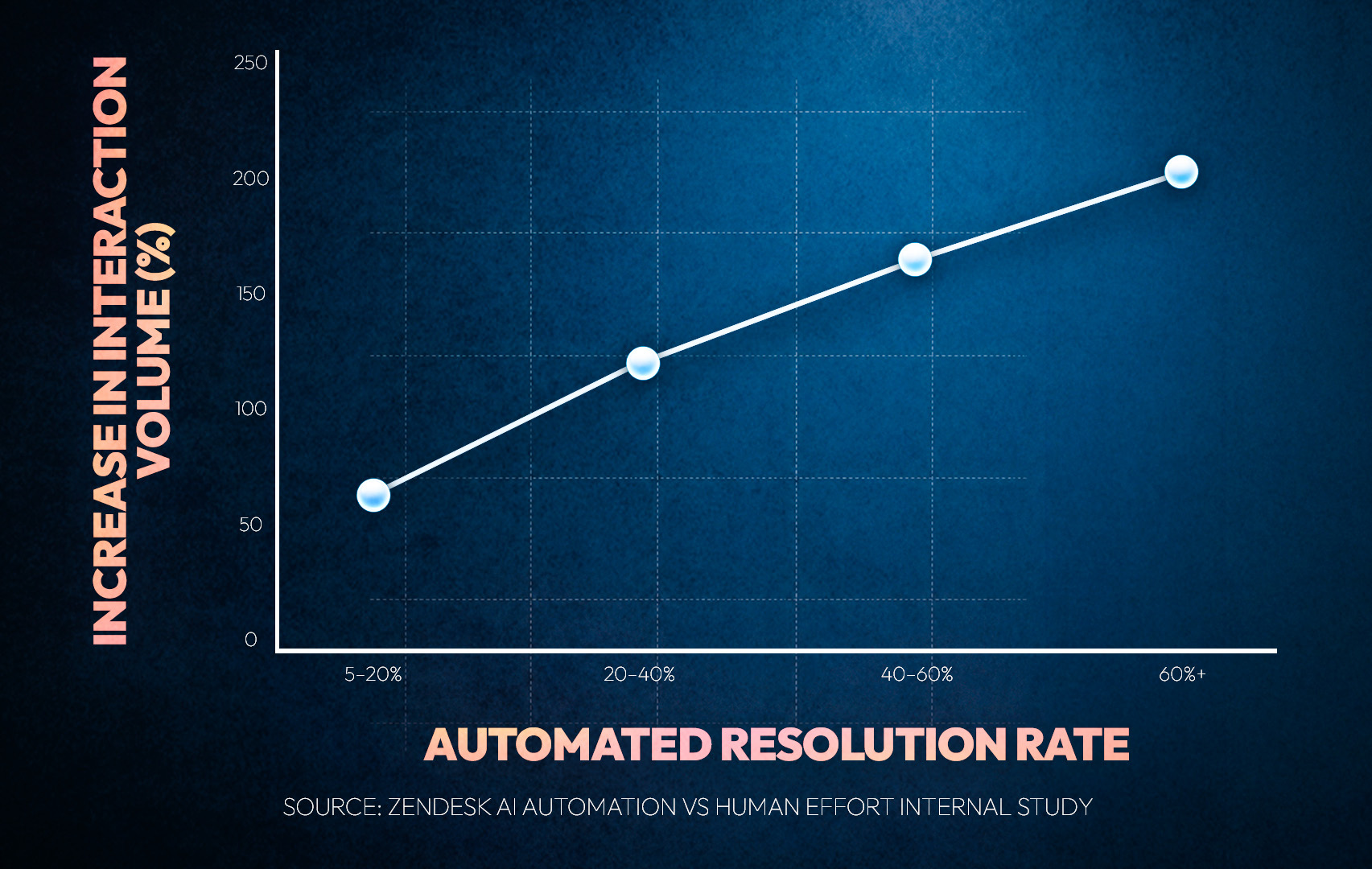
Many assumed AI would replace a significant percentage of human contact center employees. Yet as AI becomes more capable, customers are asking it questions they'd previously have let slide.
As a result, overall contact volumes are increasing, and because contact centers are handling new types of queries, the human agent workload isn’t decreasing. In fact, it's rising, too.
That’s the conclusion of a recent internal Zendesk study, with the results shown below.
At the same time, some organizations are expanding human agent roles, according to Linat Mart, Chief Product Officer at Centrical.
“The conversation has changed from shrinking headcount, with organizations finding the right resources for the right tasks, and considering what new tasks there might be.”

These tasks range from engaging in outbound campaigns that strengthen customer relationships to carefully orchestrated conversations that improve key outcomes, from retention to sales.
9. Performance Insights Get Put to Work in New Ways
A sophisticated Auto-QA program can surface a vast amount of new data, and, as part of an orchestrated performance management strategy, contact centers are starting to put it to work in new ways.
For instance, some now track when an agent's performance starts to dip and use that data, alongside employee preference data, to adjust schedules.
Another example is routing customers to specific reps based on how well they handle a particular intent or customer type.
Soon, it may even be possible to compare human and AI agent performance data on one platform to determine the ideal routing path. That's exciting in itself.
10. Contact Centers Manage Human and AI Agents on One Platform
Just because AI agents can handle a task doesn't mean they should.
More contact centers are recognizing this and considering whether a human agent, an AI agent, or a mix of both is best placed to answer each query.
As this trend gains momentum, more leaders are treating human and AI agents as one unified workforce, managed under a single performance strategy, with work orchestrated accordingly.
“We're seeing a convergence toward managing and orchestrating everything under one execution layer, because ultimately you have one goal, and you need your whole workforce - human or AI - executing on it.”
11. Agent Motivation Programs Shift to Preventing Demotivation
When an organization hires well, new agents walk in motivated to do a good job. They want to succeed and help people.
However, something happens along the way as they discover how many obstacles stand between them and great service: a tech stack that's impossible to figure out, highly restrictive policies, and a lack of resources or empowerment to deliver consistently.
Ultimately, the natural motivation they walked in with dissipates, and frustration sets in.
Making this point, Toister said: “There's even something called learned helplessness, where after a while agents stop trying because they don't believe extra effort will make a difference.”
“So, the real challenge for contact centers is preventing agent demotivation, and leaders do that by working with agents to understand the obstacles in their way and trying to reduce or eliminate them.”
As contact centers get a better handle on this, the focus will keep shifting away from forced motivational activities and toward closer alignment between service leaders and their teams.
Learn More About Contact Center Performance Management
Performance management is changing and, fundamentally, that's a good thing.
The industry is moving away from stale QA scorecards, one-and-done coaching, and unhelpful mid-call AI pop-ups, and toward a more mature performance operating system.
However, OVO isn't alone in pushing the industry forward. Firstsource, Swisscom, and Unilever are also embracing new performance management approaches to prepare their teams for the customer operations of tomorrow.
Discover how they’re moving the needle by signing up for Centrical’s Big Game 2026 on Thursday, October 15, 2026.
The event takes place in London, but it's also available virtually, so everyone can tune in and unlock insights to support the contact center workforce of tomorrow.