
August 19, 2026 • 5 min read
Assistive AI: Where CX Progress Quietly Plateaus

CX Analyst & Thought Leader
August 19, 2026
If you’re still in the AI experimentation phase, you’re officially behind: and you’re probably already well aware of it. What’s not so obvious, however, is the specific roadblock standing between long-term AI implementation success and failure.
Forethought AI by Zendesk’s Third Edition of the State of AI in CX Report identifies a series of culprits behind an AI strategy’s failure to consistently improve, but one in particular surprised me: Assistive AI.
The research found that about 57% of assistive AI initiatives fail to improve resolution rates, and that only 33% of teams using assistive AI are likely to see improved CSAT scores.
The report isn’t advocating for abandoning Assistive AI entirely. What it found, however, was that Assistive AI only improves the customer experience by so much before it hits the ceiling and starts to plateau.
According to the findings, consistent AI progress requires balancing assistive AI with action-taking agentic AI that completes multi-step processes across channels and systems, then learns and self-improves from every interaction.
Case in point? 74% of teams using action-taking AI report improved resolution rates – nearly 31 points higher than those using assistive AI alone. Further, 53% of teams using action-taking or agentic AI are likely to see improved CSAT scores – 20 points more than those at the assistive stage.
Despite these clear wins, the research found that 41% of organizations currently using AI are still in the Assistive stage, while only about 28% have made it to the agentic stage (and of that 28%, only 11% describe their agentic AI as self-improving.)
What’s stopping organizations from moving from the assistive AI to the agentic AI phase, what does it take to get there, and how can organizations maintain consistent CX improvements from AI over time?
Assistive AI vs Agentic AI: Comparing Outcomes
First, a quick review of the differences in definition and outcomes between assistive and agentic AI.
Assistive AI is generative, based primarily around knowledge retrieval (RAG). It suggests next-best actions, summarizes interactions, drafts replies, and pulls relevant data information from integrated systems like your knowledge base and CRM. In an assistive environment, AI is more of a co-pilot: humans still need to actually take the action to resolve the issue.
Agentic AI takes action autonomously (without requiring a human), orchestrating multiple steps across systems, channels, and workflows on its own to solve problems end-to-end. It can place orders, follow up with customers, book appointments, issue refunds, etc. Importantly, agentic AI also learns from every interaction, leveraging machine learning to get better and faster the more you use it.
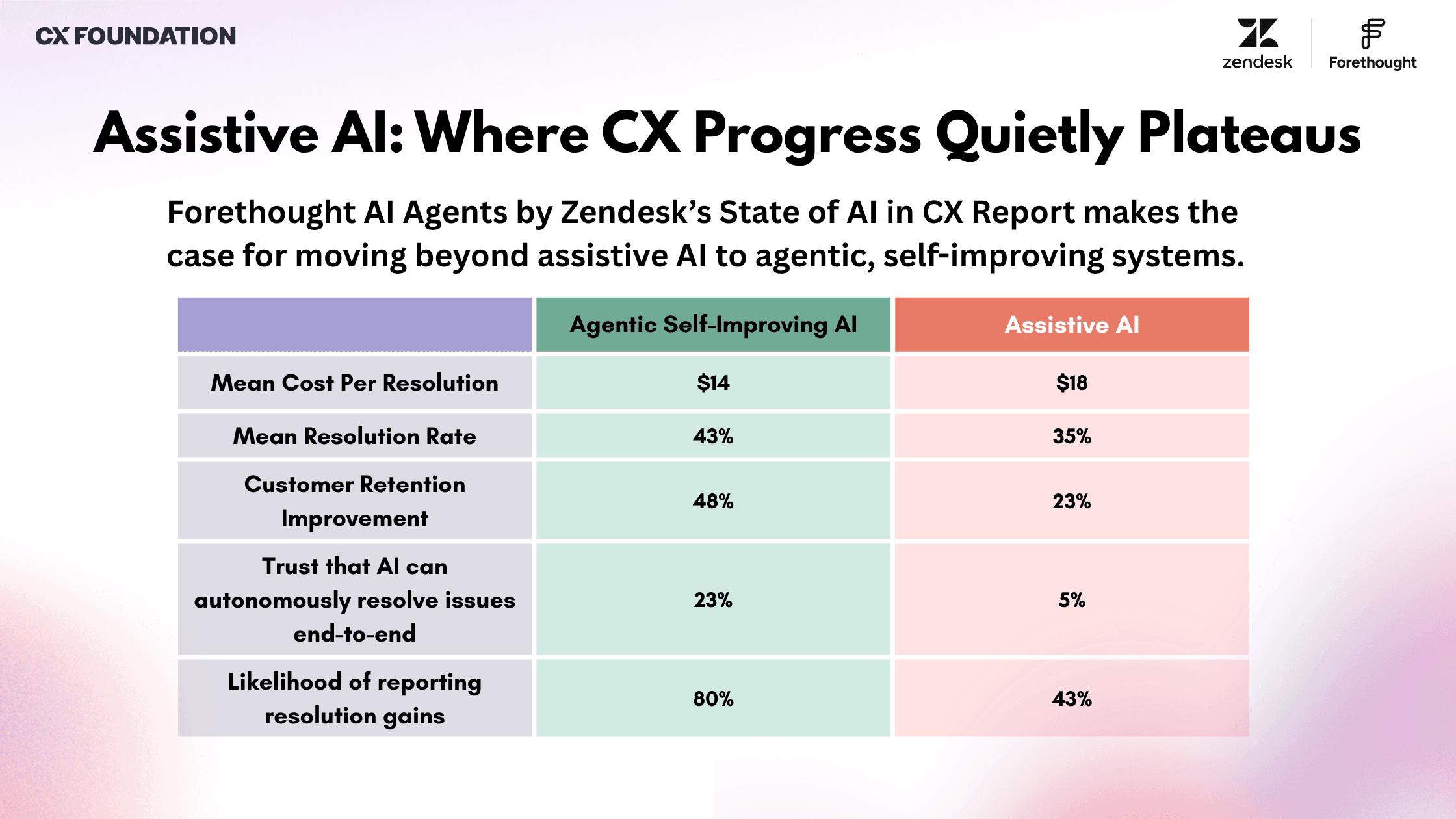
Unsurprisingly, Forethought AI by Zendesk’s report found that agentic AI outperforms assistive AI across key metrics including resolution rate, cost per resolution, likelihood to recommend the AI platform, and likelihood to renew the AI platform.
| Agentic Self-Improving AI | Assistive AI | |
| Mean Cost Per Resolution | $14 | $18 |
| Mean Resolution Rate | 43% | 35% |
| Customer Retention Improvement | 48% | 23% |
| Trust that AI can autonomously resolve issues end-to-end | 23% | 5% |
| Likelihood of reporting resolution gains | 80% | 43% |
How To Move From Assistive To Agentic AI
The report shows that successfully moving from assistive AI-only to agentic, self-improving AI requires a specific foundation purpose-built architecture, models trained on historic company data, feedback loops, and orchestration across channels and systems.
Purpose-Built AI For CX Architecture
First, the report compares three common AI for CX operating models: purpose-built AI for CX platforms, embedded/bolt-on AI integrations, and a DIY system cobbled together by in-house engineers from general-purpose APIs.
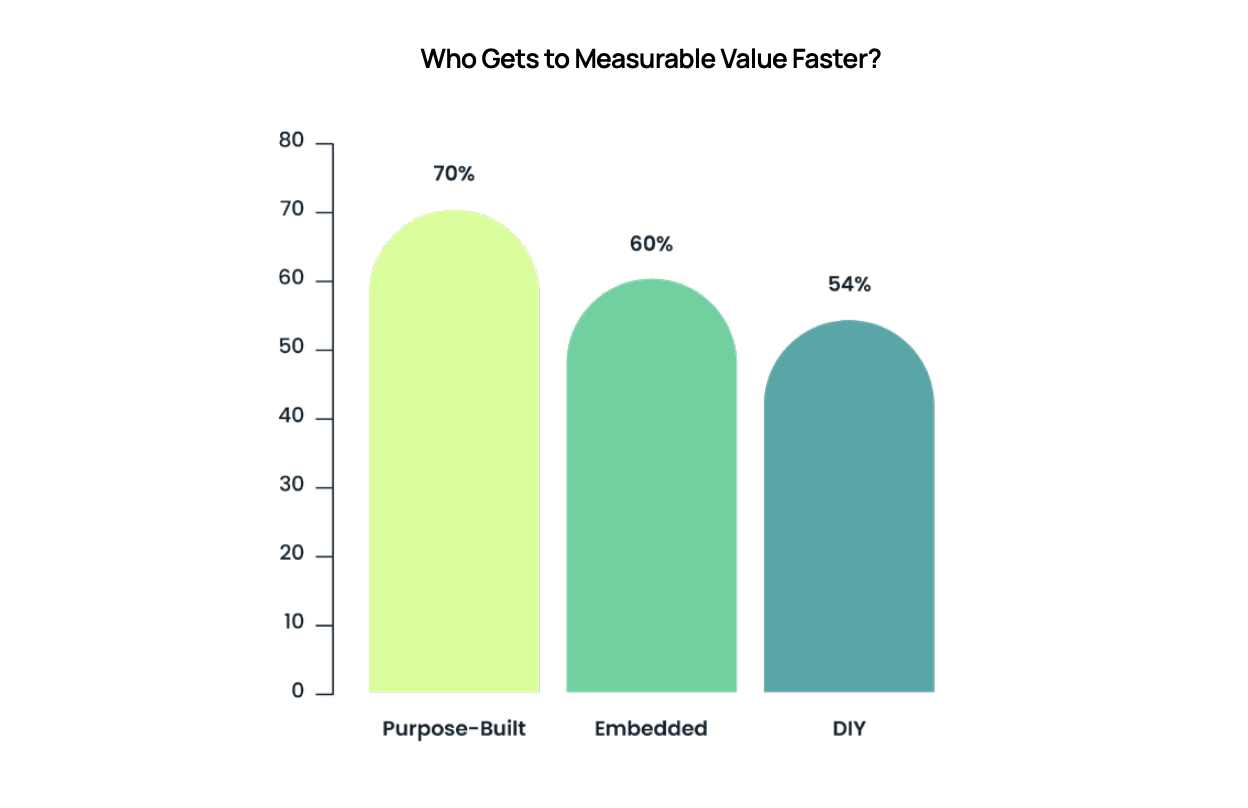
The data found that purpose-built AI for CX platforms consistently outperformed DIY and embedded operating models, achieving a 62% resolution rate compared to just a 46% resolution rate for DIY systems.
AI Training With Historic Service Data
Then, there’s how you train AI models. While 69% of those polled currently train their AI on their existing company data like conversation transcripts and analytics, the report found that historic service data alone isn’t enough.
The report showed just 39% of the 606 leaders polled use human feedback and QA scores to train AI, while just 37% use CX-specific models.
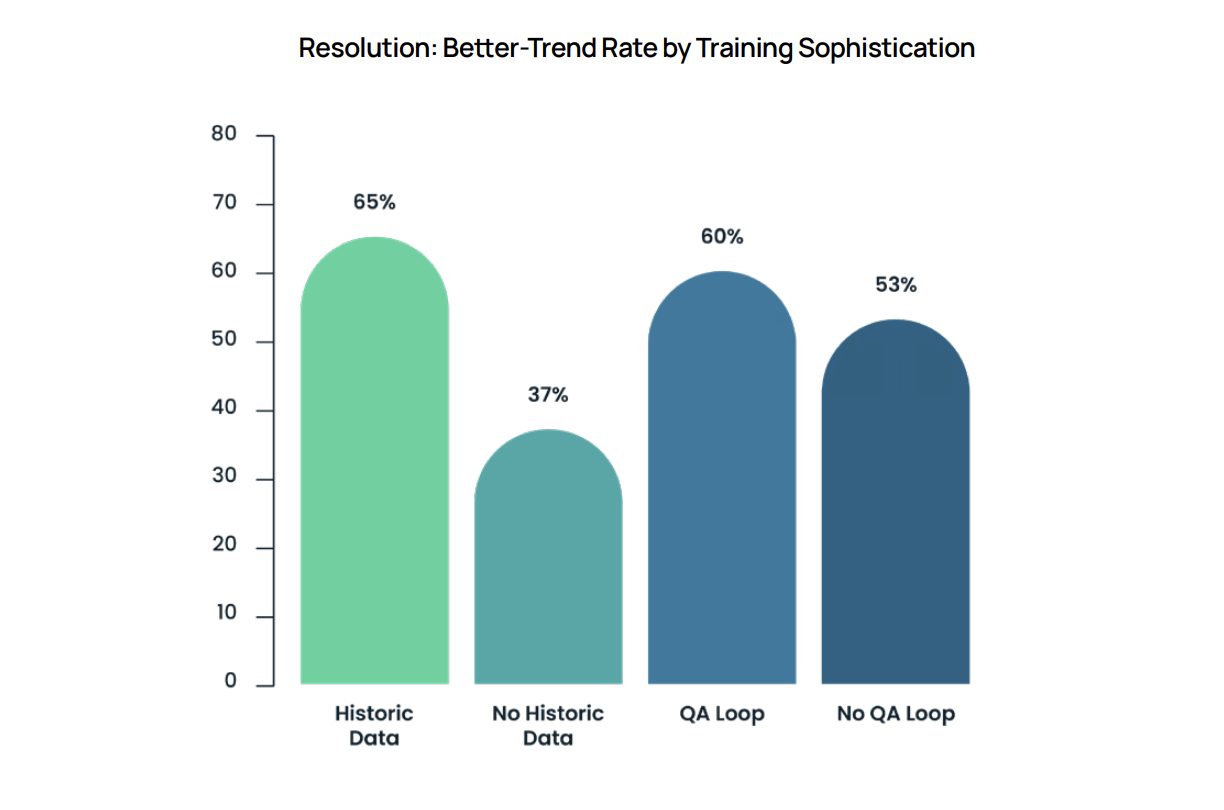
Long-term AI implementation success requires QA scoring (including human feedback) and CX-specific training models in addition to historic services data. The research also found those with a QA loop have a resolution rate that’s 7 points higher than those that do not, and that those training their AI on historical data score have a resolution rate 28 points higher than those that don’t.
AI Orchestration At Scale
The good news is that the vast majority of today’s support environment is already omnichannel. The bad news is that AI support (virtual agents) is not – and that’s it’s especially underused in the voice environment.
Despite all the hullabaloo about Voice AI this year, the report found that even though 71% of respondents offer voice as a support channel, only about 20% provide live Voice AI support.
When AI can’t follow a conversation across systems and channels, context is lost, tickets are instantly escalated, and resolution rate plummets. True orchestration means preserving context across channels and connecting AI to the systems where work actually happens.
Less Talk, More Action: Closing the CX AI Gap
Forethought AI by Zendesk’s report found that organizations with the most long-term AI for CX success treat assistive AI as a floor, not a ceiling. The goal here is to focus on building the right foundation: purpose-built architecture, training on your own data, developing active feedback loops, and achieving orchestration across the entire customer experience.