March 18, 2026 • 5 min read
Neat Appoints Javed Khan as CEO, Signals Shift Toward Edge Computing
March 18, 2026
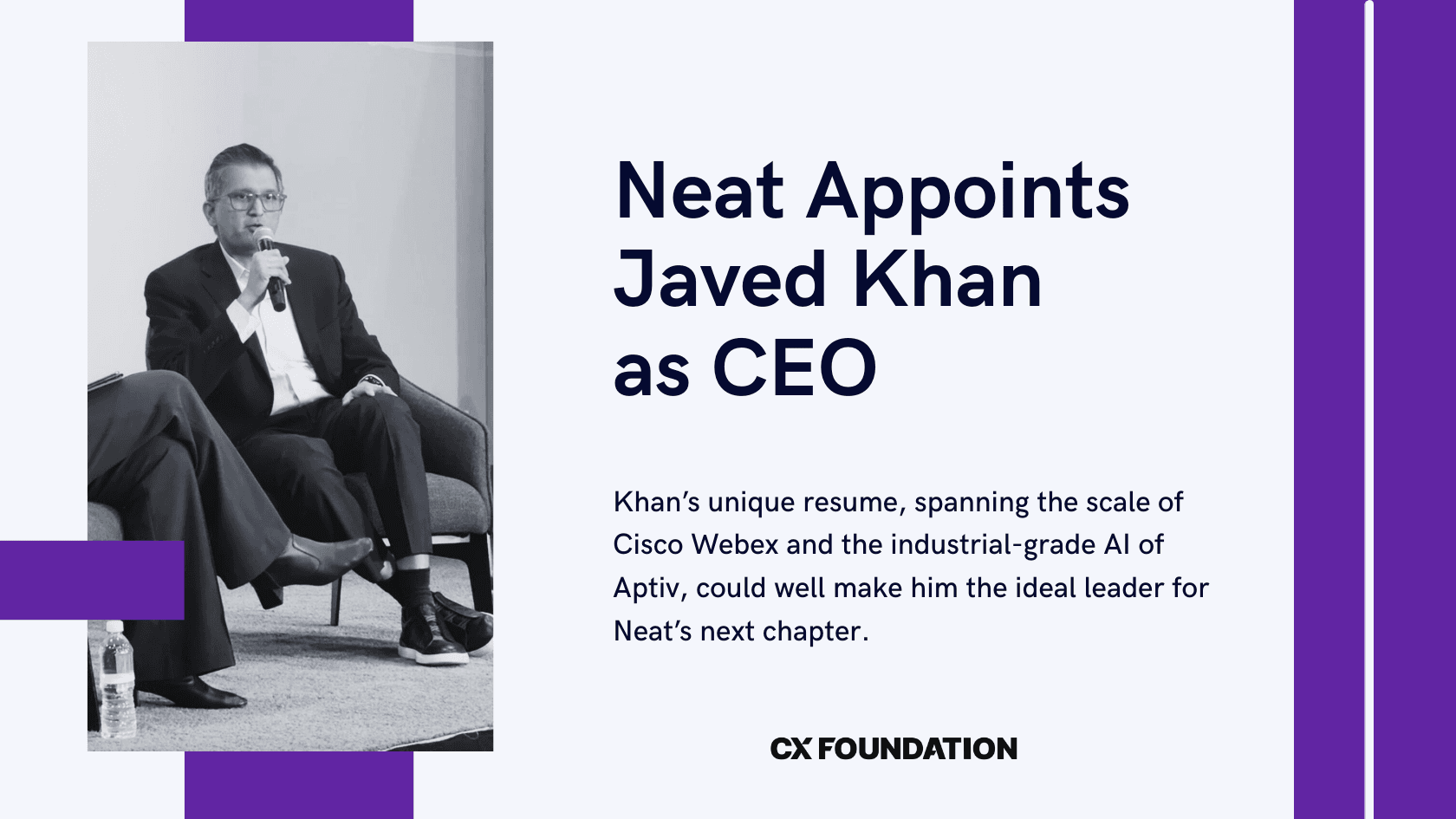
Video collaboration giant Neat has appointed Javed Khan as its new CEO.
Khan succeeds Janine Pelosi, who successfully transitioned Neat from a disruptive challenger into a mainstream enterprise company.
The new CEO comes from Aptiv, where he most recently served as EVP of Intelligent Systems. Previously, he held the position of SVP & GM for Cisco Collaboration.
With a unique resume, Khan brings two critical assets to Neat:
- Global Scale: Khan understands the "plumbing" of global enterprises. He knows what IT decision-makers need when deploying across thousands of locations.
- Ecosystem Fluency: Under Khan, Webex evolved from being just a meeting app to becoming a platform. This aligns with Neat’s current trajectory, having recently expanded to support Google Meet, Microsoft Teams, and Zoom.
Yet, perhaps most notably, his appointment could signal the next chapter for the video collaboration industry.
For the last decade, the space has sat in a state of steady refinement, with better interfaces, easier to use devices, and more variety, enabling hybrid work to surge.
However, the next chapter will bring AI integration into edge endpoints, transforming video experiences.
The Next Chapter
Khan’s experience at Aptiv suggests he’s ready to lead the next chapter of AI integration into edge endpoints.
At the company, he first focused on the automotive sector, building intelligent edge solutions for autonomous vehicles. That mission soon expanded into warehousing, robotics, telecoms, and beyond.
In helping to spearhead this expansion, Khan saw how intelligent edge computing transformed industries in ways that eventually became indispensable. This is the “secret sauce” he brings to Neat.
After all, most video conferencing companies still treat AI as a set of cloud-based post-processing features (e.g., blurring a background or cleaning up audio).
Yet, Khan can help deliver the power of the edge. That’s the first of two big technological advancements he can leverage to steer Neat’s future innovation:
- The Power of the Edge: By running Large Language Models (LLMs) and computer vision locally on the device in the conference room, Neat can achieve lower latency and higher privacy.
- Complex Spatial Awareness: Just as a vehicle must understand its 3D environment to navigate safely, a modern conference room needs to understand "spatial intelligence" to frame participants perfectly and suppress complex noise.
Ultimately, with his background, Khan is uniquely positioned to bring together edge computing with Neat’s signature simple, elegant user experience.
Edge Computing Will Enable More Frictionless Experiences
While the shift toward edge computing is a technical milestone, its true value lies in the frictionless experience it enables.
By processing AI locally at the "edge" of the room, Neat can deliver near-instantaneous audio and visual adjustments, such as auto-framing and noise suppression, without the lag of cloud processing.
For the end-user, this means technology that finally gets out of the way, allowing for more authentic, "in-room" feelings during remote sessions. This can have implications for internal meetings as well as interactions with customers.
Under Khan’s leadership, the focus isn't just on building a more powerful device, but on creating an intuitive environment where the complexity of AI serves to make human collaboration feel more effortless and inclusive than ever before.
Why This Matters for the Neat Customer
For the IT director or the end-user, a CEO change can sometimes signal a shift in focus that disrupts the product roadmap. However, Khan’s arrival appears to be a doubling down on Neat’s core DNA.
1. Solving the "Complex Space" Problem
Neat’s distributed architecture is designed to bring AI into large, complex rooms that have historically been too expensive or difficult to outfit. Khan’s expertise in scaling AI-enabled systems means customers can expect devices that don't just "see" a room, but "understand" it.
2. The End of "BYOD" Headaches
Enterprise IT has struggled with "Bring Your Own Device" (BYOD) for years. Khan has already highlighted Neat Open as a genuine solution to this friction, signaling that Neat will continue to prioritize flexibility without sacrificing enterprise-grade manageability.
3. Future-Proofing via Hardware
Because Neat builds its own hardware and software in tandem, Khan’s "product-first" mindset ensures that the silicon inside the devices is ready for the next five years of AI advancements, not just the next six months.
The Road to Public Markets
Neat is transitioning from a disruptive challenger to a mainstream enterprise platform. With Khan leading the company, it’s accelerating toward public market readiness, but it needs a unique industry position to do this. There are many collaborations suppliers, many of which sell at a lower price. Neat is a premium price. A compelling edge AI story may help fend off the competition. Khan can tell this story.
Meanwhile, his deep relationships with the industry, and even the Neat founding team, many of which are from Cisco, ensure this won't be a transition that upsets the company or its customers, but rather a rapid evolution
In the "Next Act" of video collaboration, the winners won't be the companies with the most buttons or on-screen widgets. They will be the companies that make the most intelligent use of the "edge." By hiring the person who helped modernize Webex and then learned how to make cars think, Neat has placed a massive bet on becoming the intelligent edge of the modern office.